Why Diversify Ad Placements for Better ROI in 2026
Posted on
Marketing
Posted at

Diversifying ad placements across multiple channels reduces reliance on any single platform and lowers acquisition costs. It also expands reach, fights creative fatigue, and provides more accurate data on campaign performance.
Ad placement diversification is the practice of distributing your advertising budget across multiple channels and platforms to reduce risk, expand reach, and lower acquisition costs. Relying on a single platform is a structural fragility problem, not just a missed opportunity. Businesses using three or more advertising channels achieve a 287% higher purchase rate and a 46% lower cost per acquisition with integrated strategies. That gap is too large to ignore. Understanding why diversify ad placements matters is the first step toward building a paid media system that holds up when any single platform shifts.
Why diversify ad placements: platform dependency is your biggest risk
Single-channel reliance is a single point of failure. When one platform controls 70–80% of your acquisition budget, a single algorithm update or policy change can collapse your growth overnight. That is not a hypothetical. After Apple's iOS 14.5 privacy changes, single-channel campaigns saw CPA spikes of 30–60%, while diversified portfolios absorbed the shock with far smaller increases.
Platform dependency creates three compounding problems:
Cost volatility. Auction dynamics on any single platform shift with competition, seasonality, and policy. You have no fallback when CPMs spike.
Audience ceiling. Every platform has a finite addressable audience. Once you saturate it, frequency rises and performance drops.
Reporting blind spots. Single-channel data gives you a distorted view of your customer's actual path to purchase.
Treating your media mix as a portfolio, not a single bet, is what separates advertisers who scale from those who stall. No single platform should control more than 40–50% of your total acquisition budget. That threshold gives you enough concentration to build expertise on your anchor channel while keeping enough flexibility to absorb platform shocks.
The 40–50% budget concentration limit is not arbitrary. It reflects the point at which platform-specific volatility stops being a manageable variable and starts being an existential threat to your campaign performance. Atdigiagency applies this framework across every client account to protect against exactly this kind of structural exposure.
How diverse placements expand reach and fight creative fatigue
Different platforms reach different people at different moments in the buying cycle. A prospect searching on Google is in a different mindset than someone scrolling through a social feed or reading a niche newsletter. Audience fragmentation across platforms means that buyers on TikTok, Reddit, LinkedIn, and Google Search behave as distinct segments. A single-channel strategy misses most of them entirely.

Creative fatigue is the other side of this problem. When the same audience sees the same ad repeatedly on one platform, performance declines fast. Multi-channel campaigns reduce frequency per platform, extending reach and keeping audiences engaged longer. Spreading exposure across channels gives your creative room to breathe.
The benefits of ad placement diversity also show up in your testing data. Running creative tests across multiple platforms generates five times the signal volume compared to single-platform testing. That means faster learning cycles and clearer insight into which messages resonate in which contexts.
Native ads work well for content-heavy audiences at the awareness stage.
Push notifications re-engage users who have already shown intent.
Paid social builds brand familiarity and drives top-of-funnel volume.
Paid search captures high-intent demand at the bottom of the funnel.
Each format serves a different role. Mixing them is not redundancy. It is coverage.
Pro Tip: When adapting creative across placements, do not just resize assets. Rewrite the hook for each platform's native context. A headline that works on Google Search reads as tone-deaf on Instagram Stories.
Best practices for building a diversified ad strategy
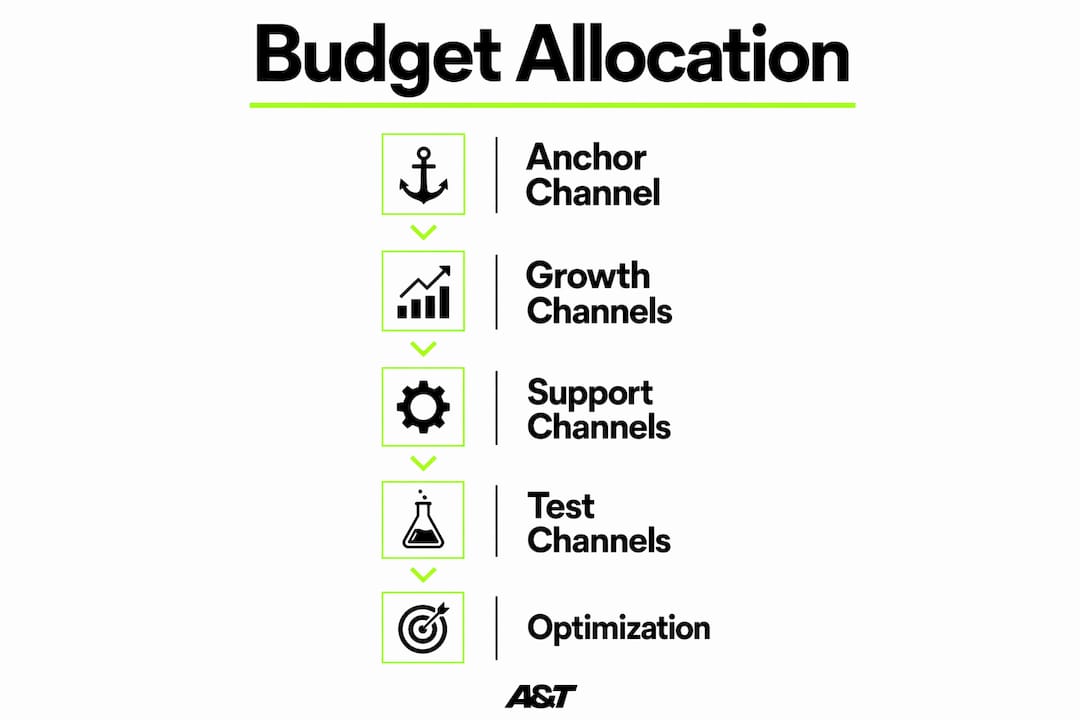
The most common mistake in channel diversification is spreading budget too thin too fast. A phased approach works better. Start with one anchor channel that receives 40–50% of your budget, then add channels sequentially as each one reaches a stable performance baseline. Experts recommend this anchored channel strategy to avoid fragmented attribution and wasted spend during the learning phase.
Budget allocation and funnel role framework
Channel type | Budget share | Primary funnel role |
|---|---|---|
Anchor channel (e.g., Google Search) | 40–50% | Bottom-of-funnel conversion |
Secondary channel (e.g., Meta Ads) | 20–30% | Mid-funnel retargeting |
Tertiary channel (e.g., display, native) | 10–20% | Top-of-funnel awareness |
Test budget (new platforms) | 5–10% | Incremental reach testing |
Messaging coordination is non-negotiable. Conflicting retargeting messages across platforms harm user experience and erode trust. Each channel should carry a consistent brand message adapted to its format, not a completely different story. Think of it as one conversation happening in different rooms, not five separate conversations with no connection.
Operational complexity is real. Managing multiple platforms requires significant manual work, and fragmented reporting is the most common result. Match your channel count to your team's actual capacity. Three well-managed channels outperform six poorly managed ones every time. For practical guidance on keeping spend efficient as you scale, the ad budget planning principles Atdigiagency uses with clients provide a solid starting framework.
Pro Tip: Build a shared campaign calendar across all channels before launch. Coordinating promotions, creative refreshes, and budget shifts in one place prevents the messaging conflicts that kill multi-channel performance.
How to measure results across multiple ad platforms
Measurement breaks down when you add channels without updating your attribution model. Last-click attribution assigns all credit to the final touchpoint before conversion. That model systematically underfunds awareness and mid-funnel channels, which quietly do the work of warming up your audience before the final click happens.
Multi-touch attribution solves this by distributing credit across every interaction in the path to purchase. The practical steps to get there:
Standardize UTM parameters across every channel and campaign. Consistent naming conventions are the foundation of clean cross-channel data.
Implement server-side tracking to reduce signal loss from browser privacy restrictions and ad blockers.
Use conversion APIs on platforms like Meta to recover data that pixel-based tracking misses post-iOS 14.5.
Run incrementality tests using geo holdouts to measure the true lift each channel contributes, independent of what platform dashboards report.
Normalize platform metrics before comparing them. Each platform defines conversions differently, and comparing raw numbers across platforms without normalization produces misleading conclusions.
Unified attribution systems using consistent UTMs and server-side tracking reveal the true assist structure of your campaigns. That insight tells you which channels to fund more and which to cut. For a deeper look at building measurement systems that hold up across platforms, the campaign measurement guide covers the full process.
Incrementality testing and geo holdouts are the most reliable advanced methods for understanding true channel contribution. They are more work to set up, but they remove the guesswork that platform-reported ROAS introduces. Overcoming the broader digital marketing measurement challenges that come with multi-channel campaigns requires this kind of discipline from the start.
Key Takeaways
Diversifying ad placements across three or more channels is the most reliable way to reduce acquisition costs, protect against platform shocks, and reach the full range of buyers in your market.
Point | Details |
|---|---|
Platform dependency is a structural risk | No single channel should exceed 40–50% of your acquisition budget. |
Three or more channels lower CPA | Integrated multi-channel strategies produce a 46% lower cost per acquisition on average. |
Creative fatigue accelerates on single platforms | Spreading placements reduces per-platform frequency and extends audience engagement. |
Phased expansion beats spreading thin | Add channels sequentially from an anchor, matching pace to your team's capacity. |
Attribution must match your channel count | Multi-touch attribution and server-side tracking reveal true channel contribution and guide budget decisions. |
The uncomfortable truth about «diversification» most marketers miss
Ann here. After years of working on paid media across dozens of accounts, the pattern I see most often is this: marketers add channels to solve a performance problem on their primary platform, without fixing the underlying issue first. They call it diversification. It is actually avoidance.
Real diversification starts with a clear view of where your funnel breaks. If your Google Search campaigns convert well but you have no awareness layer feeding new demand into the funnel, adding Meta Ads makes sense. If your creative is exhausted and your audience is oversaturated, adding a new channel buys you time, but it does not fix the creative problem. You will hit the same wall six months later on the new platform.
The other thing I have learned: post-click optimization matters as much as the placement itself. Post-click optimization is essential to capitalize on diversified traffic. Sending paid traffic from five channels to a landing page that converts at 1% is not a media strategy. It is an expensive way to collect data you will not act on.
The mindset shift that actually works is treating your media mix like a portfolio. Each channel has a role, a budget range, and a performance threshold. You fund what earns it and cut what does not. That is not complicated. But it requires discipline most teams skip when they are moving fast.
— Ann
How A&T agency manages multi–channel paid ads for real results
Atdigiagency builds and manages Google Ads and Meta Ads campaigns as part of coordinated multi-channel paid media systems. The team applies the budget allocation frameworks, attribution setups, and creative coordination practices covered in this article to every client account. The focus is always on measurable outcomes: lower CPA, higher conversion volume, and campaigns that hold up when platforms shift. If you are ready to build a paid media system that does not depend on any single platform, Atdigiagency is the team to do it with. No unnecessary meetings. Just campaigns that perform.
FAQ
What does it mean to diversify ad placements?
Ad placement diversification means distributing your advertising budget across multiple channels and platforms rather than concentrating it on one. The goal is to reduce platform dependency, expand audience reach, and stabilize acquisition costs.
How many channels do I need to see results from diversification?
Businesses using three or more advertising channels achieve a 287% higher purchase rate and 46% lower CPA compared to single-channel campaigns. Three channels is the practical minimum for meaningful diversification benefits.
What is the right budget split across ad channels?
No single channel should receive more than 40–50% of your total acquisition budget. A common starting framework allocates 40–50% to an anchor channel, 20–30% to a secondary channel, and the remainder to awareness and test budgets.
Why does creative fatigue happen faster on single platforms?
When the same audience sees the same ad repeatedly on one platform, frequency rises and engagement drops. Multi-channel campaigns spread exposure across platforms, reducing per-platform frequency and extending the life of your creative assets.
How do I measure performance accurately across multiple ad platforms?
Use standardized UTM parameters, server-side tracking, and conversion APIs to build clean cross-channel data. Multi-touch attribution and incrementality testing then reveal the true contribution of each channel, replacing the distorted picture that last-click attribution produces.