What Is Ad Rank? Google Ads Placement Explained
Posted on
Marketing
Posted at

Ad Rank is a real-time score Google calculates for each auction to determine ad eligibility and position.
Focusing on ad quality, landing page, and asset optimization offers more sustainable results than simply increasing bids.
Ad Rank is defined as the real-time score Google calculates for every ad auction to determine whether your ad appears and exactly where it shows on the search results page. It is not a fixed number you set once and forget. Google recalculates it fresh for every single query, for every user, at every moment. That dynamic nature is what makes Ad Rank the most consequential metric in any Google Ads campaign. Understanding how it works, and what drives it, is the difference between wasting budget and winning placements at a lower cost than your competitors pay.
What factors determine Ad Rank in Google Ads?
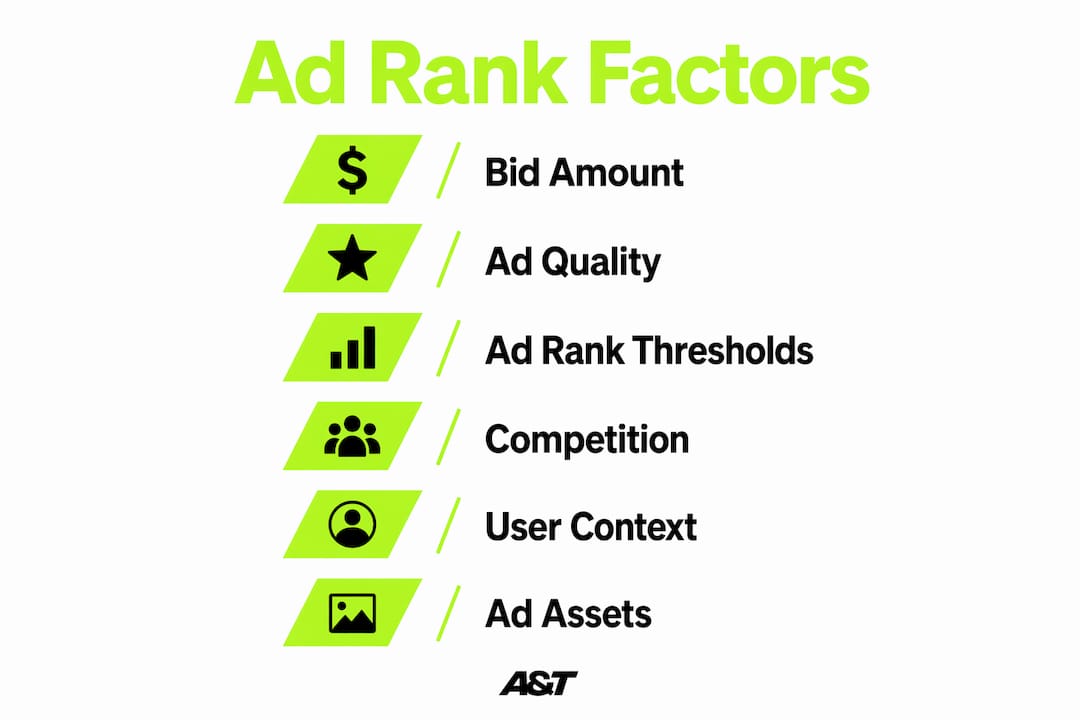
Google uses six critical factors to calculate Ad Rank: your bid, the quality of your ad and landing page, Ad Rank thresholds, auction competitiveness, search context, and the expected impact of your ad assets. Each factor carries real weight. Ignoring any one of them leaves money and position on the table.

Factor | What it means | Advertiser control |
|---|---|---|
Bid amount | The maximum you're willing to pay per click | Full control |
Ad quality | Expected CTR, ad relevance, landing page experience | Full control |
Ad Rank thresholds | Minimum quality floors set by Google per position | Indirect control |
Auction competitiveness | How strong competing ads are in the same auction | No direct control |
Search context | Device, location, time, query phrasing | Partial control via bid adjustments |
Ad assets impact | Extensions like sitelinks, callouts, and structured snippets | Full control |
Bid amount sets your ceiling, but it does not set your floor. You can bid $20 per click and still lose to a competitor bidding $8 if their quality signals are significantly stronger.
Ad quality breaks into three components Google evaluates separately:
Expected click-through rate (CTR): How likely users are to click your ad for that specific query
Ad relevance: How closely your ad copy matches the intent behind the search
Landing page experience: Whether the page users land on is fast, relevant, and transparent
Ad Rank thresholds act as quality gates. Top-of-page positions carry substantially higher thresholds, which means low-quality ads are excluded from premium placements regardless of bid size.
Search context variables include the user's device, physical location, time of day, and the exact phrasing of their query. Two users searching for the same product can trigger entirely different auctions with different Ad Rank outcomes.
Pro Tip: Tightly themed ad groups, where each group targets a narrow cluster of related keywords, directly raise your expected CTR and ad relevance scores. That improvement flows straight into a better Ad Rank without touching your bid.
How does Ad Rank affect ad eligibility and position?
Ad Rank governs two separate decisions Google makes before your ad ever appears. First, it decides eligibility. Second, it decides position. Most advertisers focus only on position and miss the eligibility problem entirely.
The eligibility decision works through Ad Rank thresholds. Google prefers to show no ad rather than a low-quality ad, and thresholds are the mechanism that enforces that preference. If your Ad Rank falls below the minimum threshold for a given position, your ad simply does not show. No amount of bidding overrides that gate.
The position decision works through relative ranking. Once eligible, your ad competes against other eligible ads. The advertiser with the highest Ad Rank wins the top slot, the second highest wins the second slot, and so on. Position is always relative to the competition in that specific auction.
Here is how position plays out in a real auction scenario:
Google receives a search query and identifies all eligible advertisers targeting that keyword.
Each advertiser's Ad Rank is calculated in real time using all six factors.
Ads that fail to meet the minimum threshold for any position are excluded.
Remaining ads are ranked from highest to lowest Ad Rank.
The highest-ranked ad wins the top-of-page position, subject to the top-of-page threshold.
"Ad Rank is recalculated for every single auction, causing ad position and eligibility to fluctuate rapidly according to auction context. The same ad can have different positions within seconds and for different users."
Top-of-page ads face stricter quality requirements than bottom-of-page ads. For informational queries where user intent is not clearly commercial, Google may show no ads at the top at all. That is not a bug. It is Ad Rank thresholds working as designed to protect the user experience.
What is the relationship between Ad Rank and actual CPC?
Ad Rank determines not just where you appear but what you pay. The actual cost-per-click formula is: (Ad Rank of the competitor directly below you ÷ Your Quality Score) + $0.01. That formula has a powerful implication. A higher Quality Score directly reduces what you pay for the same position.
Higher Quality Score advertisers pay less while achieving higher positions. This is the core mechanic that makes quality investment more valuable than raw bid increases over time.
Common misconceptions about bidding and cost:
"Bidding higher always means paying more." Not true. If your Quality Score rises, your actual CPC can drop even when you win a better position.
"The top bidder always pays the most." The top bidder pays only what is needed to beat the competitor below them, adjusted for quality.
"Quality Score is a soft metric." Quality Score is a direct input into the CPC formula. It has a hard dollar impact on every click you buy.
The second-price auction model Google uses means you rarely pay your maximum bid. You pay just enough to beat the next competitor. That gap between your max bid and your actual CPC widens as your Quality Score improves.
Pro Tip: Improving your landing page experience score is often the fastest path to a lower CPC. A faster, more relevant page raises your Quality Score, which reduces your actual CPC on every click you win, compounding savings across your entire campaign.
How can marketers improve Ad Rank beyond raising bids?
A balanced focus on quality signals combined with strategic bid adjustments outperforms simple bid increases in sustainable Ad Rank improvement. Raising your bid is the most expensive lever. It also has diminishing returns in competitive auctions. Quality improvements, by contrast, compound over time.
Improve ad copy relevance and expected CTR
Write ad copy that mirrors the exact language of your target keywords. Use responsive search ads to test multiple headlines and descriptions simultaneously. Google's system identifies which combinations generate the highest CTR and weights them accordingly. Tightly themed ad groups with focused copy consistently outperform broad ad groups on relevance scores. For deeper guidance on this, the A&T Digital resource on ad relevance and performance breaks down the mechanics in practical terms.
Optimize your landing page experience
Ads leading to fast, relevant, and transparent landing pages earn higher landing page experience scores. Speed matters. Relevance matters. If a user clicks an ad about running shoes and lands on a general footwear homepage, Google registers a relevance mismatch. That mismatch lowers your Quality Score and raises your CPC. Match the landing page content directly to the ad's promise.
Use ad assets to raise expected impact scores
Ad assets, formerly called ad extensions, include sitelinks, callouts, structured snippets, call extensions, and image assets. Google factors in the expected impact of these assets when calculating Ad Rank. More assets give Google more options to build a compelling ad format, which raises the probability of a click. Adding all relevant assets costs nothing extra and directly improves your Ad Rank calculation.
Apply Smart Bidding for auction–level precision
Smart Bidding strategies improve Ad Rank by adjusting bids in real time based on signals like device type, location, audience segment, and time of day. Target CPA and Target ROAS bidding strategies let Google bid more aggressively in auctions where conversion probability is high and pull back where it is low. That precision means you win more valuable auctions without inflating your average CPC across the board. Understanding the full ad auction mechanics helps you configure Smart Bidding strategies with the right targets from the start.
Pro Tip: Monitor your Ad Rank thresholds by watching your impression share lost to rank versus lost to budget. If rank is the bigger loss, the problem is quality, not budget. Fix quality first before adding spend.
For a broader view of how quality and bidding interact to drive returns, the A&T Digital guide on improving ad ROI covers the full picture. Understanding how SEO ranking factors interact with paid search visibility also gives you a more complete picture of how Google evaluates content quality across channels.
Key Takeaways
Ad Rank is a real-time, multi-factor score that controls both your ad's eligibility and its position, making quality improvements more valuable than bid increases for long-term campaign performance.
Point | Details |
|---|---|
Ad Rank has six inputs | Bid, quality, thresholds, competition, context, and ad assets all factor into every auction calculation. |
Quality Score cuts your CPC | A higher Quality Score directly lowers your actual cost-per-click through the CPC formula. |
Thresholds block low-quality ads | No bid amount overrides a minimum Ad Rank threshold; quality floors are non-negotiable. |
Ad Rank changes every auction | The same ad can rank differently for different users within seconds due to real-time recalculation. |
Assets improve Ad Rank for free | Adding sitelinks, callouts, and other assets raises expected impact scores at no additional cost. |
Annʼs take: why most advertisers misread Ad Rank
Most advertisers I work with treat Ad Rank like a dial they turn by adjusting their bid. They see their ad drop in position, they raise the bid, and they feel like they've solved the problem. They haven't. They've just paid more for the same underlying issue.
The part that consistently surprises people is the threshold mechanic. Your ad can be excluded from top placements entirely, not because you bid too low, but because your quality signals don't meet the floor for that position. Raising the bid in that situation does nothing. The fix is always in the ad copy, the landing page, or the asset setup.
What I've found actually works is treating Ad Rank as a quality audit trigger. Every time position drops or impression share falls, I look at Quality Score components first. Expected CTR, ad relevance, and landing page experience each tell you exactly where the gap is. Fix the gap, and the position improvement follows without spending an extra dollar.
The other thing worth saying plainly: Ad Rank is not a score you achieve and hold. It is recalculated in every auction, against every competitor, in every context. That means your position is always relative and always temporary. The advertisers who win consistently are the ones who treat quality management as an ongoing practice, not a one-time setup task.
— Ann
How A&T agency approaches Ad Rank management for clients
Ad Rank improvement is not a one-time fix. It requires continuous attention to bid strategy, ad quality, landing page performance, and asset coverage. That is exactly the work A&T Digital does for clients running Google Ads campaigns across competitive verticals. The team focuses on the quality signals that reduce CPC while improving position, so your budget works harder without simply spending more. If your campaigns are losing impression share to rank rather than budget, that is a quality problem with a clear solution. A&T Digital's Google Ads management service is built to diagnose and fix exactly that, with a data-driven approach that prioritizes measurable results over guesswork-free execution.
FAQ
What is ad rank in Google Ads?
Ad Rank is the score Google calculates in real time for every auction to determine whether your ad is eligible to show and what position it occupies on the search results page. It is based on six factors: bid, ad quality, Ad Rank thresholds, auction competitiveness, search context, and ad asset impact.
Does a higher bid always mean a better ad position?
No. A higher bid improves your Ad Rank only if your quality signals already meet the minimum threshold for the target position. High bids alone cannot overcome Ad Rank thresholds; ads that fail quality floors are excluded from top placements regardless of bid size.
How does Quality Score relate to Ad Rank?
Quality Score is Google's diagnostic rating of your ad quality, covering expected CTR, ad relevance, and landing page experience. It feeds directly into the Ad Rank formula and into the actual CPC calculation, meaning a higher Quality Score can both improve your position and lower what you pay per click.
How often does Ad Rank change?
Ad Rank is recalculated for every single auction, which means it can change within seconds for different users searching the same keyword. Stable positioning requires continuous quality and bid management, not a one-time campaign setup.
What is the fastest way to improve Ad Rank without raising bids?
Improving your landing page experience and tightening your ad group themes are the two highest-impact moves. Both raise your Quality Score, which improves your Ad Rank and reduces your actual CPC simultaneously.