What Is Vertical Marketing? A 2026 Strategy Guide
Posted on
Marketing
Posted at

Vertical marketing targets a single industry with tailored messaging, leading to higher customer lifetime value and shorter sales cycles. Implementing it requires selecting a niche, creating industry-specific content, and aligning sales and marketing efforts around that focus. This strategy transforms a vendor into an industry authority and improves overall business performance.
Vertical marketing is defined as a strategy where a business concentrates its messaging, products, and sales efforts on a single industry or niche market rather than addressing a broad audience. This approach is also called niche market targeting in academic marketing frameworks. A Forrester Research 2026 study found that companies using vertical marketing report 43% higher customer lifetime value and 35% shorter sales cycles compared to broad-market approaches. Those numbers reflect a structural advantage, not a marginal one. Vertical marketing works because specialized messaging resonates more deeply, reduces friction in the sales process, and positions a business as an authority rather than a generalist vendor.
What is vertical marketing and how does it differ from other approaches?
Vertical marketing is the practice of targeting one specific industry segment with tailored content, language, and solutions. A cybersecurity firm that markets exclusively to healthcare providers is practicing vertical marketing. A general IT services company pitching every industry at once is not.
Horizontal marketing takes the opposite approach. It targets a wide, cross-industry audience with broad messaging designed to appeal to many buyer types simultaneously. Consumer packaged goods brands like soap or bottled water use horizontal marketing because their product fits nearly every household. B2B software companies, professional services firms, and specialized manufacturers rarely benefit from that model.
A third concept causes frequent confusion: the vertical marketing system, or VMS. A VMS is a supply chain integration model where producers, wholesalers, and retailers coordinate under unified control to reduce costs and improve distribution efficiency. It has nothing to do with audience targeting. The term sounds similar, but the purpose is entirely different.
Dimension | Vertical marketing | Horizontal marketing |
|---|---|---|
Audience focus | Single industry or niche | Broad, cross-industry |
Messaging style | Industry-specific terminology | General, universal language |
Sales process | Consultative, longer cycle | Transactional, shorter cycle |
Primary goal | Deep market penetration | Wide market reach |
Best fit | B2B, professional services | Consumer goods, mass retail |
Pro Tip: Never use "vertical marketing" and "vertical marketing system" interchangeably in client presentations or internal briefs. One is a targeting strategy; the other is a distribution structure. Mixing them signals a lack of domain fluency to sophisticated buyers.
What are the core elements of an effective vertical marketing strategy?
Vertical marketing focuses messaging and sales efforts on specific industry needs, using specialized content and terminology that generic campaigns cannot replicate. The strategy has several non-negotiable components.
Industry-specific messaging: Content must use the language, pain points, and compliance concerns of the target vertical. A campaign aimed at healthcare CFOs should reference HIPAA, reimbursement cycles, and margin compression, not generic cost savings.
Account-based marketing (ABM): ABM treats individual accounts as markets of one. It pairs vertical targeting with personalized outreach, making it the most direct application of vertical marketing in B2B sales.
Specialized content formats: Case studies, vertical-specific webinars, and white papers that address niche regulatory or operational challenges outperform generic blog posts in every measurable engagement metric.
Niche segmentation: Deep customer profiling within the vertical, including job titles, buying authority, and budget cycles, sharpens targeting and reduces wasted ad spend.
Sales process alignment: Sales teams need scripts, objection-handling frameworks, and demo environments built around the vertical's specific workflow, not a generic product pitch.
75% of B2B marketersreport improved engagement when they use tailored, industry-specific content. That improvement comes from relevance, not volume. Buyers in specialized industries ignore content that does not speak their language.
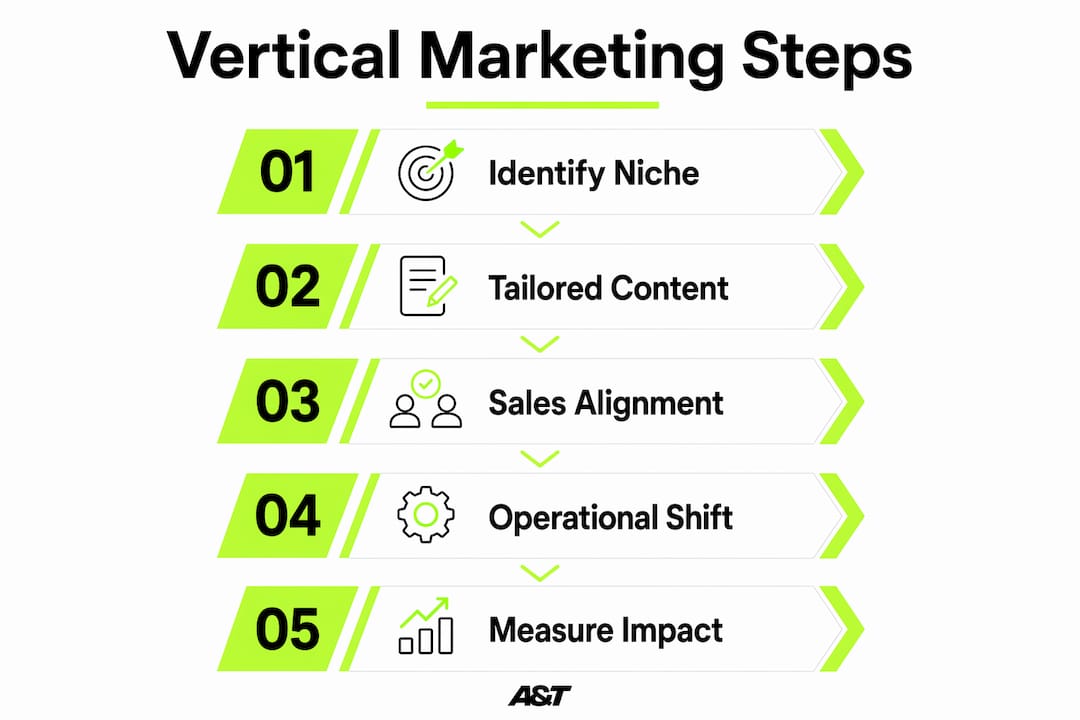
Committing to a vertical strategy also requires operational shifts that integrate sales, marketing, and product development around the niche customer's specific needs. This is not a campaign-level adjustment. It is a business model decision.

Pro Tip: Build a vertical glossary before writing a single piece of content. List 20–30 terms your target industry uses daily. If your content does not include those terms naturally, it will not earn credibility with that audience.
What are the measurable benefits of vertical marketing?
The performance case for vertical marketing is concrete. Companies that adopt vertical marketing reduce cost per acquisition through precise segmentation and improve overall marketing efficiency. Fewer wasted impressions, higher conversion rates, and stronger retention all follow from targeting a defined audience with relevant messaging.
The Forrester Research data makes the business case clear. A 43% lift in customer lifetime value means each client relationship generates significantly more revenue over time. A 35% reduction in sales cycle length means deals close faster, freeing sales capacity for new pipeline. Both outcomes compound: more revenue per client, more clients per quarter.
Vertical marketing also transforms businesses from generic vendors into recognized industry experts. That expert status creates pricing power. A firm known as the go-to provider for, say, telehealth marketing can charge a premium that a generalist agency cannot justify. Buyers in specialized industries pay more for vendors who understand their world without needing a lengthy education.
Performance metric | Vertical marketing | Broad-market approach |
|---|---|---|
Customer lifetime value | 43% higher | Baseline |
Sales cycle length | 35% shorter | Baseline |
B2B content engagement | Significantly higher | Lower |
Cost per acquisition | Reduced through segmentation | Higher due to broad targeting |
Brand positioning | Industry expert | General vendor |
Overcoming the common obstacles in digital marketing becomes easier when your targeting is tight. Vertical focus eliminates the noise that broad campaigns generate and gives your team a clear benchmark for success.
How can businesses implement vertical marketing step by step?
Implementation requires a deliberate sequence. Jumping straight to content production without selecting the right vertical wastes resources and produces messaging that fits no one well.
Identify your strongest vertical candidates. Audit your existing client base. Which industries represent your highest-margin accounts, your longest client relationships, or your most frequent referrals? Those patterns reveal where you already have a natural advantage.
Validate market opportunity. Confirm that the vertical has sufficient addressable market size, active buyers, and budget cycles that align with your sales capacity. A niche with 50 potential clients is too small for most businesses.
Build a vertical-specific buyer persona. Go beyond job title. Map the buyer's daily challenges, regulatory pressures, success metrics, and preferred content formats. This persona drives every downstream decision.
Develop tailored messaging and content. Write landing pages, ad copy, and sales decks that speak directly to the vertical's pain points. Use the glossary approach described earlier. Every piece of content should feel written for that industry, not adapted from a generic template.
Align your sales process to the vertical. Train your sales team on the vertical's terminology, buying process, and common objections. Build demo environments or case study libraries that reflect the vertical's specific use cases.
Select the right channels. Multi-channel advertising works best when channel selection matches where your vertical's buyers actually spend their attention. LinkedIn works for B2B healthcare executives. Google Search works for buyers actively researching solutions. Meta campaigns work for consumer-facing verticals like retail and wellness.
Measure and refine by vertical KPIs. Track cost per acquisition, sales cycle length, and customer lifetime value by vertical. Compare results quarterly and double down on the verticals where your numbers outperform your baseline.
The most common implementation mistake is treating vertical marketing as a content project rather than a business strategy. Producing a few industry-specific blog posts does not constitute vertical marketing. The strategy requires sales, marketing, and product to align around the same niche customer profile. Without that alignment, the messaging is inconsistent and the buyer experience breaks down.
A practical example: a performance marketing agency that runs campaigns for telehealth clients builds vertical expertise by learning reimbursement models, patient acquisition funnels, and HIPAA-compliant ad restrictions. That knowledge becomes a competitive barrier. Generalist agencies cannot replicate it quickly. The performance marketing workflow that supports vertical campaigns requires this kind of domain depth built into every stage of execution.
Key Takeaways
Vertical marketing delivers measurably better results than broad-market approaches because specialized targeting, industry-specific messaging, and deep buyer knowledge compound into higher lifetime value, faster sales cycles, and lower acquisition costs.
Point | Details |
|---|---|
Core definition | Vertical marketing targets a single industry with tailored messaging, not a broad audience. |
Performance advantage | Forrester Research data shows 43% higher customer lifetime value and 35% shorter sales cycles. |
VMS distinction | Vertical marketing systems are supply chain structures, not targeting strategies. Keep them separate. |
Implementation sequence | Start with vertical selection based on existing strengths, then build messaging, sales alignment, and channel strategy. |
Expert positioning | Specialization converts a generic vendor into a recognized industry authority with real pricing power. |
Why vertical marketing is the sharpest tool in a crowded B2B market
I have watched businesses spend years producing content for everyone and converting almost no one. The instinct to cast a wide net feels safe. It is not. Wide nets catch a lot of noise and very few qualified buyers.
The analogy that stays with me: vertical marketing is like being a specialist surgeon versus a general practitioner. The specialist commands higher fees, earns faster trust, and gets referrals from other specialists. The generalist competes on price because they cannot differentiate on expertise.
What companies consistently underestimate is the operational commitment required. Vertical marketing is not a campaign. It is a business model orientation. The businesses I have seen succeed with it made deliberate choices to say no to clients outside their target vertical, even when short-term revenue was tempting. That discipline is what builds the reputation that eventually makes the phone ring without paid ads.
The emerging trend worth watching is AI-driven vertical segmentation. Platforms now allow granular audience targeting by industry, job function, and behavioral signals at a scale that was not practical five years ago. That capability makes vertical marketing more accessible to smaller businesses, but it also raises the bar. If your competitors can target the same vertical with the same precision, your messaging and domain expertise become the only real differentiators.
Commit to the vertical. Build the expertise. Let the results compound.
— Ann
How A&T agency builds vertical marketing campaigns that perform
A&T Digital works with businesses that need more than generic ad spend. The team builds paid advertising systems designed around specific verticals, from telehealth and health and wellness to retail and entertainment. Every campaign starts with a deep understanding of the vertical's buyer, not a template. Google Ads and Meta campaigns are built to match the language, intent signals, and conversion paths of the target industry. The result is lower cost per acquisition, faster sales cycles, and campaigns that scale because they are built on real market knowledge. If you are ready to stop running broad campaigns and start owning a niche, A&T Digital is the team to call.
FAQ
What is vertical marketing in simple terms?
Vertical marketing is a strategy where a business targets one specific industry with messaging and solutions built for that industry's unique needs. It contrasts with horizontal marketing, which targets a broad, cross-industry audience.
How does vertical marketing differ from a vertical marketing system?
Vertical marketing is a customer targeting strategy focused on niche industries. A vertical marketing system is a distribution channel structure where producers, wholesalers, and retailers coordinate under unified control. The two concepts are unrelated.
What industries use vertical marketing most effectively?
B2B industries including healthcare, financial services, legal, and technology use vertical marketing most effectively. These sectors have complex buying processes and specialized terminology that reward deep industry knowledge over broad messaging.
What are the main benefits of vertical marketing?
The primary benefits include higher customer lifetime value, shorter sales cycles, reduced cost per acquisition, and stronger brand positioning as an industry expert. Forrester Research data confirms a 43% lift in customer lifetime value for companies using this approach.
How do I start implementing a vertical marketing strategy?
Start by auditing your existing clients to identify which industries already generate your best results. Then build a detailed buyer persona for that vertical, develop industry-specific messaging, align your sales process, and select channels where that vertical's buyers are most active.