What Is Event Based Marketing? Your 2026 Guide
Posted on
Marketing
Posted at

Event-based marketing delivers personalized messages triggered by specific customer actions in real time. It outperforms traditional campaigns by providing more relevant and timely communication based on behavioral signals.
Event-based marketing is defined as a strategy that sends personalized messages triggered instantly by specific customer actions, not by fixed schedules. Unlike batch campaigns that blast the same message to everyone on a set date, event-based marketing responds to what a customer actually does. A user abandons a cart, and a message fires within minutes. A subscriber hits a usage milestone, and a tailored offer appears. This approach, also called trigger-based marketing or behavioral marketing, puts the customer's context at the center of every communication.
What is event based marketing and how does it differ from traditional campaigns?
Event-based marketing triggerspersonalized, context-aware communication in real time based on specific user actions, not fixed schedules. That distinction matters more than it sounds. Traditional campaigns are built around the marketer's calendar. Event-based campaigns are built around the customer's behavior. The result is messaging that arrives when a customer is already thinking about the topic, which is the moment they are most likely to act.

True event-based marketingdiffers from scheduled automation sequences by reacting to real-time user states rather than fixed timelines. A welcome email sent three days after signup is scheduled automation. A message sent the moment a user completes their first purchase is event-based. The difference is not just timing. It is relevance. One message interrupts. The other responds.Event-based campaigns yield betteropen rates, conversions, and retention than batch campaigns by aligning messaging with user intent. Behavioral triggers act on real user actions, not calendar timing. That alignment is the core advantage of the approach.
How does event–based marketing work in practice?
The mechanics of event-based marketing follow a clear sequence: detect an event, evaluate a trigger condition, and deliver a message. Each step requires specific technology and deliberate setup.
Identifying trackable events is the first task. Events fall into three categories:
User actions: page visits, clicks, purchases, form submissions, app opens
Lifecycle milestones: trial expiration, subscription renewal dates, first login, 30-day inactivity
Behavioral thresholds: a user viewing a pricing page three times, or dropping below a usage threshold that signals churn risk
Real-time event ingestion requires integrated CRM or ERP systems capable of processing these signals instantly. The data flows from your website, app, or product into a central platform. That platform evaluates whether the event meets a trigger condition you have defined in advance.
Once a trigger fires, the system routes the message to the right channel. Multi-channel coordination across email, push, in-app, and SMS is the standard for optimal engagement. A cart abandonment might trigger an email first, then a push notification 24 hours later if the email goes unopened. The channel sequence is part of the workflow design.
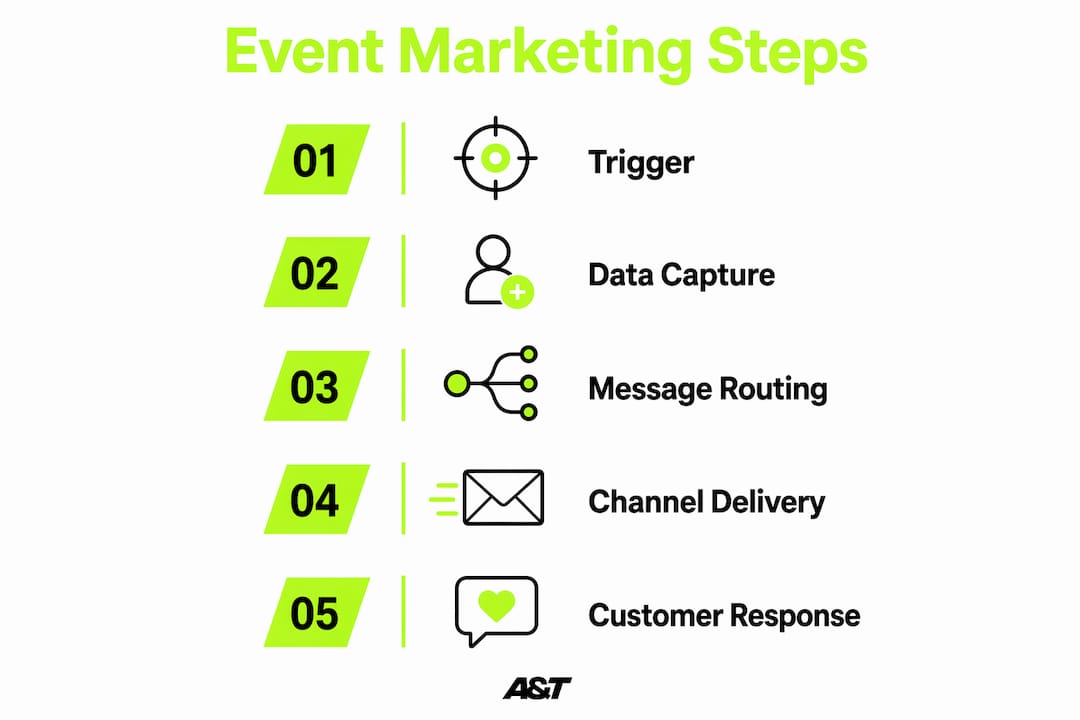
Pro Tip: Map your customer journey before you build a single trigger. List every meaningful moment where a customer's behavior signals intent, hesitation, or readiness. Those moments are your events. Build the technology around them, not the other way around.
Automation platforms like those covered in this marketing automation checklist handle the trigger logic, message routing, and timing rules once the events are defined.
What are common examples of event–based marketing campaigns?
Concrete examples make the strategy easier to apply. The following use cases appear across e-commerce, SaaS, and travel industries.
Cart abandonment recovery. A shopper adds items to a cart and leaves without buying. A trigger fires within one hour, sending a personalized email with the exact items left behind. Conversion rates on these messages consistently outperform standard promotional emails.
Feature adoption nudges. A SaaS product detects that a user has never activated a key feature after 14 days. A trigger sends an in-app message or email showing a short tutorial. This directly reduces churn by closing the gap between signup and value realization.
Renewal reminders. A subscription platform sends a message 30 days before a renewal date, then again at 7 days. The timing is tied to the contract date, not a broadcast calendar. Each message is specific to that customer's plan and usage history.
Churn prevention alerts. Tracking user session frequency and feature adoption thresholds helps identify engagement opportunities before a customer cancels. A drop in logins triggers a check-in message or a discount offer.
Upsell triggers. A customer who has used a product heavily for 60 days receives a message about the next tier. The trigger is usage volume, not a scheduled promotion date.
Travel rebooking prompts. A travel app detects that a user searched for flights to a destination twice but did not book. A push notification fires with a price alert for that specific route.
The common thread across all these examples is timing and context. Businesses that use behavioral data to address churn risks and drive upsells can deliver one-to-one messaging at scale. That scale is what separates event-based marketing from manual outreach.
What technical requirements and challenges come with event–based marketing?
Event-based marketing is not plug-and-play. It requires a specific technology stack and deliberate data management.
The core requirement is a platform capable of real-time event ingestion. Real-time data ingestion is a primary technical hurdle. Systems must process events instantly to maintain the timing advantage that makes this strategy work. A trigger that fires six hours after the event is no longer event-based. It is just a delayed batch message.
The table below shows how two common implementation approaches compare on key criteria.
Criteria | Basic automation setup | Full event-based platform |
|---|---|---|
Event processing speed | Delayed (minutes to hours) | Real time (seconds) |
Trigger complexity | Simple time-based rules | Behavioral state conditions |
Channel coordination | Single channel | Multi-channel workflows |
Data requirements | Basic contact fields | Rich behavioral event data |
Personalization depth | Segment-level | Individual user-level |
Clean data is the second requirement. Dirty or incomplete data produces misfired triggers. A renewal reminder sent to a customer who already canceled is not just unhelpful. It damages trust.
Event fatigue is a real risk. When too many triggers fire too frequently, customers disengage or unsubscribe. Frequency caps and priority rules prevent this. A priority rule might say: if a customer has received a message in the last 48 hours, suppress the next trigger unless it is a time-critical alert. Understanding campaign frequency principles helps you set these rules correctly from the start.
Pro Tip: Build a trigger priority matrix before launch. Rank every event by urgency and business impact. High-priority events like payment failures always fire. Lower-priority events like feature tips get suppressed if the customer has already received a message recently.
How can marketers optimize event–based marketing strategies for best results?
Getting the mechanics right is only half the work. The other half is making sure the strategy actually drives results.
Define meaningful events first. Teams spend roughly 70% of their effort defining meaningful events and only 30% on messaging assets. That ratio is correct. A well-defined event produces a relevant trigger. A vague event produces noise. Start with the customer behavior you want to respond to, then build the message.
Use behavioral segmentation, not broad segments. Sending the same trigger message to all users who abandon a cart ignores the difference between a first-time visitor and a loyal customer who has bought 10 times. Segment by purchase history, engagement level, or product category to make the message more specific.
Balance automation with personal tone. Automated messages can still sound human. Short, direct copy that references the specific action the customer took outperforms generic promotional language every time.
Monitor lifetime value and retention, not just open rates. Open rates tell you if the subject line worked. Lifetime value tells you if the strategy worked. Track how event-based campaigns affect repeat purchase rates and subscription retention over 90-day windows.
Audit your event library regularly. Customer behavior changes. An event that was meaningful 12 months ago may no longer signal the same intent. Review your trigger conditions quarterly and retire events that no longer produce results.
A data-driven marketing approach ties all of this together. The goal is not to send more messages. It is to send the right message at the exact moment it will matter to that specific customer.
Key takeaways
Event-based marketing works because it responds to customer behavior in real time, making every message relevant to the moment the customer is already in.
Point | Details |
|---|---|
Core definition | Event-based marketing sends messages triggered by specific customer actions, not scheduled dates. |
Technical foundation | Real-time event ingestion via CRM or marketing automation platforms is required for this strategy to work. |
Event definition effort | Teams should spend the majority of their effort defining meaningful events before building message assets. |
Avoiding event fatigue | Frequency caps and priority rules prevent over-messaging and customer disengagement. |
Optimization focus | Track lifetime value and retention, not just open rates, to measure true campaign impact. |
Why most businesses are still doing this wrong
Most businesses I see treat event-based marketing as a synonym for automated email sequences. They set up a welcome series, a cart abandonment flow, and call it done. That is not event-based marketing. That is scheduled automation with a behavioral trigger bolted on.
The real shift is conceptual. EBM should map customer intent signals, not just automate responses. When a customer views a pricing page three times in one week, that is a signal. When a user's session frequency drops by half, that is a signal. The question is not "what message should we send this week?" The question is "what is this customer telling us right now, and what is the most helpful response?"
AI is making this easier. But AI's effectiveness depends entirely on data quality. I have seen teams invest heavily in automation platforms and get poor results because their event definitions were sloppy. The platform was fine. The inputs were not. Clean data and precise event definitions are the foundation. Everything else is execution.
The businesses that win with this approach treat it as a listening system, not a broadcasting system. They ask what the customer just did, what it means, and what would actually help right now. That mindset change is more valuable than any platform upgrade. You can also explore automation and PPC efficiency to see how this thinking applies to paid advertising as well.
— Ann
How A&T agency helps you act on customer signals in real time
Event-based marketing produces results when the right message reaches the right person at the right moment. A&T Digital builds and manages paid advertising systems on Google Ads and Meta that operate on exactly that principle. We target audiences based on real-time behavioral signals, not broad demographic buckets. Our campaigns are built around what customers are doing right now, which means your ad spend goes toward people who are already showing intent. If you want campaigns that respond to customer behavior and drive measurable conversions, our Google Ads management and Meta Ads management services are built for exactly that.
FAQ
What is event–based marketing in simple terms?
Event-based marketing sends a personalized message the moment a customer takes a specific action, such as abandoning a cart or reaching a usage milestone. It replaces fixed-schedule broadcasts with real-time, behavior-triggered communication.
How does event–based marketing differ from email automation?
Standard email automation follows a fixed timeline after signup. Event-based marketing fires messages based on what a customer actually does, regardless of when they signed up, making each message more relevant to the customer's current situation.
What are the most common event–based marketing examples?
Cart abandonment emails, churn prevention alerts, feature adoption nudges, and subscription renewal reminders are the most widely used applications across e-commerce, SaaS, and subscription businesses.
What technology do you need for event–based marketing?
A CRM or marketing automation platform capable of real-time event ingestion is the core requirement. The platform must process behavioral signals instantly and coordinate message delivery across email, push, SMS, and in-app channels.
How do you avoid overwhelming customers with too many triggers?
Frequency caps and priority rules limit how often a customer receives automated messages. Setting a minimum interval between messages and ranking triggers by urgency prevents event fatigue and keeps engagement rates healthy.