Retail Customer Win–Back Ad Examples That Convert
Posted on
Marketing
Posted at

The highest-performing retail customer win-back ad examples share one trait: they match the message to the customer's value tier before choosing an offer. Targeted product recommendations, early access, and tiered incentives outperform blanket discounts every time. Here are copy-ready templates you can run this week.
Execution checklist (one line): Segment by RFM → assign message type → select offer tier → apply suppression rule before sending.
Email subject lines by segment:
Lapsed loyalist (3+ purchases, 90 days silent): "Your rewards points expire soon, [First Name]" / CTA: Redeem Now
One-time buyer (single purchase, 60 days silent): "Still thinking it over? Here's what's new" / CTA: See What's New
Dormant VIP (high AOV, 120+ days silent): "Early access: our new drop before anyone else" / CTA: Shop Early
SMS snippets by segment:
Lapsed loyalist: "Hey [First Name], you have 200 points waiting. Use them before they expire → [link]"
One-time buyer: "We added new [category] you'll love. Free shipping this week only → [link]"
Dormant VIP: "Private sale opens for you 24 hrs early. No code needed → [link]"
Paid ad headlines (Meta/Google Display):
Lapsed loyalist: "Your favorites are back in stock" + dynamic product image
One-time buyer: "Complete your collection" + related SKU carousel
Dormant VIP: "Members-only preview: new arrivals" + lifestyle creative
Pro Tip: Before launching any sequence, suppress active purchasers from the last 30 days. Sending a win-back offer to someone who just bought destroys trust and wastes budget.
Key Takeaways
Segmentation-first win-back programs consistently outperform blanket discount campaigns because they match incentive cost to customer value at every stage.
Point | Details |
|---|---|
RFM before any send | Score customers by recency, frequency, and monetary value before assigning any offer or channel. |
Lead with non-discount offers | Use loyalty points, early access, and free shipping first; reserve discounts for phase 2–3 non-responders. |
Phase sequences 30–60–90 | Adjust timing to your category's purchase cadence; escalate channels only for segments that justify the cost. |
Suppress after 3–4 attempts | Remove unengaged contacts after 90–180 days to protect deliverability and avoid wasted spend. |
A&T Digital for execution | A&T Digital runs turnkey win-back programs covering segmentation, creative, media buying, and measurement. |
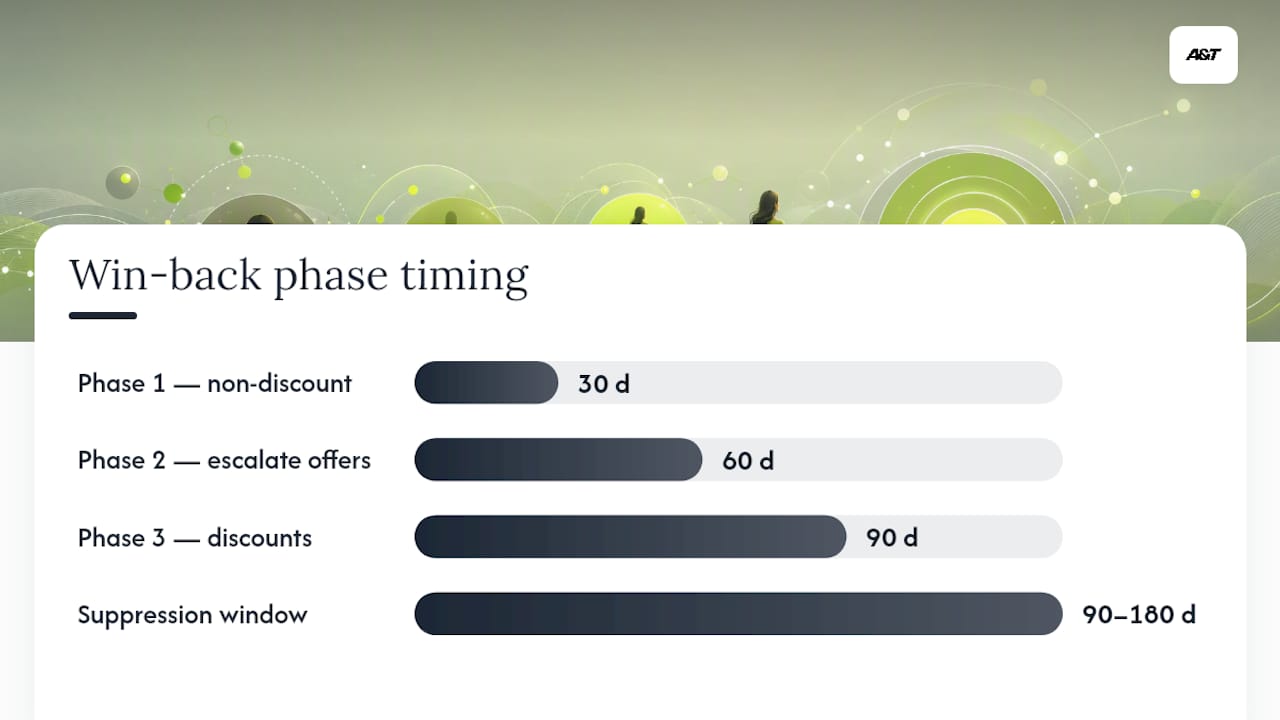
Table of Contents
How do you define "lapsed" and run RFM segmentation for retail?
What offer should you lead with, and when do discounts make sense?
Plug-and-play multi-touch sequences with timing and copy
What paid ad creatives actually win back lapsed shoppers?
High-lift tactics that avoid deep discounts
When should you escalate channels, and when do you stop?
How do you measure win-back ads and what should you A/B test?
Real win-back results: four case studies worth studying
How a performance agency runs your win-back program end-to-end
Why segmentation beats blanket discounts every time
Ready to run win-back ads that protect margin and scale?
Sources
How do you define «lapsed» and run RFM segmentation for retail?
RFM segmentation (Recency, Frequency, Monetary) is the right framework because it ties incentive spend directly to customer value and purchase cadence. Define lapse by your category's natural repurchase window, not a calendar default.
Practical score bands:
High-value recent (R3–5, F3–5, M3–5): 60–90 days since last purchase. Worth a personalized, non-discount first touch.
Single-purchase recent (R3–4, F1, M2–3): 45–75 days. Needs a risk-lowering offer or product education.
Dormant high-value (R1–2, F4–5, M4–5): 120–180 days. Justify a stronger incentive; direct mail is viable here.
Long-term dormant (R1, F1–2, M1–2): 180+ days. Suppress or run a final "last chance" touch before removing.
Operational checklist for pulling RFM: You need order date, order count, and lifetime revenue per customer. Set a lookback window of 12–18 months for most retail categories. Apparel and consumables can use 6–12 months; furniture or electronics need 18–24 months. Aim for at least 200 customers per segment before spending on paid channels.
Pro Tip: Dormancy is a behavioral signal, not just a date. If a customer opened your last three emails but never clicked, they are not truly lapsed — they are hesitant. Treat them differently from someone who has not opened anything in six months.
What offer should you lead with, and when do discounts make sense?
Lead with non-discount incentives first. Talon recommends bonus loyalty points, early access, and personalized product recommendations before any price reduction. Discounts belong in phase two or three, reserved for non-responders.
For retail discount creative mechanics, bundles and free-shipping thresholds protect margin better than percent-off offers because they increase average order value while the customer still feels rewarded.
Plug–and–play multi–touch sequences with timing and copy
A phased 30–60–90 framework works for most retail categories. Adjust the windows to your purchase cadence: a consumables brand might compress to 20–45–60 days; a furniture brand might stretch to 60–120–180 days.
Branching rules:
Trigger | Channel action |
|---|---|
No open after email 1 | Add to Google Display / Meta retargeting audience |
Opened but no click | Send email 2 with different subject line and offer |
Clicked but no purchase | Trigger SMS within 24 hours |
VIP + 120 days dormant | Escalate to direct mail postcard |
Sequence 1: One-time buyer (Days 1, 14, 30)
Day 1 email — Subject: "We saved something for you, [First Name]" — Body: "You tried [product]. Here's what customers who loved it bought next." CTA: Shop Now
Day 14 email — Subject: "Free shipping, just for you" — Body: "No minimum. This week only." CTA: Claim Free Shipping
Day 30 SMS — "Still here, [First Name]. Your free shipping expires tonight → [link]"
Sequence 2: Lapsed loyalist (Days 1, 10, 21)
Day 1 email — Subject: "Your 200 points expire in 7 days" — Body: "You've earned rewards. Don't let them go to waste." CTA: Use My Points
Day 10 email — Subject: "New arrivals in [category you love]" — Body: Personalized product grid. CTA: Shop New Arrivals
Day 21 SMS — "Points expiring soon + 15% off your next order → [link]"
Sequence 3: Dormant VIP (Days 1, 7, 21, 35)
Day 1 email — Subject: "You're on the early access list" — Body: "New collection drops publicly Friday. You get it Wednesday." CTA: Shop Early
Day 7 email — Subject: "Did you see the new [product]?" — Body: Dynamic product recommendation block. CTA: View My Picks
Day 21 SMS — "VIP offer: 20% off + free gift this week only → [link]"
Day 35 direct mail postcard — Personalized product image + voucher code
A/B test per touch: Subject line (curiosity vs. urgency) on touch 1; incentive type (points vs. free shipping) on touch 2; timing (morning vs. evening send) on touch 3.
What paid ad creatives actually win back lapsed shoppers?
Dynamic product retargeting with segmented custom audiences outperforms generic prospecting for win-back. Build separate Meta and Google audiences by LTV tier, then serve creative that matches the email offer exactly.

Meta carousel (lapsed loyalist): Headline: "Your favorites are waiting." Description: "Back in stock + double points this week." Each card: last-purchased product image + "Shop Now" CTA.
Google Display dynamic remarketing (one-time buyer): Headline: "Complete your [category] collection." Body: "Free shipping on orders over $50." Feed fields to surface: last-purchased SKU, top-related SKU, price.
YouTube/short-form video hook (dormant VIP): "You haven't been back in a while — here's what you missed." Cut to new product reveal. End card: "Early access for members. Link in bio."
For retargeting audience setup and bidding strategy, use Target ROAS bidding for warm win-back audiences and cap frequency at 3–5 impressions per week to avoid fatigue.
Pro Tip: Match the ad creative to the email offer exactly. If your email says "20% off," the ad must say "20% off." Inconsistency between channels kills conversion and erodes trust.
High–lift tactics that avoid deep discounts
Before reaching for a coupon, test these margin-protecting mechanics:
Loyalty point bonuses: "Earn 3x points this weekend" costs a fraction of a 20% discount and drives the same urgency for enrolled members.
Early access: VIPs and lapsed loyalists respond strongly to exclusivity. "Shop 48 hours before everyone else" requires zero margin sacrifice.
Curated bundles: Pair a replenishment item with a complementary SKU at a slight bundle price. Average order value rises; margin stays intact.
Free-shipping thresholds: "Free shipping on orders over $45" nudges customers to add items rather than discount existing ones.
Gifts-with-purchase: A low-cost sample or branded accessory feels high-value to the customer without the revenue hit of a percent-off offer.
For one-time buyers, a small gift or trial-size product lowers the perceived risk of a second purchase more effectively than a discount. Gate loyalty bonuses and early access to enrolled members to prevent leakage to non-loyalty customers. For customer retention tactics that complement these mechanics, segmentation is the common thread.
When should you escalate channels, and when do you stop?
Escalate only when a segment's value justifies the channel cost and you have confirmed consent. Suppression logic is as important as the creative itself for long-term deliverability.
Channel priority by segment:
All segments: Email first, always.
Opened but no purchase after 2 emails: Add to Meta/Google retargeting.
High-value + no email engagement after 3 touches: Trigger SMS (confirmed opt-in only).
Dormant VIP + 120 days: Escalate to direct mail postcard.
Suppression rules: Remove contacts after 90–180 days of zero engagement or after 3–4 failed win-back attempts. Validate email addresses before entry into any win-back flow. For SMS, send only to contacts with explicit TCPA-compliant opt-in; include opt-out instructions in every message. For email, honor CAN-SPAM unsubscribe requests within 10 business days and include a physical mailing address in every send.
Pro Tip: Direct mail reaches customers who have stopped opening email entirely. For high-AOV repeat buyers, a segmented postcard with a personalized voucher code can deliver strong ROAS precisely because the channel is unexpected.
How do you measure win–back ads and what should you AB test?
Prioritize these five KPIs: reactivation rate, incremental revenue, win-back customer acquisition cost, 90-day post-reactivation lifetime value, and ROAS on paid channels. Industry benchmarks put reactivation rates at 8–15% for high-value recent segments with multi-channel approaches.
For attribution, use voucher codes tied to each sequence phase. This gives you a clean conversion view without relying on last-touch attribution, which tends to over-credit the final ad impression. Run incremental holdout groups (10–20% of each segment receives no win-back messaging) to measure true lift against organic return.
A/B test priority list:
Subject line: curiosity-based ("You left something behind") vs. urgency-based ("Your points expire Friday")
Incentive type: loyalty points vs. free shipping vs. percent-off
Send timing: morning (7–9 AM) vs. evening (6–8 PM) for your category
Channel escalation path: email-only vs. email + SMS vs. email + paid retargeting
Creative format: static product image vs. dynamic carousel vs. lifestyle video
Minimum sample size: 500 per variant for email tests; 1,000+ for paid ad tests to reach statistical confidence. For data-driven measurement frameworks, incremental holdouts are the most defensible way to prove win-back ROI to leadership.
Budget allocation: Allocate roughly 60% to email (low cost, high volume), 30% to paid retargeting (Meta + Google Display), and 10% to testing reserve. Scale retargeting spend only after email benchmarks confirm the offer resonates.
Real win–back results: four case studies worth studying
Bone Brox (direct mail): A segmented postcard campaign targeting lapsed repeat buyers reached 1,359% ROAS using voucher-code attribution. The lesson: direct mail works when email has stopped working, but only for multi-purchase segments where the lifetime value justifies the postcard cost.
JOLYN (AI-powered timing): Maestra's AI-driven win-back flow delivered a substantial conversion lift over a static control flow by personalizing offer timing and discount depth. High-intent customers received smaller discounts; lower-intent customers received stronger incentives. The lesson: offer selection by intent tier protects margin while improving conversion.
Weezie (timing and offer optimization): AI-driven timing and offer optimization produced a 51% conversion rate lift for Weezie. The lesson: when you stop sending the same offer to everyone at the same time, results improve measurably.
Getir (creative pattern interrupt): An unorthodox win-back email that broke from the standard "we miss you" format drove approximately 300 orders and outperformed the campaign benchmark. The lesson: if your standard win-back email is underperforming, a creative reframe — not a bigger discount — is often the faster fix.
How a performance agency runs your win–back program end–to–end
Treating win-back as a P&L-owned channelwith its own unit economics, suppression rules, and quarterly creative refreshes is what separates repeatable programs from one-off campaigns. Here is how A&T Digital approaches it.
Execution checklist:
Week 1: Data pull, RFM scoring, segment definition, suppression list build
Week 2: Three creative bundles (email, SMS, paid ad) per segment; channel build in Klaviyo + Meta + Google
Week 2–3: QA all flows, confirm TCPA/CAN-SPAM compliance, set holdout groups
Week 4: Launch; monitor deliverability and early open rates daily
Early KPI benchmarks (first 60 days): Email open rate above 20% on touch 1; reactivation rate of 8–12% for high-value recent segments; paid retargeting ROAS above 3x before scaling budget.
For marketing automation setup that supports segmented win-back flows, the tech stack matters as much as the creative.
Pro Tip: A 2–4 week launch is realistic for a team that already has clean customer data. If your data needs cleaning first, add one week. Rushing the data step is the most common reason win-back programs underperform in the first 30 days.
Why segmentation beats blanket discounts every time
Segmentation-focused win-back protects margin and scales. The brands that treat win-back as a channel with its own budget, KPIs, and suppression rules consistently outperform those that send a 20% off code to everyone who hasn't bought in 90 days. The discount becomes the default when there is no segmentation. With RFM in place, you discover that a meaningful share of your lapsed customers would have returned for early access or a loyalty bonus alone — no margin sacrifice required.
The immediate next step: run your RFM scoring this week, identify the top 10% of lapsed customers by lifetime value, and build one sequence for that segment before touching anyone else. That single cohort will tell you more about what works than any broad-list campaign.
Ready to run win–back ads that protect margin and scale?
A&T Digital builds and manages turnkey win-back programs for U.S. retail brands: RFM segmentation, three-bundle creative development, Klaviyo flow setup, Meta and Google retargeting audiences, suppression rules, and a 30/60/90-day test plan with holdout measurement. You get a program built to your category's purchase cadence, not a generic template. If your lapsed customer list is sitting unused while your acquisition costs climb, that is the highest-ROI problem to fix right now. Talk to the performance marketing team to get a win-back audit started.
Sources
How Bone Brox won back dormant customers with direct mail and reached 1,359% ROAS | PostPal
JOLYN Achieves 9X Winback Flow Conversion with AI-Powered Automation | Maestra
How to Build a DTC Win-Back Engine That Scales Past $55M – D2C Times
Winback Campaigns: Reactivating Lapsed Customers (Shopify Enterprise)
Pro Tip: Start with the D2C Times piece if you want the P&L framing, then use Talon.One's RFM guide to build your segment definitions. The case studies are most useful once your segmentation is already in place.