Paid Growth Experiments for Startups: Fourteen Plug–and–Play Tests
Posted on
Marketing
Posted at

The fastest paid growth experiments for early-stage startups are focused creative tests, search-intent capture on Google, and tight retargeting cells. Start with a $2K–$5K one-channel test that validates your CAC before you touch scale. Two signals to set up before you spend a dollar: GA4 event tracking and Facebook Conversions API. Without those, you're flying blind.
Here's the short version of what to run first:
Creative A/B test on Meta (video vs. static, one ICP, two hooks) — fastest signal on messaging
Google Search intent capture — high-intent keywords only, no broad match at seed stage
Retargeting cell (7–14 day window) — convert visitors who already showed intent
Lookalike expansion — only after your retargeting cell proves the funnel converts
Programmatic placement test — small awareness budget, directional only
One condition before any of this: your landing page must convert, you need a known CAC ceiling, and you should have at least one repeatable organic signal. Paid acquisition is a multiplier, not a foundation — use it to validate and scale proven funnels, not to establish product-market fit. Pick one channel, one ICP, one offer, and a disciplined 2–4 week test window, as experiment durations typically range from 2 to 4 weeks.
Key Takeaways
Paid growth experiments work when you isolate one variable, define kill criteria before launch, and measure quality-adjusted outcomes — not platform vanity metrics.
Point | Details |
|---|---|
Start with preconditions | Only start paid when your landing page converts, you have a known CAC ceiling, and one organic channel repeats. |
Best starter experiment | Run a Meta creative A/B (video vs. static) with one ICP and a $1,500–$2,000 budget over two weeks. |
Sample-size guardrail | Spend 3–5× your target CAC per test cell and aim for 20–30 conversions before judging a channel. |
Measurement essentials | Set up GA4 conversion events, Facebook Conversions API, and consistent UTM taxonomy before launch. |
A&T Digital experiment program | A&T Digital manages hypothesis logs, creative cells, tracking setup, and weekly sprint reviews for clients running paid experiments. |
Table of Contents
1. What are the main types of paid growth experiments for startups?
2. Ready-to-run paid experiment templates you can copy today
3. How to design, measure, and validate a paid experiment
4. How to prioritize experiments and build a sprint roadmap
5. Practical tracking and attribution for paid experiments
6. Budget rules, scaling winners, and spend governance
7. Common pitfalls and red flags in paid experiments
8. How A&T Digital Agency runs paid experiments for clients
9. Legal and compliance considerations for paid growth experiments
What founders actually get wrong about paid testing
A&T Digital runs paid experiments that produce real decisions, not just data
Sources
What are the main types of paid growth experiments for startups?
The types of paid growth experiments startups run most effectively map directly to funnel stage. Here's the full catalog, organized by where in the funnel the test lives.
Acquisition experiments
These tests answer one question: can you reach your ICP at a cost that makes the unit economics work?
Google Search (intent capture): Bid on high-intent keywords where buyers are actively searching. Choose Google Search when buyer intent is active; it's the highest-signal channel at seed for most B2B and transactional consumer products.
Meta prospecting (Facebook & Instagram Ads): Test ICP × hook combinations. Three hooks per audience minimum before drawing conclusions. Best for consumer, prosumer, and B2B with broad ICPs.
LinkedIn Ads: Expensive per click, but precise for narrow B2B ICPs (job title, company size, industry). Use for demo requests and gated content downloads when your ICP is specific.
TikTok Ads: Strong for demo-driven or visually compelling products. Short-form video tests here often reveal creative angles that transfer to Meta.
Programmatic/placement tests: Small awareness budgets on display networks or niche publications. Directional only — don't expect direct conversion data at seed budgets.
Activation and first–use experiments
Getting a click is not the same as getting a customer. These tests close that gap.
Landing page variants: Test headline, offer framing, and CTA copy. Use Optimizely or an equivalent A/B tool to isolate one variable per test.
Ad-to-onboarding flow tests: Match the ad's promise to the first screen a user sees after signup. Mismatches here kill activation rates silently.
Gated content to trial offers: Run LinkedIn or Meta ads to a lead magnet, then measure how many leads convert to a trial or demo. Amplitude or Mixpanel tracks the activation funnel from that point forward.
Demo scheduling ads: Direct-response ads with a calendar embed. Works well for B2B SaaS when the ICP is well-defined.
Monetization experiments
Pricing A/B via paid traffic: Send two identical audiences to two pricing pages. Measure conversion rate and average order value.
Feature-bundle ads: Test which feature combination drives the most paid conversions. Useful for products with multiple tiers.
Checkout flow tests: Apple Pay, one-click options, and payment plan messaging all affect conversion at the bottom of the funnel.
Retention and referral experiments
Re-engagement ads: Paid retargeting to lapsed users with a time-limited offer. Measure reactivation rate, not just CTR.
Paid referral incentives: Seed your referral program with paid ads targeting existing users. Track referral-driven CAC vs. direct paid CAC.
Cross-sell paid sequences: Retargeting campaigns for existing customers promoting adjacent products or upgrades.
Channel–specific tactics worth testing
Lookalike audiences built from your highest-LTV customers (not just all converters)
Retargeting window splits: 7-day vs. 14-day vs. 30-day to find the highest-intent window
Dynamic product ads for e-commerce
Brand vs. non-brand search splits to measure brand equity lift
Creative format experiments: video vs. static vs. carousel on Meta and TikTok
Paid creative testing returns the fastest signal in B2B SaaS. Prioritize creative variants and landing pages before product-level experiments, and allocate a dedicated testing budget — the recommended range is 15–20% of paid spend.
Ready–to–run paid experiment templates you can copy today
Each template below follows the same structure: hypothesis, primary metric, channel, audience, creative brief, tracking plan, minimum budget, test window, and kill/scale criteria. Use these as your starting point, not a finished plan.
Template 1: Meta creative A B (video vs. static)
Hypothesis: A 15-second product demo video will generate a lower cost per qualified lead than a static benefit-focused image for our SaaS ICP. Primary metric: Cost per qualified lead (CPQL) Channel: Meta Ads (Facebook & Instagram) Audience: One ICP, cold prospecting, 1M–3M audience size Creative brief: Two ad sets, identical targeting — one video, one static. Same headline and CTA. Tracking: Use consistent UTM tags per ad set and GA4 conversion event tracking, enabling Facebook Conversions API where possible. Minimum budget: $1,500–$2,000 Test window: 2 weeks Kill/scale criteria: Pause the underperforming creative at 30 conversions or 14 days, whichever comes first
Template 2: Google Search intent capture
Hypothesis: High-intent exact-match keywords will deliver a lower CAC than broad-match terms for our product category. Primary metric: CAC (cost per acquisition) Channel: Google Ads Audience: Exact-match and phrase-match keywords only; exclude branded terms in this test Tracking: Use UTM source/medium/campaign tagging, GA4 purchase or lead event tracking, and Google Ads conversion import for accurate attribution. Minimum budget: $1,000–$1,500 Test window: 2–3 weeks (500–1,500 clicks for directional signal) Kill/scale criteria: If CAC exceeds 3× target after 20 conversions, pause and revise keyword list
Template 3: LinkedIn ICP demo request
Hypothesis: Targeting CFOs at 50–500 person SaaS companies with a ROI-focused ad will generate demo requests at a cost below $X. Primary metric: Cost per demo scheduled Channel: LinkedIn Ads Audience: Job title + company size + industry filters Tracking: Use LinkedIn Insight Tag alongside UTM tags and GA4 form-submit event tracking for effective conversion measurement. Minimum budget: $2,000–$3,000 (LinkedIn CPCs are high; aim to gather 100–300 leads to gain directional insights.) Test window: 3–4 weeks Kill/scale criteria: Scale if cost per demo is within 1.5× target; pause if quality score (show rate) drops below 50%
Template four: Retargeting funnel with incremental offer
Hypothesis: Visitors who saw the pricing page but didn't convert will respond to a time-limited discount retargeting ad within a 14-day window. Primary metric: Retargeting conversion rate vs. cold traffic baseline Channel: Meta Ads or Google Display Audience: 14-day website visitors, pricing page segment Tracking: Facebook pixel + Conversions API, GA4 retargeting audience, separate UTM campaign tag Minimum budget: $500–$1,000 Test window: 2 weeks Kill/scale criteria: Scale if retargeting ROAS exceeds cold traffic ROAS by 2×
Template 5: Pricing A B via paid traffic
Hypothesis: A monthly pricing anchor ($X/month) will convert at a higher rate than an annual anchor ($Y/year) for first-time visitors from paid search. Primary metric: Conversion rate to paid plan Channel: Google Ads (send traffic to two landing page variants) Tracking: Optimizely or equivalent for page split, GA4 purchase event per variant, UTM variant tags Minimum budget: $1,500–$2,000 Test window: 3–4 weeks Kill/scale criteria: Declare winner at 30 conversions per variant or statistical confidence above 80%
Template 6: Programmatic placement awareness test
Hypothesis: Display ads on niche industry publications will generate branded search lift measurable via GA4 direct/organic traffic. Primary metric: Branded search volume lift (secondary: brand recall survey) Channel: Programmatic display (Google Display Network or niche DSP) Minimum budget: $1,000–$1,500 Test window: 4 weeks Kill/scale criteria: No measurable branded search lift after 4 weeks = pause
Template summary
Spend roughly 3–5× your target CAC before judging a paid channel — that's the practical floor for seeing directional signal rather than noise. For search tests, 500–1,500 clicks gives you enough data. For LinkedIn, you need 100–300 leads before drawing conclusions.
Pro Tip: Before launching any template, create a separate landing URL per ICP, confirm GA4 conversion events fire correctly, and verify Facebook Conversions API is passing server-side events. A broken pixel invalidates the entire test.
How to design, measure, and validate a paid experiment
Every paid experiment starts with a crisp hypothesis: "If we [change X] for [audience Y], we expect [metric Z] to improve because [reason]." Without that sentence written down before you spend, you're running a campaign, not an experiment.
Control vs. treatment setup
Isolate one variable per test. Change the creative OR the audience OR the landing page — never two at once. When you change two variables simultaneously, you can't attribute the result to either one. This sounds obvious; most teams still violate it under deadline pressure.
Sample–size and duration guidance
Aim for 20–30 conversions per cell before drawing conclusions
Spread spend over at least 10–14 days to smooth day-of-week variance (B2B conversion rates on Mondays and Fridays differ significantly)
For search tests: 500–1,500 clicks gives directional signal
For LinkedIn: 100–300 leads before comparing to other channels
The 3–5× CAC rule: Before you judge a paid channel, spend at least 3–5× your target customer acquisition cost. If your target CAC is $200, that means $600–$1,000 minimum per test cell. Anything less and you're reading noise as signal.
Measurement stack checklist
UTM taxonomy: source / medium / campaign / content / term — consistent across every ad set
GA4 event mapping: define the conversion event before launch, not after
Platform conversion pixels: Google Ads conversion import, Meta pixel
Facebook Conversions API: server-side events to recover iOS-blocked signals
Session replays (Hotjar, Microsoft Clarity, or equivalent): validate that traffic quality matches expectations before treating leads as equivalent across channels
Run comparable spend windows and use a quality-adjusted decision metric— cost per qualified lead or replay-validated signup — rather than raw CTR or CPC. Most paid channel tests fail because teams compare impressions and clicks without defining a usable outcome.
Pro Tip: Use UTM parameters to create separate GA4 audiences per test cell. This lets you track post-click behavior (time on page, scroll depth, return visits) for each creative or audience variant, not just the conversion event.
How to prioritize experiments and build a sprint roadmap
Not every experiment deserves equal budget or attention. Use a simple scoring framework to rank tests before you commit spend.
ICE scoring adapted for paid experiments
Score each experiment on three dimensions (1–10 each):
Impact: How much could this move CAC, conversion rate, or revenue if it wins?
Confidence: How much existing data supports the hypothesis? (Organic data, competitor signals, customer interviews)
Ease/Cost: How fast and cheap is setup? (Lower spend + simpler creative = higher score)
ICE score = (Impact + Confidence + Ease) ÷ 3
Sample scoring for three experiments
Run the Meta creative A/B first. It's the fastest, cheapest, and most likely to produce a signal you can act on within two weeks.
Four–week sprint roadmap
Week 1: Launch primary test (one channel, one ICP, two creative variants). Confirm tracking fires correctly on day 1.
Week 2: Mid-point review. Check pacing, flag any tracking anomalies, note early directional signals without acting on them yet.
Week 3: Secondary optimization cell launches (e.g., landing page variant or audience refinement based on week 1 data).
Week 4: Full review. Apply kill/scale criteria. Document decision in hypothesis log.
Guardrails that protect your runway
Don't launch more than one new channel at once at seed stage. Pick the first channel by buyer intent and go deep before going wide.
Keep creative tests isolated from scale campaigns — mixing them contaminates both.
Allocate 15–20% of paid budget to experimentation, separate from always-on performance spend.
Practical tracking and attribution for paid experiments
Reliable tracking is what separates a real experiment from an expensive guess. Get this right before you launch anything.
Tracking setup checklist
Consistent UTM taxonomy across every channel and ad set (source, medium, campaign, content, term)
GA4 conversion events defined and tested before campaign launch
Google Ads conversion import should be linked to GA4 for consistent tracking. or direct tag
Meta pixel firing on key pages (landing page view, lead form submit, purchase)
Facebook Conversions API configured for server-side event matching
Cross-domain tagging if your ad lands on a subdomain or third-party checkout
Session replay tool installed (Hotjar or Microsoft Clarity) to validate traffic quality
Attribution windows and what they mean for your results
Short attribution windows (1-day click, 1-day view) favor search campaigns where intent is immediate. Longer windows (7-day click, 1-day view) tend to inflate retargeting results because they capture conversions that would have happened organically. For startup experiments, use a consistent window across all channels — 7-day click is a reasonable default — and document it in your hypothesis log so comparisons stay valid.
Tool recommendations
GA4: Unified event data across channels. Set up custom conversion events for each experiment, not just the default "purchase" or "form submit."
Optimizely (or equivalent like VWO or Google Optimize): Landing page A/B tests with statistical confidence reporting.
Amplitude or Mixpanel: Product event funnels and activation analysis. Connect paid acquisition events to in-product behavior to see whether paid users actually activate.
Inspect behavior after the click — session replays, signup quality, and device splits matter more than raw CTR or CPC when judging channel value. A channel with a 5% CTR that produces zero activated users is worse than one with a 1% CTR and a 40% activation rate.
For a full pre-launch checklist, the digital advertising checklist covers campaign setup and measurement validation steps in detail.
Budget rules, scaling winners, and spend governance
Startup runway is finite. These rules keep experiments meaningful without burning capital on inconclusive tests.
Budget guardrails by stage
Seed / pre-product-market fit: $2K–$5K per channel test. Run a disciplined $2K–$5K test on the channel that best matches buyer intent. If you can't get a directional signal from that envelope, the funnel underneath needs work — not more budget.
Post-PMF / early traction: Ramp only after proving CAC. Spend 3–5× target CAC per test cell before judging.
Series A+: Scale budgets when repeatable signals exist across at least two channels.
Scaling rules
Increase budget by no more than 20–30% per week to avoid resetting platform learning algorithms on Meta and Google.
Move winning creative into always-on campaigns with a controlled budget share (no more than 60–70% of total paid budget in any single creative).
When a lookalike audience outperforms cold prospecting, expand the seed audience — but keep the original test cell running at a small budget to monitor for decay.
Pause any ad set that hasn't hit 20 conversions after spending 5× target CAC.
Scaling checklist
Kill criteria defined before launch (CAC threshold, conversion volume floor)
Hypothesis log updated with result and decision rationale
Winner moved to separate always-on campaign (not merged into test campaign)
Testing budget pool protected and not cannibalized by scale campaigns
Creative refresh scheduled at 3–4 weeks to prevent fatigue
A practical example: a Meta creative test produces a winning video ad at $45 CAC against a $60 target. Week 1 post-win: increase budget 25%. Week 2: build a lookalike audience from converters and launch a parallel prospecting cell. Week 3: if lookalike CAC holds below $60, roll into always-on. If it drifts above $75, pause and refresh creative.
For a deeper look at performance marketing ROI calculations and how to set CAC ceilings, that guide walks through the unit economics in detail.
Common pitfalls and red flags in paid experiments
Most failed experiments aren't failed ideas — they're failed setups. Here's what to watch for.
Pitfalls that invalidate results
Sending paid traffic to an unproven landing page. If organic traffic hasn't converted on that page, paid traffic won't either. Fix the page first.
Declaring a winner with fewer than 20 conversions. Small samples produce random results that look like signals. Wait for the conversion floor.
Creative fatigue mid-test. If frequency climbs above 3–4 on Meta before the test window closes, your results are skewed. Cap frequency or shorten the window.
Attribution leakage. View-through conversions on Meta can claim credit for conversions that came from Google. Use a consistent attribution window and cross-reference GA4 data.
Audience overlap between test cells. If two ad sets target overlapping audiences, they compete in the same auction and inflate CPCs for both. Use audience exclusions.
Red–flag checklist
High CTR but zero activation downstream: the ad is attracting the wrong audience or the landing page breaks the promise
Low CPC but poor lead quality: broad targeting is generating volume without intent
Sudden volume spike without matching retention signals: bot traffic or incentivized clicks — validate with session replays
Conversion rate drops after budget increase: platform learning reset or audience saturation
The quality-adjusted rule: Comparing channels without a consistent offer and spend window creates false positives. Equalize offer and budget windows to get comparisons you can actually act on. A channel that looks cheaper on CPC but produces leads that never activate is not cheaper — it's more expensive per real customer.
For each red flag, the corrective action is the same sequence: pause, inspect session replays, tighten targeting or fix tracking, then relaunch with a clean test cell.
How A&T Digital Agency runs paid experiments for clients
The process A&T Digital uses follows a structured flow that eliminates guesswork at each stage.
Agency experiment process
Intake and audit: Review existing GA4 data, conversion events, and any prior paid history. Identify the funnel stage with the biggest gap.
Hypothesis log build: Document 3–5 prioritized hypotheses with ICE scores. Agree on kill/scale criteria before any spend.
Creative cell build: Develop 2–3 creative variants per ICP. Video and static tested in parallel where budget allows.
Landing page per ICP: Each test gets its own URL with UTM parameters pre-built. No shared landing pages across test cells.
Isolated test budget: Test campaigns run separately from any always-on performance campaigns. No budget mixing.
Two-week directional review: Mid-point check on pacing, tracking integrity, and early conversion data. Adjustments documented in the hypothesis log.
Scale or kill decision: At the end of the test window, apply pre-defined criteria. Winners move to always-on; losers get documented with learnings.
Two anonymized mini cases
Telehealth lead-gen creative test: A telehealth client was running a single static ad to a generic landing page. A&T Digital built three creative variants (two video, one static) each matched to a specific patient concern, with a dedicated landing page per variant. The video ad targeting the highest-urgency concern produced a meaningfully lower CAC than the control static ad, and that creative became the always-on foundation.
E-commerce retargeting promo: An e-commerce brand had strong first-purchase conversion but poor repeat purchase rates. A 14-day retargeting sequence with an incremental offer (free shipping on second order) was tested against a control group with no retargeting. The retargeting sequence improved repeat purchase rate within the test window, and the winning sequence was rolled into a permanent post-purchase flow.
What clients need to provide to run experiments
Billing access to ad platforms (Google Ads, Meta Business Manager)
GA4 property access with conversion events already firing (or willingness to set them up)
Creative assets or budget for creative development
A clear ICP definition and offer
Availability for a weekly 30-minute review call
Pro Tip: The A/B testing framework for B2B SaaS that works fastest uses one ICP, three hooks, isolated budgets per hook, and pre-defined decision criteria. Don't skip the hypothesis log — it's what separates a test from a guess.
Legal and compliance considerations for paid growth experiments
Running paid experiments in the US means navigating platform policies, data privacy laws, and advertising standards simultaneously. None of these are optional.
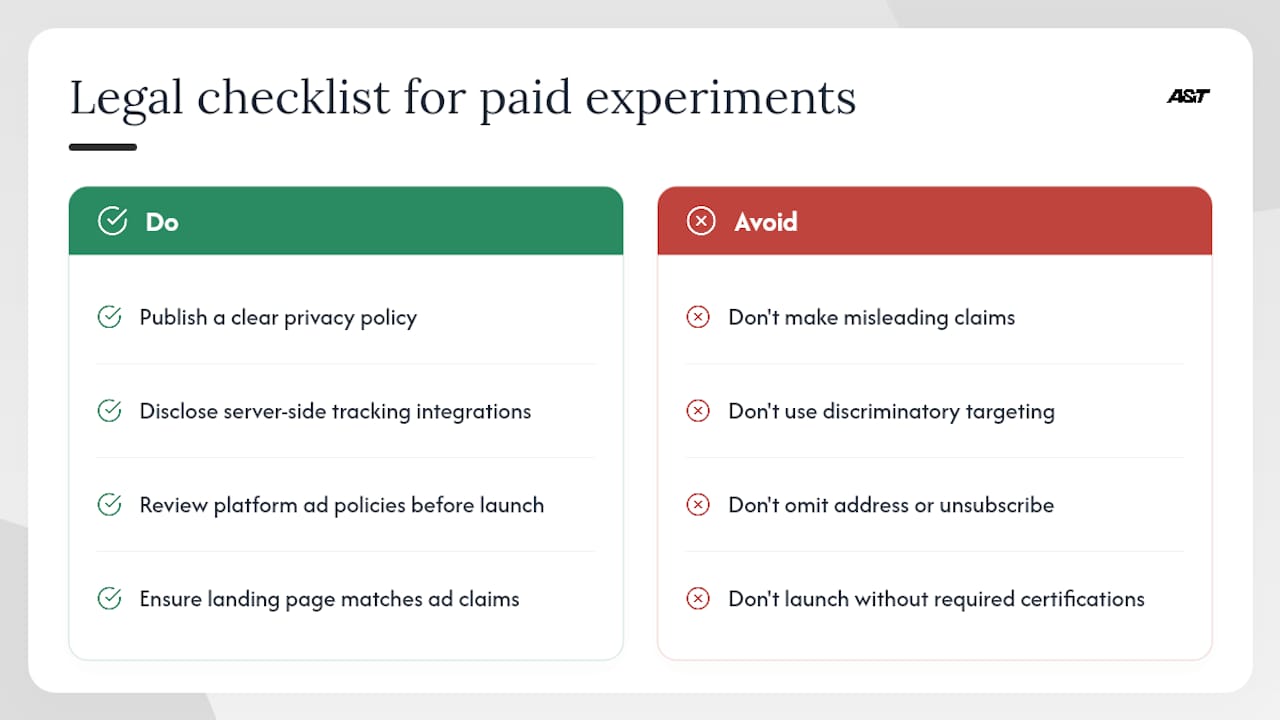
Data privacy and tracking consent. If your landing pages collect personal data — email, phone, name — you need a privacy policy that discloses how that data is used. California's CCPA applies to businesses collecting data from California residents, regardless of where your company is incorporated. If you're running Facebook Conversions API or Google's enhanced conversions, those server-side integrations must be disclosed in your privacy policy.
Ad platform policies. Google Ads and Meta both prohibit misleading claims, before-and-after imagery in certain categories (health, finance), and targeting practices that discriminate based on protected characteristics. Health and financial products face additional restrictions — telehealth advertisers on Google must complete the Google Healthcare and Medicines certification. Violating these policies mid-test gets your account suspended, which ends the experiment and potentially your entire paid program.
CAN-SPAM and lead handling. If your experiment captures email leads, every follow-up email must comply with CAN-SPAM: a physical address, an unsubscribe mechanism, and no deceptive subject lines. This applies even to automated nurture sequences triggered by paid lead forms.
Landing page accuracy. The FTC requires that ad claims match landing page claims. If your ad says "free trial," the landing page must offer a free trial without hidden conditions. Discrepancies between ad copy and landing page content are both a compliance risk and a conversion killer.
Platform-specific restrictions. LinkedIn Ads prohibits certain targeting combinations that could enable discriminatory practices. TikTok Ads has age-gating requirements for certain product categories. Review each platform's advertising policies before launching, not after your first disapproval.
This section covers general information about US advertising compliance. Consult a qualified legal professional for advice specific to your business, product category, and state.
What founders actually get wrong about paid testing
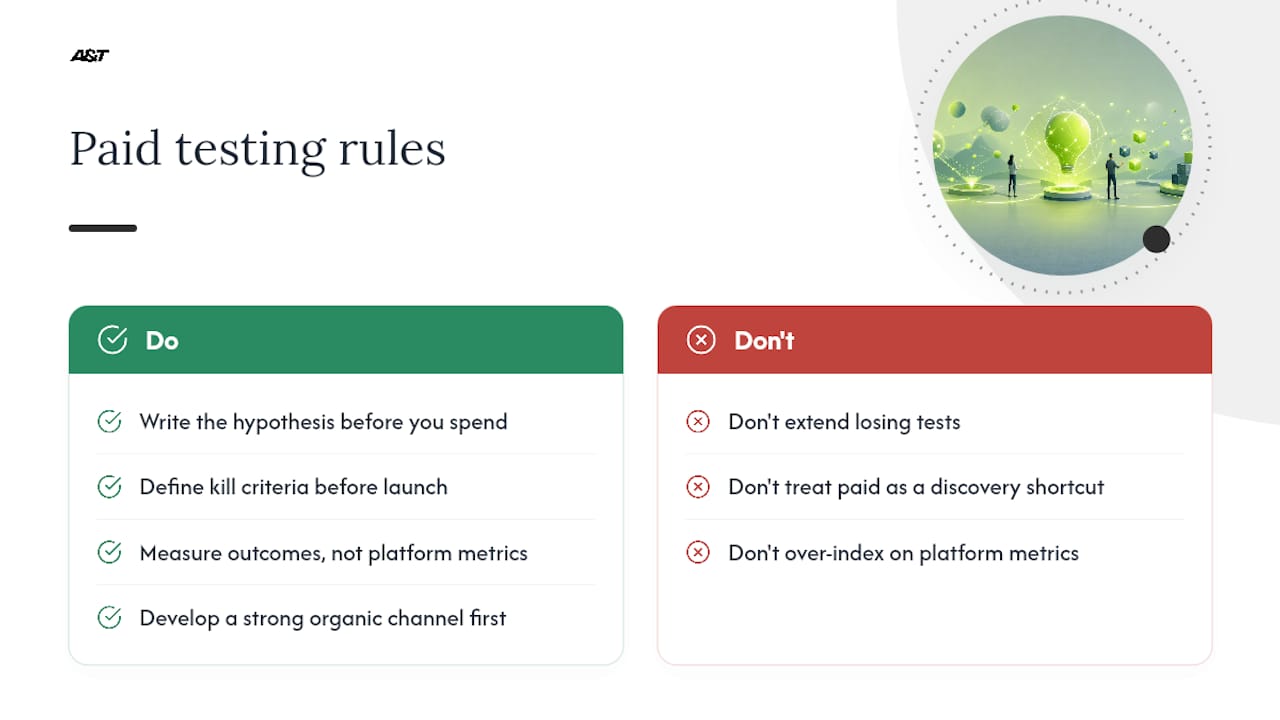
Most founders treat paid experiments as a shortcut to product-market fit. They're not. Paid is a confirmation tool, not a discovery tool. When you run a paid test before you understand why your best organic users converted, you're spending money to learn something you could have learned for free.
The discipline that separates founders who get useful data from those who burn runway is simple: write the hypothesis before you spend, define the kill criteria before you launch, and never extend a test window because you "feel like it's about to turn." Either the data says it works or it doesn't. Extending a losing test is how teams rationalize sunk costs.
There's also a tendency to over-index on platform metrics. A 4% CTR on Meta looks great until you check GA4 and see a 90% bounce rate. The click is not the outcome. The qualified lead, the activated user, the paying customer — those are the outcomes. Build your measurement stack around those, not the metrics the platform dashboard shows you first.
One more thing: develop a strong organic channel before you scale paid. Organic signals tell you which messages resonate, which ICPs convert, and which offers close. Paid then amplifies what’s already working. That sequence—organic first, paid second—is what keeps CAC manageable as you scale.
A&T agency runs paid experiments that produce real decisions, not just data
Running paid experiments well requires more than a budget and a platform login. It requires a hypothesis log, isolated test campaigns, creative cells matched to specific ICPs, proper GA4 and Conversions API setup, and a team that knows when to kill a test and when to scale it.
A&T Digital manages the full experiment program: Google Ads management, Meta Ads management, TikTok Ads, tracking and Conversions API setup, creative development, and weekly experiment reviews. Clients get a hypothesis log, dedicated test campaigns, landing pages per ICP, and a clear scale-or-kill decision at the end of every sprint. No guesswork, no wasted runway.
If you're ready to run paid experiments that produce decisions you can act on, reach out to A&T Digital and get your first experiment sprint started.
Sources
When to start paid acquisition seed 2026 (and which channel) | Causo Hub
How to Run SaaS Demand Generation Experiments Across Channels... | ProductQuant