How to Launch Google Ads for Revenue Growth
Posted on
Marketing
Posted at

Launching a Google Ads campaign can feel overwhelming when you need every dollar to deliver real results. For many American e-commerce businesses, connecting with the right shoppers is the difference between steady growth and wasted ad spend. This guide shares a practical approach for defining clear business goals, understanding your target audience, and building campaigns that drive revenue with precise targeting and measurable impact.
Table of Contents
Quick Summary
Key Insight | Explanation |
Define Business Goals First | Identify specific business objectives to guide your Google Ads strategy effectively. |
Conduct Audience Research | Gather detailed data on demographics and behaviors to create targeted marketing messages. |
Set Up Conversion Tracking | Implement precise tracking to measure your ads’ performance and effectiveness. |
Create Compelling Ad Copy | Use emotional storytelling and clear calls to action in your ads to increase engagement. |
Optimize Campaign Performance | Continuously analyze and refine ads based on performance metrics for better results. |
Define Business Goals and Target Audience
Defining your business goals and target audience is the critical first step in launching a successful Google Ads campaign that drives measurable revenue growth. This foundational work will help you create laser-focused advertising strategies that connect with the right potential customers.
To effectively define your business goals and target audience, you’ll need to conduct comprehensive research about your market and ideal customer. Detailed target audience analysis involves collecting comprehensive data about potential customers, including:
Demographic characteristics (age, gender, income level)
Geographic location
Professional occupation
Behavioral patterns and purchase history
Specific interests and motivations
Start by asking strategic questions about your business objectives. Are you seeking to:
Increase overall sales volume
Generate more qualified leads
Expand into new market segments
Improve brand awareness
Your Google Ads strategy must align directly with these specific goals. Precise targeting matters more than broad reach. By understanding exactly who your ideal customer is and what they want, you can craft advertising messages that resonate powerfully.
Strategic audience definition transforms generic advertising into precision marketing that delivers real results.
Pro tip: Use customer surveys, website analytics, and existing sales data to build a comprehensive profile of your target audience before investing in ad spend.
Here’s a quick comparison of audience definition methods and the business value they offer:
Audience Research Method | Data Gathered | Business Value |
Surveys & Interviews | Customer preferences, feedback | Direct insights for targeting |
Website Analytics | User behavior, demographics | Refines ad targeting strategies |
Sales Data Analysis | Purchase history, trends | Reveals high-value segments |
Third-Party Research Tools | Market trends, benchmarks | Supports strategic decision-making |
Set up your Google Ads account and tracking
Setting up your Google Ads account is a critical foundation for launching successful advertising campaigns that drive revenue growth. This step involves creating your account, configuring essential tracking mechanisms, and preparing the technical infrastructure for your marketing efforts.
To begin, visit the Google Ads platform and complete the account setup process by providing your business details and payment information. You’ll want to focus on several key configuration elements:
Verify your business contact information
Set up billing and payment methods
Configure your time zone and currency settings
Link your Google Analytics account for comprehensive tracking
The account setup requires careful attention to detail. Follow these numbered steps precisely:
Create your Google Ads account using your business email
Select the primary campaign goal (sales, leads, website traffic)
Configure conversion tracking pixel
Set initial budget and bidding strategy
Link Google Analytics for more in-depth performance insights
Conversion tracking is essential for measuring your campaign’s real performance. This tool allows you to understand exactly how your ads translate into tangible business results, tracking actions like purchases, sign-ups, or phone calls.
Precise tracking transforms advertising from a cost center into a revenue generation engine.
Pro tip: Install Google Tag Manager to simplify conversion tracking and reduce technical complexity across multiple marketing platforms.
Develop compelling ad creatives and copy
Creating powerful ad creatives and copy is the critical bridge between capturing audience attention and driving meaningful conversions. Your advertising messages must cut through digital noise and speak directly to your potential customers’ needs and desires.
To craft truly compelling ad content, understand narrative persuasion techniques that create emotional connections with your target audience. Your ad copy should focus on several key strategic elements:
Address specific customer pain points
Highlight unique value propositions
Create a sense of urgency
Use clear, actionable language
Align messaging with audience expectations
When developing your ad creatives, follow these structured steps:
Write multiple headline variations
Develop concise, benefit-driven descriptions
Include strong call-to-action statements
Match ad copy to landing page messaging
Test different creative approaches
Emotional resonance drives advertising effectiveness. Your ads must tell a story that subtly influences viewers without feeling overtly manipulative. Every word should serve a strategic purpose - connecting with potential customers and motivating them to take action.
Compelling advertising transforms product features into meaningful customer experiences.
Pro tip: Rotate ad variations frequently and use A/B testing to continuously optimize your creative performance and engagement rates.

Build and configure your campaign structure
Building a robust Google Ads campaign structure is the strategic foundation that determines your advertising success. Your campaign architecture will directly impact how efficiently you can target audiences, manage budgets, and optimize performance.
Campaign structure fundamentals require careful planning and systematic organization. Your campaign setup should align with your specific business objectives and create a logical framework for targeting and tracking. Consider these critical configuration elements:
Organize campaigns around distinct marketing goals
Create tightly themed ad groups
Select precise, relevant keywords
Implement strategic targeting options
Establish clear budget allocations
Follow these structured steps to build your campaign effectively:
Select your primary campaign type (search, display, video)
Define campaign-level settings and objectives
Create granular ad groups with specific themes
Develop keyword strategies for each ad group
Configure audience targeting parameters
Precise campaign configuration drives marketing performance. Each layer of your campaign structure should provide clarity, flexibility, and measurability. Think of your campaign like an architectural blueprint - every element must serve a strategic purpose and connect seamlessly.
A well-structured campaign is your roadmap to predictable, scalable advertising success.
Pro tip: Start with a narrow, focused campaign structure and gradually expand as you gain performance insights and data.
Launch campaigns and monitor performance
Launching your Google Ads campaigns marks the transition from strategic planning to active performance marketing. This critical stage transforms your carefully crafted strategy into real-world advertising execution that drives revenue growth.
Campaign performance tracking requires consistent monitoring and strategic analysis. Your ongoing assessment will determine the effectiveness of your advertising investment and guide necessary optimizations. Focus on these key performance metrics:
Click-through rates (CTR)
Conversion rates
Cost per acquisition
Return on ad spend (ROAS)
Quality score
Implement a systematic monitoring approach with these steps:
Set up conversion tracking
Connect Google Analytics
Review performance daily
Analyze key performance indicators
Make data-driven adjustments
Regular performance analysis determines advertising success. Your campaigns are living systems that require constant attention and refinement. Small, incremental improvements can dramatically enhance your overall marketing effectiveness.
Data transforms advertising from guesswork into a precise, measurable science.
Pro tip: Create automated reporting and schedule weekly performance reviews to maintain consistent campaign optimization.
Review this summary of key ad performance metrics and their significance:
Performance Metric | Measures | Why It Matters |
Click-Through Rate | Ad engagement | Indicates audience relevance |
Conversion Rate | Completed goals per ad click | Shows campaign effectiveness |
Cost Per Acquisition | Average spend to get a customer | Reflects marketing efficiency |
Return on Ad Spend | Revenue generated from ads | Assess campaign profitability |
Quality Score | Ad & landing page quality | Influences ad placement and costs |
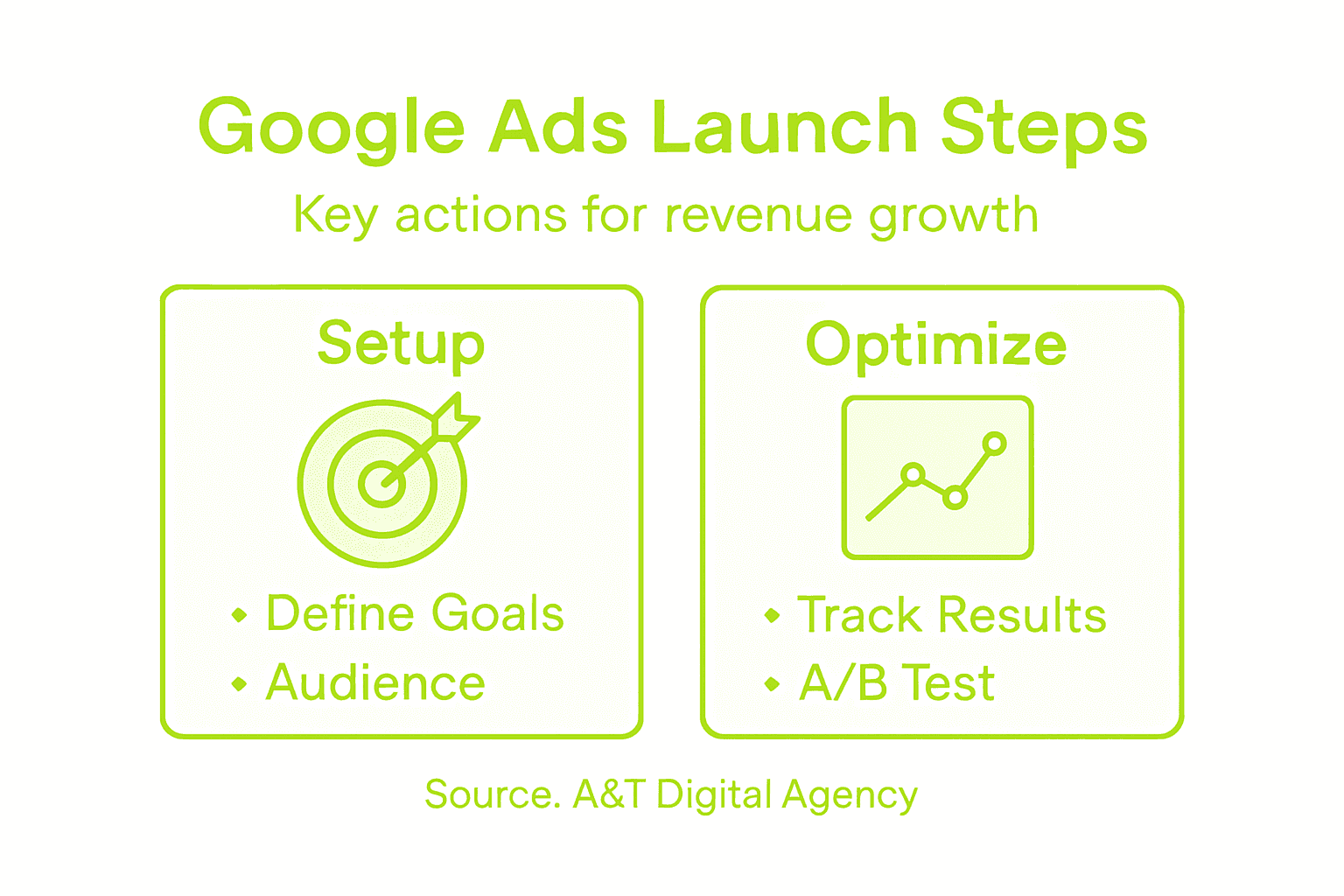
Optimize campaigns for higher conversions
Converting your Google Ads traffic into tangible business results requires strategic, data-driven optimization techniques. Your goal is to transform potential customer interest into measurable revenue growth.
Conversion rate optimization demands continuous testing and refinement of your advertising approach. Successful optimization involves systematic analysis and targeted improvements across multiple campaign dimensions. Consider these critical optimization strategies:
Conduct rigorous A/B testing
Improve landing page experience
Refine audience targeting
Adjust bidding strategies
Enhance ad copy relevance
Implement these structured optimization steps:
Analyze current conversion performance
Identify underperforming ad elements
Develop a hypothesis for improvement
Create experimental variations
Measure and validate results
Precision targeting drives conversion efficiency. Each optimization represents an opportunity to reduce wasted ad spend and increase meaningful customer interactions. Think of campaign optimization as surgical refinement - small, calculated adjustments can yield substantial performance improvements.
Intelligent optimization transforms advertising from an expense into a predictable revenue generation system.
Pro tip: Use heat mapping and user behavior tracking tools to gain more in-depth insights into how visitors interact with your landing pages and ads.
Maximize Your Revenue Growth with Expert Google Ads Support
Launching Google Ads campaigns that truly drive revenue growth requires more than just setting up ads. The article highlights key challenges such as defining precise target audiences, creating compelling ad copy that addresses customer pain points, and continuously optimizing campaigns with data-driven analysis. Many businesses struggle with tracking conversions accurately and building a well-structured campaign that aligns with their specific business goals. If you want to avoid wasting ad spend and ensure every dollar contributes to measurable growth, strategic support is crucial.
At A&T Digital Agency, we specialize in performance marketing tailored to your unique needs. Our boutique team combines strategic insight with creative development, managing everything from campaign planning to launch and ongoing optimization. We prioritize precision in targeting, creative messaging, and thorough tracking to maximize your return on ad spend. Discover how our proven approach has helped brands across telehealth, retail, and entertainment sectors achieve significant revenue growth. Explore our full range of performance marketing services and learn how to build scalable paid advertising systems without the hassle.
Ready to turn your Google Ads campaigns into reliable revenue drivers? Contact A&T Digital Agency today to start a strategic partnership that delivers measurable results. Visit us now at https://atdigiagency.com, and let’s build your growth together.
Frequently Asked Questions
How do I define my business goals for launching Google Ads?
To define your business goals, start by identifying what you want to achieve, such as increasing sales volume or generating more leads. Focus on specific objectives—set measurable targets to track success over time, aiming to refine them within the first 30 days of your campaign.
What should I consider when identifying my target audience for Google Ads?
When identifying your target audience, gather data on demographics, geographic location, behavior patterns, and interests. Create a detailed profile of potential customers to tailor your ad content and messaging, focusing on refining this profile before launching any ads.
How can I set up tracking for my Google Ads campaigns?
To set up tracking for your Google Ads campaigns, ensure you install a conversion tracking pixel and link your Google Analytics account. This will allow you to monitor key performance metrics, enhancing tracking accuracy from the moment you launch your ads.
What type of ad creatives should I develop for maximum conversion?
Develop ad creatives that address specific customer pain points and highlight your unique value propositions. Use clear, actionable language and include strong calls to action to engage potential customers effectively, testing different variations to see what works best.
How often should I monitor my Google Ads performance?
Monitor your Google Ads performance daily to analyze key metrics such as click-through rates and conversion rates. Set a schedule for weekly performance reviews to make data-driven adjustments and optimize your campaign for better results over time.
What are effective strategies for optimizing my Google Ads campaigns?
Effective strategies for optimizing your Google Ads campaigns include conducting A/B testing, refining audience targeting, and improving your landing page experience. Implement these changes iteratively, aiming for noticeable performance improvements within a few weeks.


