What Is Campaign Frequency in Digital Ads?
Posted on
Marketing
Posted at

Campaign frequency measures how many times a unique user sees an ad during a campaign, calculated by dividing total impressions by unique reach. Maintaining optimal frequency balances brand recall and ad fatigue, with thresholds varying by audience stage; exceeding them reduces performance. Strategic creative refreshes based on data, not schedules, help maximize ad effectiveness and prevent audience burnout.
Campaign frequency is the average number of times a unique user sees your ad during a campaign, calculated as total impressions divided by unique reach. This metric sits at the center of every paid advertising decision you make on platforms like Meta Ads and Google Ads. Get it right and you build brand recall, drive conversions, and spend your budget efficiently. Get it wrong and you either disappear from memory or burn out your audience before they ever buy. Understanding what is campaign frequency, and how to act on it, separates campaigns that scale from campaigns that stall.
What is campaign frequency and how is it calculated?
Campaign frequency is defined as total impressions divided by unique users reached. If your campaign delivers 10,000 impressions to 2,000 unique users, your frequency is 5. That number tells you each person saw your ad five times on average during the campaign window.
The formula is simple. The interpretation is not.
Frequency is not the same as impression share, and confusing the two is one of the most common mistakes in paid media. Impression share measures how much of the available ad inventory you are capturing. Frequency measures how often your ad hits the same person. A campaign can have low impression share but high frequency if it repeatedly reaches a small audience while ignoring everyone else. That scenario wastes budget and saturates a narrow segment.
Here is a quick breakdown of the key metrics and how they differ:
Metric | What It Measures | Primary Use |
|---|---|---|
Frequency | Average ad exposures per unique user | Audience saturation and recall |
Reach | Total unique users exposed to the ad | Audience size and coverage |
Impression Share | Your impressions vs. total available | Competitive inventory capture |
Recency | Time since last ad exposure | Timing and re-engagement |
Two more points worth knowing. First, frequency is an average. Some users in your audience see your ad ten times while others see it once. Second, campaign design directly shapes this metric. Narrow targeting, small budgets, and short flight windows all push frequency up, sometimes before you realize it.
Pro Tip: Set frequency caps at the ad set level in Meta Ads before launch, not after you notice performance dropping. Reactive frequency management always costs more than proactive setup.
What is the impact of campaign frequency on ad performance?
Frequency is not a vanity metric. It directly influences conversion and brand familiarity, and the relationship between frequency and performance follows a curve, not a straight line.

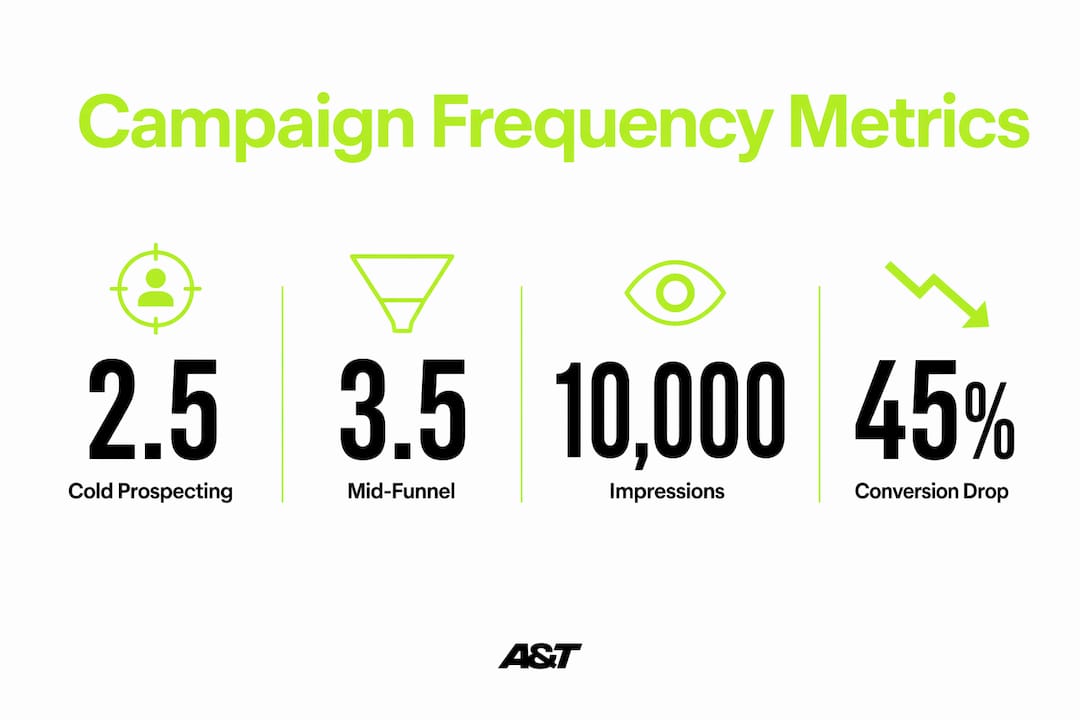
Too little frequency and your ad never registers. A user who sees your brand once in a crowded feed forgets it within hours. Brand recall requires repetition. Too much frequency and you trigger the opposite problem: banner blindness, irritation, and active avoidance. Meta analytics show that conversion likelihood drops by approximately 45% after four repeated ad exposures to cold audiences. That is not a gradual decline. It is a cliff.
The concept that defines the sweet spot is effective frequency. Effective frequency is the number of exposures needed to produce a desired response, without crossing into overexposure. The threshold varies by funnel stage, channel, and how warm your audience is.
"Frequency is the bridge between reach and conversion. Too little and you are invisible. Too much and you become noise." — mediaplacementservices.com
Here is how frequency affects behavior at each extreme:
Too low (under 2 exposures per week): Poor brand recall, weak click-through rates, low conversion volume
Optimal range: Builds familiarity, increases purchase intent, improves cost per acquisition
Too high (above 4–5 for cold audiences): Ad fatigue, rising cost per click, falling conversion rates, negative brand sentiment
The channel matters too. Search ads on Google rely on user intent rather than repeated exposure, so frequency control is less critical there. Display, social, and video ads depend heavily on managed repetition to move users through the funnel.
How to find the optimal campaign frequency for your goals
The right frequency depends on where your audience sits in the funnel. There is no single number that works for every campaign. What works for a cold prospecting campaign on Meta will oversaturate a retargeting audience in days.
Campaigns balancing reach, frequency, and recency deliver higher brand recall, better click-through rates, and lower cost per acquisition than campaigns that ignore any one of these three variables. Treat them as a system, not separate dials.
Here are the benchmarks that matter most in practice:
Funnel Stage | Recommended Weekly Frequency | Primary Goal |
|---|---|---|
Cold Prospecting | 3–5 exposures | Awareness and brand recall |
Mid-Funnel | Up to 3.5 (Meta threshold) | Consideration and engagement |
Retargeting / Warm Audiences | 2–3 exposures | Conversion and purchase |
Meta Ads specifically recommends 7-day frequency thresholds of 2.5 for cold prospecting and 3.5 for mid-funnel audiences. Crossing those thresholds is a direct signal to refresh your creative, not to pause the campaign.
Performance signals tell you more than any benchmark. Watch your CTR and conversion rate (CVR) daily. When CTR drops more than 20% from its peak and frequency is climbing, your creative is fatiguing. That is the moment to rotate, not the moment to wait for a scheduled review.
Pro Tip: Do not rotate creatives on a calendar schedule. Data-driven creative refresh based on frequency thresholds and CTR drops preserves winning ads longer and prevents you from killing a high-performer too early.
For Meta Ads strategy, the practical rule is this: broad audiences need more frequency to build recall; warm audiences need less frequency but more precise messaging. Adjust your targeting width and budget pacing together to keep frequency in range.
How often should you run campaigns and refresh creatives?
Managing how often to run campaigns is as much about pacing as it is about frequency caps. The two work together. A campaign running on a compressed timeline with a small audience will hit damaging frequency levels in days. Spreading the same budget over a longer flight window lowers frequency and extends reach.
Here is a practical framework for creative refresh timing by funnel stage:
Cold prospecting: Monitor frequency daily. Refresh creative when the 7-day frequency crosses 2.5 or when CTR drops more than 15–20% from the campaign's peak.
Mid-funnel: Refresh when frequency exceeds 3.5 over 7 days or when engagement metrics (video views, link clicks) show a consistent week-over-week decline.
Retargeting: Refresh every 2–3 weeks regardless of frequency, because warm audiences exhaust creative novelty faster than cold ones.
Email campaigns: For context, e-commerce email marketing research shows that sending 1–3 campaign emails per week maintains unsubscribe rates below 0.3%. The same principle applies to paid ads: consistent, measured exposure beats sporadic bursts.
The risk of calendar-based refresh is real. Approximately 4–5% of creative assets qualify as true winners. Rotating them out on a fixed schedule because "it's been two weeks" kills performance unnecessarily. Let data make that call.
Budget pacing also controls frequency. Daily budget caps spread impressions evenly across a campaign window. Accelerated delivery front-loads impressions, which spikes frequency early and leaves little room for the algorithm to find new users. Standard pacing is the default choice for frequency management on both Meta and Google Ads.
Pro Tip: Use ad management platforms that give you frequency breakdowns by audience segment, not just campaign-level averages. Segment-level data reveals which specific audiences are oversaturated while others remain underexposed.
Key takeaways
Optimal campaign frequency requires balancing reach, repetition, and creative freshness across every funnel stage to maximize ROI without burning out your audience.
Point | Details |
|---|---|
Core formula | Frequency equals total impressions divided by unique reach; a result of 5 means each user saw the ad five times. |
Frequency vs. impression share | These are different metrics; high frequency with low impression share means you are saturating a small audience. |
Performance cliff | Conversion likelihood drops approximately 45% after four exposures for cold audiences on Meta. |
Channel benchmarks | Cold prospecting performs best at 3–5 weekly exposures; retargeting works at 2–3 exposures per week. |
Data-driven refresh | Rotate creatives when frequency crosses platform thresholds or CTR drops, not on a fixed calendar schedule. |
Frequency is a strategy, not just a setting
I have reviewed hundreds of paid ad accounts over the years, and the pattern is always the same. Businesses that struggle with frequency are not struggling because they lack data. They are struggling because they treat frequency as a technical setting rather than a strategic decision.
The most common mistake I see is launching multiple simultaneous campaigns to different audience segments, each with its own creative, its own message, and its own goal. The intent is to cover more ground. The result is audience confusion and fragmented frequency that serves none of the campaigns well. Consistent, repeated exposure builds the mental availability that drives brand growth. Scattered messaging does the opposite.
My honest advice: run fewer campaigns with tighter focus and longer flight windows. Let frequency build deliberately. Watch the signals. Refresh the creative when the data tells you to, not when you get bored with the ad. The campaigns that scale are the ones where someone is paying close attention to these numbers every week, not just at the end of the month.
— Ann
How A&T agency manages campaign frequency for real results
Frequency management is one of the highest-leverage activities in paid advertising, and it is also one of the most time-consuming to do well. A&T Digital's performance marketing team handles Meta Ads and Google Ads campaigns with a data-first approach to frequency, creative rotation, and audience segmentation. We monitor frequency thresholds, CTR trends, and CVR signals weekly so your budget reaches new users instead of exhausting the same ones. If your campaigns are showing signs of ad fatigue or wasted spend, explore our Meta Ads management services to see how we build and scale paid ad systems that convert.
FAQ
What does campaign frequency mean in digital advertising?
Campaign frequency is the average number of times a unique user sees your ad during a set period. It is calculated by dividing total impressions by unique reach.
What is the optimal campaign frequency for meta ads?
Meta recommends a 7-day frequency of 2.5 for cold prospecting audiences and 3.5 for mid-funnel audiences before triggering a creative refresh.
How does high campaign frequency hurt ad performance?
Conversion likelihood drops by approximately 45% after four repeated exposures for cold audiences, according to Meta analytics. High frequency causes ad fatigue, rising CPCs, and falling conversion rates.
How is campaign frequency different from impression share?
Frequency tracks how often the same user sees your ad. Impression share measures what percentage of available ad inventory your campaign is capturing. A campaign can have high frequency and low impression share simultaneously.
How often should you refresh ad creatives to control frequency?
Refresh creatives when frequency crosses platform thresholds (2.5 for cold audiences on Meta) or when CTR drops more than 15–20% from peak performance, rather than on a fixed calendar schedule.