Demystifying Meta Ads: Strategies for High ROI
Posted on
Marketing
Posted at

Most American marketers struggle to achieve consistent results with Meta Ads, despite the platform's advanced targeting options. Precision audience segmentation on Facebook and Instagram can be difficult to master, risking missed revenue opportunities for digital marketing managers in e-commerce and healthcare brands worldwide. Drawing on proven strategies, this guide shows you how granular targeting and creative optimization drive higher conversion rates and minimize wasted ad spend.
Table of Contents
Key Takeaways
Point | Details |
|---|---|
Precision Targeting | Utilize Meta Ads' advanced targeting capabilities for detailed audience segmentation to maximize ad relevance. |
Campaign Types | Select appropriate campaign types like Awareness, Traffic, or Lead Generation based on your specific marketing objectives. |
Optimization Strategy | Implement A/B testing and robust tracking to refine ad components and ensure high ROI through continuous improvement. |
Common Pitfalls | Avoid broad targeting and static strategies by focusing on specific audience segments and adapting your approach based on performance data. |
Meta Ads Explained for Digital Marketers
Meta Ads represent a sophisticated digital marketing approach that leverages user data across Facebook and Instagram platforms to deliver precision-targeted advertising. These ads allow digital marketers to connect with potential customers through highly granular audience segmentation and advanced targeting capabilities.
Understanding Meta's advertising ecosystem requires recognizing its core components. Social network advertising enables advertisers to reach specific audiences by utilizing detailed demographic, behavioral, and interest-based targeting parameters. Marketers can design campaigns that precisely match user profiles, ensuring maximum relevance and engagement potential. This means you can target professionals in specific industries, individuals with particular interests, or consumers exhibiting specific online behaviors.
The Meta Ads platform provides multiple campaign objectives designed to support different marketing goals. Digital marketers can select objectives ranging from brand awareness and reach to lead generation and direct conversions. Key targeting options include age, location, interests, behaviors, connections, and custom audience segments. Sophisticated targeting allows businesses to minimize wasted ad spend by focusing exclusively on the most promising potential customers.
Pro tip: Always start with a small budget and conduct rigorous A/B testing to understand which audience segments and ad creatives generate the most cost-effective results.
Types of Meta Ad Campaigns and Their Uses
Meta Ads offer digital marketers a comprehensive suite of campaign types designed to meet diverse business objectives. Meta Ads campaigns follow a strategic three-tiered structure that allows precise targeting and goal-specific optimization across Facebook and Instagram platforms.
The primary campaign types include Awareness, Traffic, Engagement, Lead Generation, and Conversion campaigns. Awareness campaigns focus on building brand recognition by maximizing visibility among potential customers. Traffic campaigns drive users to websites or specific landing pages, while Engagement campaigns aim to increase interactions through likes, comments, and shares. Lead Generation campaigns capture potential customer information, and Conversion campaigns directly target sales and specific action completions.
Each campaign type requires a tailored approach. Awareness campaigns work best with visually compelling content that introduces your brand. Traffic campaigns demand clear, clickable messaging and attractive visuals. Engagement campaigns benefit from interactive content that encourages user participation. Lead Generation campaigns need compelling offers and streamlined information collection processes, and Conversion campaigns require strong calls-to-action and persuasive value propositions.
Here's a comparative overview of Meta Ad campaign types and their ideal use cases:
Campaign Type | Primary Goal | Recommended Content Style | Typical Measurement Metric |
|---|---|---|---|
Awareness | Build brand recognition | Eye-catching visuals, brand focus | Impressions, reach |
Traffic | Drive website visits | Clear links, high-conversion images | Click-through rate |
Engagement | Increase interaction | Interactive posts, polls, contests | Comments, shares, likes |
Lead Generation | Collect customer contacts | Optimized forms, incentive offers | Leads captured |
Conversion | Boost direct sales/actions | Strong CTA, persuasive proposition | Conversions, sales |
Pro tip: Select campaign objectives that align precisely with your specific marketing goals, and continuously monitor performance metrics to refine your targeting strategy.
Core Features That Drive Campaign Success
Successful Meta Ads campaigns require a strategic approach to crafting compelling visual and textual elements. Meta Ads consist of five essential components that directly impact campaign performance: primary text, creative visuals, headline, description, and call-to-action button. Understanding how these elements work together is crucial for digital marketers seeking maximum engagement and conversion rates.
The creative component represents the most critical aspect of ad performance, contributing 60-80% of overall campaign success. High-quality images and videos that capture user attention quickly are paramount. Primary text must be concise and compelling, communicating the core value proposition within limited character constraints. Headlines should be clear and provocative, while descriptions provide additional context that entices potential customers to take action.

Optimizing these components requires careful consideration of placement across different Meta platforms. Ads must be designed to perform effectively in News Feeds, Stories, and Reels, ensuring visual consistency and messaging clarity. This means creating adaptable creative assets that maintain their impact regardless of screen size or platform-specific viewing conditions. Marketers must also align their ad components with specific campaign objectives, whether that involves brand awareness, lead generation, or direct conversions.
Use this summary to guide your Meta Ads component optimization strategy:
Component | Key Function | Business Impact |
|---|---|---|
Primary Text | Intro offer/message | Drives initial engagement |
Creative Visuals | Showcase brand or product | Influences attention and recall |
Headline | Communicate main value | Enhances click-through rate |
Description | Add supporting details | Increases clarity and persuasion |
Call-to-Action | Direct user action | Converts browsers into customers |
Pro tip: Develop multiple ad variations and systematically test different creative elements to identify the most effective combinations for your target audience.
Optimizing Meta Ads for Maximum ROI
Successful digital marketing demands a strategic approach to Meta Ads that goes beyond basic targeting. Optimizing Meta Ads requires precise goal alignment with specific business objectives, ensuring every advertising dollar contributes meaningfully to overall revenue generation. Understanding the nuanced relationship between campaign setup, audience targeting, and conversion tracking is crucial for achieving superior return on investment.
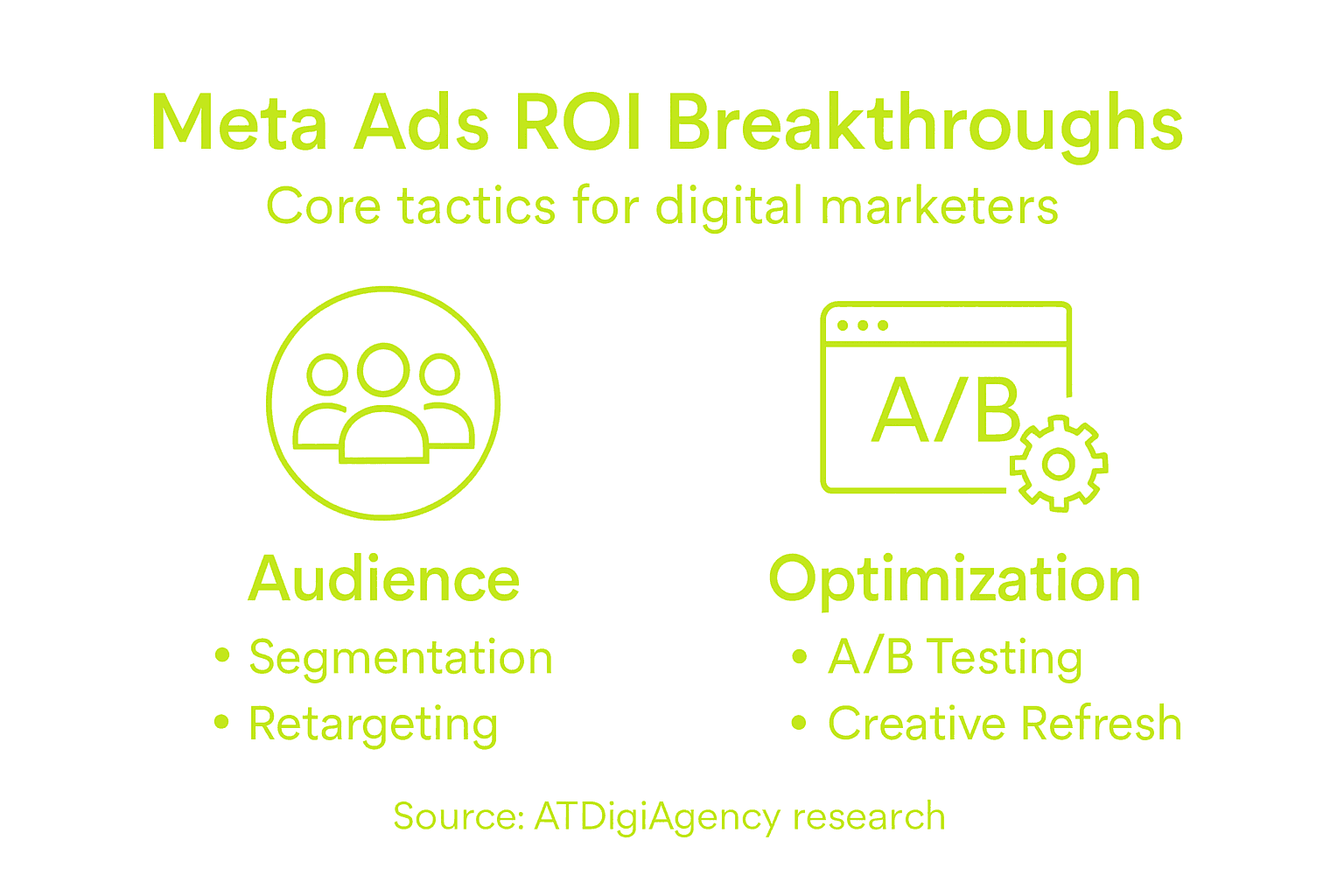
The foundation of high-performing Meta Ads lies in meticulous audience segmentation and creative optimization. Digital marketers must leverage advanced targeting options that allow granular selection based on demographics, interests, behaviors, and past interactions. This means developing multiple ad variations that speak directly to different audience segments, continuously testing and refining creative elements to improve engagement rates and conversion potential.
Tracking and measurement play a critical role in ROI optimization. Implementing robust tracking mechanisms like Meta Pixel enables marketers to move beyond surface-level metrics, diving deep into actual conversion data and understanding the true economic impact of their advertising efforts. This approach allows for dynamic budget allocation, focusing resources on the most productive audience segments and ad configurations while systematically eliminating underperforming strategies.
Pro tip: Implement a strict A/B testing protocol, allocating 20% of your ad budget to experimental variations that challenge your current best-performing campaigns.
Avoiding Common Pitfalls and Inefficiencies
Digital marketers frequently encounter obstacles that can significantly drain advertising budgets and reduce campaign effectiveness. The most critical errors stem from poorly defined targeting, generic creative assets, and inadequate performance tracking. Understanding these potential pitfalls is essential for maintaining an efficient and profitable Meta Ads strategy.
One fundamental mistake is over-relying on broad audience targeting, which leads to wasted ad spend and low conversion rates. Successful campaigns require hyper-specific audience segmentation that considers not just demographic information, but also behavioral patterns, purchase history, and precise interest alignment. This means moving beyond basic demographic filters and developing nuanced audience personas that reflect genuine customer motivations and pain points.
Another significant inefficiency arises from static ad strategies that fail to adapt to changing market conditions and audience preferences. Digital marketers must implement continuous testing and optimization protocols, systematically analyzing performance data to refine targeting, creative elements, and messaging. This dynamic approach involves regularly updating ad variations, monitoring key performance indicators, and being willing to pivot strategies quickly when data suggests underperformance.
Pro tip: Establish a quarterly performance audit that critically examines your Meta Ads campaigns, identifying and eliminating strategies that consistently fail to meet predefined ROI benchmarks.
Unlock High ROI with Expert Meta Ads Management
The challenge many digital marketers face is turning complex Meta Ads strategies into measurable revenue growth without wasting ad spend. This article highlights key pain points such as the need for precise audience targeting, continuous creative optimization, and data-driven performance tracking to avoid common inefficiencies. If you find yourself overwhelmed by broad targeting or uncertain about ad creative effectiveness, you are not alone. Successful campaigns require a bespoke approach that aligns with your unique business goals and constantly adapts based on analytics insights.
At A&T Digital, we specialize in building and scaling Meta advertising campaigns designed for maximum return on investment. Our boutique team combines strategic planning with creative execution to deliver targeted campaigns that increase conversions, generate qualified leads, and accelerate revenue growth. From A/B testing multiple ad variations to leveraging advanced audience segmentation and conversion tracking, our performance marketing services ensure every dollar you spend works harder for your business. Discover how our proven methodology can address your Meta Ads challenges and elevate your digital presence through performance marketing crafted for real results.
Ready to stop guessing and start growing through Meta Ads?
Take the next step toward smarter, more effective advertising with A&T Digital Agency. Contact us today to get a personalized campaign strategy that delivers high-impact outcomes without unnecessary meetings or wasted budgets.
Frequently Asked Questions
What are Meta Ads?
Meta Ads are precision-targeted advertisements that leverage user data across Facebook and Instagram platforms, allowing marketers to connect with specific audiences through advanced targeting capabilities.
How can I optimize my Meta Ads for better ROI?
To optimize your Meta Ads for maximum ROI, focus on precise audience segmentation, continuous A/B testing, creative optimization, and robust tracking of performance metrics to inform your strategies.
What types of campaigns can I run using Meta Ads?
You can run various campaigns with Meta Ads, including Awareness, Traffic, Engagement, Lead Generation, and Conversion campaigns, each tailored to achieve specific marketing goals.
What are the common mistakes to avoid when running Meta Ads?
Common mistakes include broad audience targeting, using generic creative assets, and failing to implement adequate performance tracking. It's essential to adopt a hyper-specific targeting approach and continuously optimize your campaigns.