Event Retargeting Strategy Guide for SMEs in 2026
Posted on
Marketing
Posted at

Event retargeting focuses on engaging users who interacted with your event but did not complete registration or purchase. It relies on first-party data, platform setup, and stage-specific creative strategies to maximize conversions in a privacy-conscious environment. Proper technical implementation with CAPI and audience segmentation is essential for effective, measurable campaigns.
Event retargeting is the practice of targeting users who interacted with your event's digital touchpoints but never completed a key action like registration or ticket purchase. This event retargeting strategy guide covers everything you need to build campaigns that actually convert: audience segmentation, platform setup, creative management, and measurement. The stakes are real. Post-iOS privacy changes mean the old pixel-only approach no longer cuts it, and marketers who ignore first-party data are leaving registrations on the table. Whether you're promoting a conference, product launch, or community event, this guide gives you the exact framework to close the gap between interest and conversion.
What is an event retargeting strategy and why does it matter?
Event retargeting strategy is a conversion-focused discipline, not a brand awareness play. Aligning retargeting to the next funnel action increases campaign effectiveness far more than broad, generic targeting. That means someone who visited your registration page but didn't sign up should see a different ad than someone who added a ticket to their cart and abandoned it.
The business case is straightforward. First-party audiences built from opted-in emails and site behavior convert approximately three times higher than cold audiences. That gap exists because retargeted users already know your event exists. They need a reason to act, not an introduction.
Tools like the Meta Pixel, Meta Conversions API (CAPI), Google Tag Manager, and email retargeting platforms form the technical backbone of any modern event retargeting program. Each serves a distinct role. The pixel captures browser-level behavior. CAPI captures server-side signals. Email retargeting reaches opted-in contacts directly. Together, they create a multi-signal view of your audience that no single tool can replicate alone.
How to define goals and segment your audience
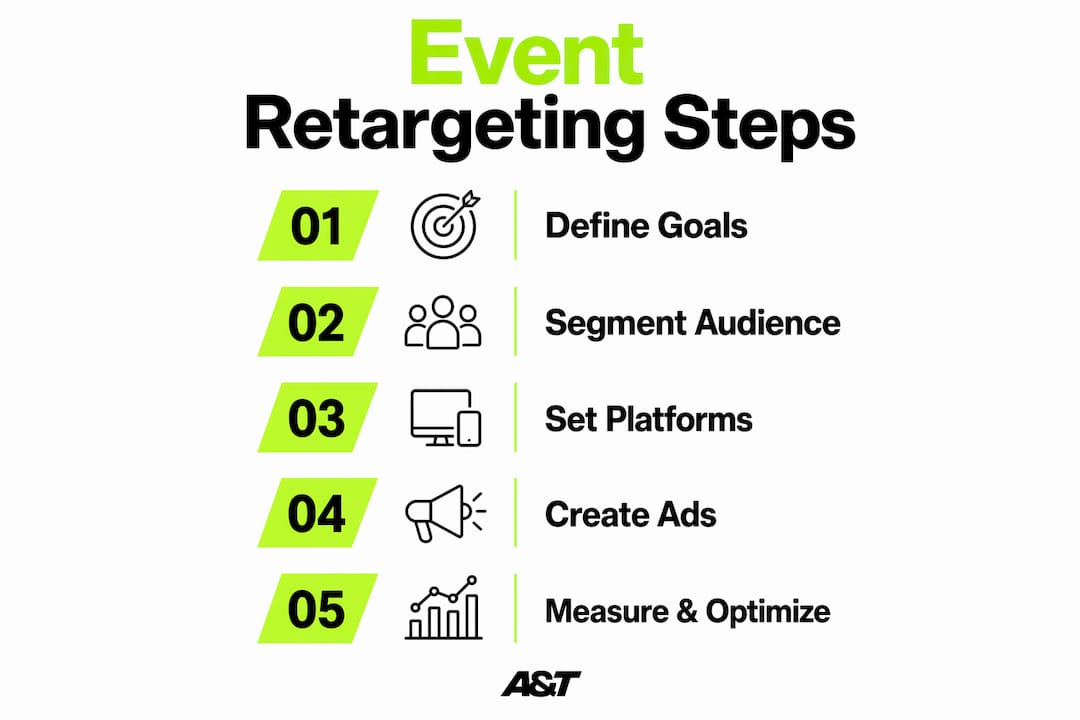
Clear goals determine everything downstream: which audiences you build, which platforms you use, and how you measure success. Before you place a single pixel, define your primary objective.
Common event retargeting goals include:
Increase registrations by targeting site visitors who viewed the event page but didn't sign up
Reduce no-shows by retargeting registered attendees with reminder sequences and logistics content
Attract sponsors by reaching decision-makers who visited your sponsorship page
Drive ticket upgrades by targeting general admission purchasers with VIP offers
Once goals are set, segment your audience by behavior. Site visitors who spent more than 60 seconds on your event page are warmer than someone who bounced in five seconds. Cart abandoners are warmer still. Past attendees from previous events represent your highest-intent segment because they have already converted once.
First-party data is the backbone of this segmentation. Your CRM, email list, and event platform data are assets that no privacy update can take away. Post-iOS privacy changes mean roughly 75% of iOS users opt out of cross-app tracking, which degrades pixel-only audiences significantly. Building segments from opted-in email lists and server-side data protects your campaign from that signal loss.

Pro Tip: Use your event registration platform's export feature to create a "past attendee" custom audience in Meta and Google. Upload it as a customer list and use it as both a retargeting segment and a lookalike seed audience for prospecting.
Pair your segmentation with smart audience targeting strategies that apply exclusion logic from the start. Excluding current registrants from your registration-push campaigns prevents wasted spend and keeps your frequency data clean.
What platforms and technical setup work best in 2026?
Platform selection follows audience behavior. Meta (Facebook and Instagram) remains the strongest channel for event retargeting because of its granular custom audience tools and broad reach across age groups. Google Display and YouTube work well for visual event promotion and reminder campaigns. Email retargeting through platforms like Klaviyo or Mailchimp handles opted-in contacts directly and carries no pixel dependency.
The technical setup is where most SME campaigns fall short. The table below shows the core components and their function:
Component | Function | Priority |
|---|---|---|
Meta Pixel | Browser-level event tracking | Required |
Meta Conversions API | Server-side signal capture | Required |
event_id deduplication | Prevents double-counting conversions | Required |
Google Tag Manager | Centralized tag deployment | Recommended |
30-day recency window | Maintains audience delivery thresholds | Recommended |
Implementing Meta CAPI alongside the browser pixel can increase event match rate from roughly 45% to 75-85%. That improvement directly expands your retargeting audience quality and gives Meta's algorithm better signals to optimize against.
Deduplicating pixel and CAPI eventsvia a consistent event_id is non-negotiable. Without it, Meta counts the same conversion twice, which corrupts your ROAS data and causes the algorithm to under-optimize. Pass the same event_id from both the browser and server for every tracked action.
Recency windows deserve careful thought. Short windows like 3-day or 7-day audiences sound precise, but low pixel fire volumes cause under-delivery because Meta requires a minimum estimated audience of roughly 1,000 users to serve ads. For most SME events, a consolidated 30-day window delivers more stable campaigns without sacrificing relevance.
Pro Tip: If your event registration page gets fewer than 500 visits per week, skip the 7-day window entirely. Build a 30-day ViewContent audience and layer behavioral filters inside the ad set instead.
How to create ads that convert at every funnel stage
Ad creative is where retargeting either earns its budget or burns it. The mistake most SME marketers make is running the same creative to every retargeting segment. A cart abandoner and a first-time page visitor are in completely different mental states. Your ads need to reflect that.
Match creative to funnel stage:
Awareness retargeting (page visitors): Use event highlight reels, speaker announcements, or social proof from past editions. The goal is reinforcing credibility and building urgency.
Consideration retargeting (cart abandoners, form starters): Lead with a specific objection handler. Address price, timing, or relevance directly. A testimonial from a past attendee works well here.
Conversion retargeting (high-intent visitors): Use a direct offer. Early-bird pricing, a limited seat count, or a bonus for registering today. Pair this with a clear, conversion-focused CTA that matches the landing page headline exactly.
Retargeting performs bestwhen ad messaging and landing page copy are synchronized. If your ad says "Only 12 seats left," your landing page needs to say the same thing. Inconsistency between ad and page kills conversion rates.
Rotate creatives on a 7 to 14 day cadence. Creative rotation every 7-10 days prevents ad fatigue and protects your brand from the negative associations that come with overexposure. Use an ad rotation strategy that schedules new creative versions before frequency scores spike.
Frequency caps protect your budget and your audience relationship. The table below shows recommended limits by channel:
Channel | Recommended frequency cap | Risk if exceeded |
|---|---|---|
Meta / Instagram | 2-3 impressions per week | Ad fatigue, negative feedback |
Google Display | 3 impressions per day | Banner blindness, wasted spend |
YouTube | 2-3 impressions per week | Skip rate increase, brand damage |
CTV | 2-3 impressions per week | Audience annoyance, low completion |
Frequency caps and exclusion lists are critical to avoid wasting budget. Add converted users to an exclusion list the moment they register. Add accidental clickers who spent less than 10 seconds on your page. These two exclusions alone can cut wasted impressions by 20 to 30 percent on a typical SME campaign.
Pro Tip: Create a "converted" custom audience in Meta and Google and exclude it from every active retargeting ad set. Refresh this list weekly. Serving ads to people who already registered is one of the most common and costly mistakes in event retargeting.
How to measure and optimize your event retargeting campaigns
Measurement without a clear framework produces noise, not insight. Set conversion-focused KPIs before your campaign launches, not after.
Cost per registration (CPR): The primary metric for event sign-up campaigns. Track it by audience segment to identify which groups convert most efficiently.
Return on ad spend (ROAS): Relevant for ticketed events with a defined revenue value per ticket. Calculate it at the campaign and ad set level.
Frequency score: Monitor this weekly. A frequency above 4 on Meta within a 7-day window is a warning sign that your audience is too small or your budget is too high for the segment.
Audience overlap rate: High overlap between segments means you're competing against yourself. Use Meta's Audience Overlap tool to diagnose this before launch.
Landing page conversion rate: If your ads are getting clicks but registrations are low, the problem is the page, not the ad. Separate ad performance from page performance in your reporting.
A/B testing is the fastest way to improve results. Test one variable at a time: headline versus headline, image versus video, or offer versus no offer. Run tests for at least seven days before drawing conclusions, and make sure each variant has enough impressions to be statistically meaningful.
Common pitfalls that kill event retargeting campaigns include pixel misconfiguration (especially missing CAPI setup), running too many small audience segments that all fall below delivery thresholds, and failing to update creative after the first week. Timing also matters. Retargeting intensity should increase in the two weeks before your event and taper off three days before to avoid annoying people who are already committed.
Adjust budgets based on what the data shows, not what feels right. If your cart abandoner segment has a CPR 40% lower than your general page visitor segment, shift budget toward it. Let performance data drive allocation, not assumptions.
Why privacy first retargeting is the only retargeting that works now
The shift to privacy-first data collection is not a future concern. It's the current operating environment, and most SME marketers are still running campaigns built for 2020.
Working with event clients across entertainment venues, health and wellness, and retail, the pattern is consistent: teams that invested in CAPI setup and first-party data collection in 2024 and 2025 are now running retargeting campaigns with audience match rates above 75%. Teams that didn't are dealing with shrinking audiences, inflated CPRs, and attribution gaps they can't explain.
The uncomfortable truth about event retargeting is that technical setup is now a marketing skill. You can't outsource signal quality to your pixel alone. Server-side tracking, event_id deduplication, and first-party data hygiene are table stakes. Without them, your creative and segmentation work on top of a broken foundation.
Multi-channel retargeting with email integration is the approach that consistently outperforms single-channel campaigns. Email sequences that mirror your paid ad messaging create a reinforcement effect. Someone who sees your Meta ad and then receives a personalized email reminder is far more likely to register than someone who only sees the ad. The retargeting strategies that boost ROI in 2026 are the ones that treat paid and owned channels as a single system.
Balance frequency and personalization. More impressions do not equal more conversions. The right message at the right moment to the right segment is what drives registrations. That requires discipline, not volume.
— Ann
How A&T agency builds event retargeting campaigns that convert
At Atdigiagency, we build paid ad systems that cover every layer of the event retargeting process: tracking setup, audience segmentation, creative development, and ongoing optimization. Our team handles Meta CAPI integration, event_id deduplication, and multi-channel campaign management so your retargeting audiences are accurate and your budget goes toward real potential attendees. We've driven results for entertainment venues, health and wellness brands, and retail clients using the same data-driven approach outlined in this guide. If you're ready to turn event interest into registrations, explore our multi-channel paid ads management services and see what a properly built retargeting system looks like in practice.
Key takeaways
Event retargeting works when technical setup, audience segmentation, and stage-matched creative operate as a single system, not three separate tasks.
Point | Details |
|---|---|
First-party data is the foundation | Opted-in email lists and server-side data protect audience quality from iOS tracking losses. |
CAPI setup is non-negotiable | Meta Conversions API lifts event match rates from 45% to 75-85%, directly improving audience quality. |
Segment by funnel stage | Page visitors, cart abandoners, and past attendees need different creative and different CTAs. |
Frequency caps prevent budget waste | Cap Meta and social at 2-3 impressions per week and exclude converted users immediately. |
Measure CPR and frequency weekly | Cost per registration and frequency score are the two metrics that tell you when to adjust. |
FAQ
What is event retargeting?
Event retargeting is the practice of serving ads to people who engaged with your event online but didn't complete a conversion action like registration or ticket purchase. It targets warm audiences already familiar with your event, which is why first-party audiences convert approximately three times higher than cold audiences.
How do I retarget events without a large audience?
Consolidate your retargeting into a 30-day recency window rather than short 3 or 7-day windows. Meta requires a minimum estimated audience of roughly 1,000 users for ad delivery, and short recency windows cause under-delivery when pixel fire volume is low.
Which platforms work best for event retargeting?
Meta (Facebook and Instagram) is the strongest starting point for most SME event campaigns due to its custom audience tools and reach. Google Display and YouTube add visual reinforcement, while email retargeting through platforms like Klaviyo handles opted-in contacts without any pixel dependency.
How often should I change my retargeting ad creative?
Rotate creative every 7 to 14 days. Creative rotation every 7-10 days prevents ad fatigue and protects your brand from the negative associations that come with overexposure, particularly in the high-frequency weeks leading up to your event.
What is the biggest technical mistake in event retargeting?
Running Meta retargeting with only the browser pixel and no Conversions API setup. Without CAPI and event_id deduplication, your conversion data is unreliable, your audiences are smaller than they should be, and your optimization signals are corrupted by double-counted events.