What Is Sequential Advertising? A 2026 Strategy Guide
Posted on
Marketing
Posted at

Sequential advertising guides users through a deliberate narrative with ads shown in a specific order, significantly increasing conversion rates. Limiting sequences to 2-3 ads, each functioning as a standalone message, enhances audience engagement and minimizes drop-off. Effective implementation relies on careful tracking, testing, and optimization of each step to build trust and drive results.
Sequential advertising is defined as a paid media strategy that delivers ads to the same user in a predetermined order, guiding them through a narrative from awareness to conversion. Unlike random ad rotation, this approach treats each ad as one chapter in a larger story. Platforms like Meta Ads Manager and Google Ads now support this natively, making it accessible to marketers at every budget level. Users exposed to sequential ad paths see a 14–17x higher conversion rate versus random ad delivery. That number alone explains why sequential advertising strategy has moved from experimental tactic to standard practice in performance marketing.
What is sequential advertising and how does it work?
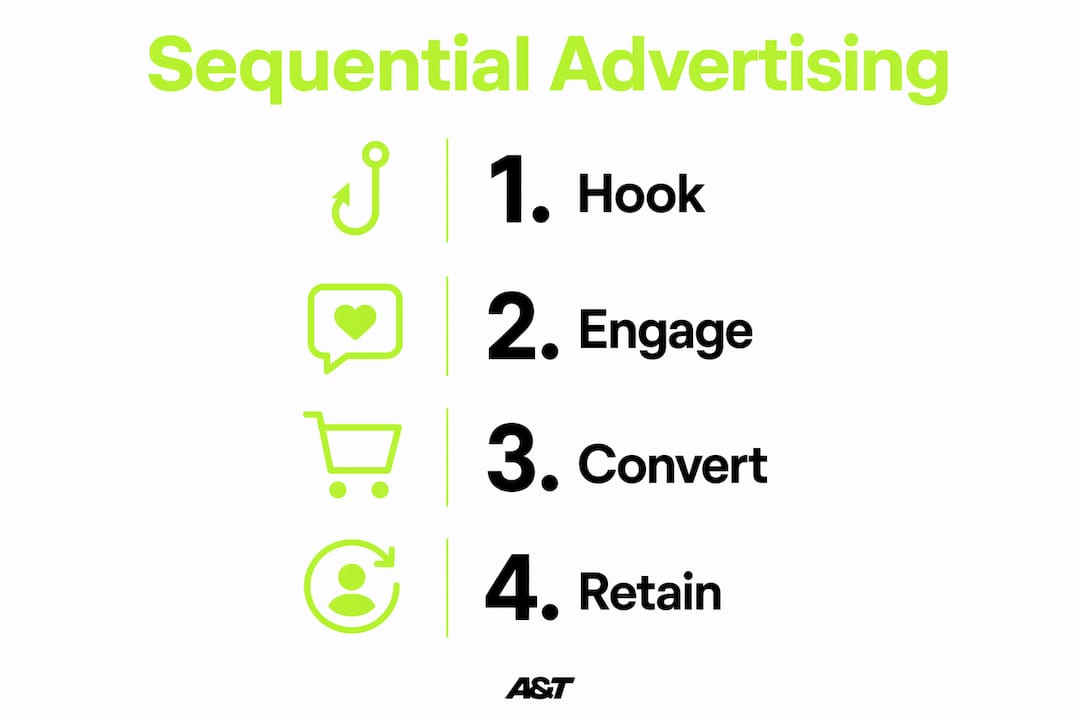
Sequential advertising, also called ad sequencing, works by tracking a user's exposure to Ad 1 and then automatically serving Ad 2 only after that impression is logged. Platforms track impressions via device IDs and cookies to enforce the delivery order. This means Ad 2 never appears before Ad 1, preserving the narrative flow you designed.
Here is how a standard three-step sequence runs in Meta Ads Manager:
Ad 1 (Hook): A short video or image that identifies a pain point the audience recognizes. No selling yet. The goal is attention and recognition.
Ad 2 (Reveal): A follow-up ad that introduces your product or service as the answer to the pain point raised in Ad 1. This is where you build credibility.
Ad 3 (Resolution): A direct-response ad with a clear offer, testimonial, or call to action. The user is now primed to convert.
Meta Ads Manager and Google Ads both support sequencing for awareness and engagement campaign objectives. You configure the sequence at the campaign level, assign creatives to each step, and set impression thresholds that trigger the next ad. The platform handles delivery automatically from there.
Pro Tip: Keep your sequence to 2–3 steps. Research confirms conversion rates drop sharply beyond three steps, and audience drop-off accelerates quickly with each additional ad.

What are common sequential advertising examples and campaign types?
Sequential advertising covers several distinct campaign formats. Understanding each type helps you choose the right structure for your goal.
Storytelling journeys: A brand runs three video ads that tell a product origin story. Ad 1 shows the problem, Ad 2 shows the founder's solution, Ad 3 shows customer results. Video ad sequencing on Google Ads is built specifically for this episodic format.
Full-funnel sequences: Ad 1 targets cold audiences with educational content. Ad 2 retargets viewers with a comparison or demo. Ad 3 hits warm audiences with a limited offer. This mirrors the classic awareness, consideration, and conversion funnel.
Behavior-triggered retargeting: A user watches 75% of your video. That action triggers Ad 2 automatically. This type of sequential messaging builds on demonstrated interest rather than just impressions.
Product launch sequences: Ad 1 teases the launch. Ad 2 reveals the product with key features. Ad 3 opens with a launch discount or early-access offer.
Campaign type | Format | Primary goal |
|---|---|---|
Storytelling journey | Video series (3 episodes) | Brand recall and trust |
Full-funnel sequence | Mixed formats (video + static) | Awareness to conversion |
Behavior-triggered retargeting | Dynamic creative | Re-engagement |
Product launch | Teaser, reveal, offer | Sales and sign-ups |
Each type works because it respects where the user is mentally. You are not showing a purchase offer to someone who has never heard of your brand. You are earning the right to ask for the sale.
What are the benefits of sequential advertising in a marketing strategy?
The core benefit is compounding attention. Each ad builds on the last, so by the time a user sees your conversion message, they already recognize your brand and understand your offer.
"Sequential advertising is not merely retargeting. It consciously engineers the user's psychological journey to build trust and attention stage by stage."
Here is what that translates to in practice:
Higher conversion rates. The 14–17x conversion lift over random delivery is the most cited proof point. It reflects the power of context and familiarity.
Reduced ad fatigue. Showing the same static ad repeatedly burns out your audience. Sequential campaigns rotate messaging naturally, so each impression feels fresh and relevant.
Better funnel alignment. Full-funnel personalization matches your message to the user's mindset at each stage, increasing relevance without increasing spend.
Trust built progressively. A user who has seen your hook and reveal ads is far more receptive to your offer than a cold prospect. Familiarity reduces friction at the decision point.
Sequential advertising also gives you cleaner data. Because each step is tracked separately, you can see exactly where users drop off and which creative is underperforming. That visibility is hard to get from standard ad rotation.
Best practices and challenges in designing sequential campaigns
Designing a sequence that actually converts requires discipline. The most common mistake is treating the sequence as a funnel where only the last ad matters. Every step must carry its weight.
Design principles that hold up in practice:
Map each ad to a specific mindset stage: hook (pain recognition), reveal (solution awareness), resolution (decision).
Write each ad to stand alone. Each ad in a sequence must deliver clear value and a call to action even if the viewer missed prior steps.
Limit your sequence to 2–3 steps. Practitioners call longer sequences "sequence bloat," and the data supports avoiding it.
Measure hook efficiency (click-through rate on Ad 1), completion rate (how many reach Ad 3), and resolution conversion (purchases or leads from Ad 3) as separate metrics.
Challenges you need to plan for:
Sequential advertising requires higher CPMs and less flexible delivery than randomized rotation. The platform cannot optimize freely across your audience because the delivery order is fixed. That constraint costs more per impression in the short term. The payoff is a higher-quality conversion path over the full campaign.
Pro Tip: Test your hook ad as a standalone campaign first. If it cannot generate strong engagement on its own, the rest of the sequence will underperform regardless of how good Ads 2 and 3 are.
How to implement sequential advertising: tools, tracking, and optimization
Launching a sequential campaign is straightforward once you understand the platform mechanics. Here is a practical workflow for Meta Ads Manager, which is the most widely used tool for this format.
Define your sequence goal. Choose between brand awareness, video views, or conversions as your campaign objective. Sequencing works best with awareness and engagement objectives at the top of the funnel.
Build your creative assets. Produce 2–3 short videos or static ads. Short vertical videos under 15 seconds achieve a 53.7% completion rate in sequences, compared to 29.4% for longer formats. That gap is significant.
Configure the sequence in Ads Manager. Set Ad 1 as the entry point. Define the impression threshold that triggers Ad 2. Repeat for Ad 3 if applicable.
Set targeting and budgets per step. Allocate more budget to Ad 1 since it reaches the broadest audience. Subsequent steps target smaller, warmer pools.
Track performance at each step. Use a dedicated ad performance tracking framework to measure hook efficiency, mid-funnel completion, and final conversion rate separately.
Iterate on weak steps. If Ad 2 shows high drop-off, test a new creative or adjust the messaging angle before scaling.
Step | Platform action | Key metric |
|---|---|---|
Ad 1 (Hook) | Broad audience targeting | Click-through rate |
Ad 2 (Reveal) | Triggered by Ad 1 impression | Video completion rate |
Ad 3 (Resolution) | Triggered by Ad 2 impression | Conversion rate |
Google Ads offers a parallel feature called video ad sequencing, which works across YouTube and the Display Network. The setup logic is similar: you assign creatives to ordered steps and the platform manages delivery. For marketers running both Google and Meta campaigns, running parallel sequences on both platforms increases reach without duplicating effort.
Understanding how your ad funnels boost sales at each stage gives you a stronger foundation for building sequences that convert, not just sequences that run.
Key takeaways
Sequential advertising delivers a 14–17x conversion lift over random ad delivery by guiding users through a deliberate narrative from awareness to decision.
Point | Details |
|---|---|
Definition | Sequential advertising delivers ads in a fixed order to build a narrative and guide users toward conversion. |
Optimal sequence length | Limit sequences to 2–3 steps to avoid audience drop-off and maintain strong ROI. |
Creative rule | Every ad must work as a standalone piece with a clear message and call to action. |
Format advantage | Short vertical videos under 15 seconds achieve a 53.7% completion rate in sequences. |
Measurement priority | Track hook efficiency, completion rate, and conversion rate at each step separately. |
Why most sequential campaigns fail before Ad 3
I have reviewed a lot of sequential campaigns over the years, and the failure point is almost always the same. Marketers spend 80% of their creative energy on the final conversion ad and treat the hook as an afterthought. That is backwards.
The hook is the entire foundation. If Ad 1 does not generate genuine recognition or curiosity, the user will not pay attention to Ad 2 when it appears. You cannot buy your way out of a weak hook with a bigger budget. I have seen campaigns where the hook had a 0.4% click-through rate, and the team kept optimizing Ad 3 wondering why conversions were flat.
The other thing I see consistently is teams skipping per-step measurement. They look at overall campaign ROAS and call it a day. That tells you nothing about where the sequence is breaking down. You need hook efficiency, mid-funnel completion, and resolution conversion tracked as three separate data points. Without that, you are flying blind.
Sequential advertising is not a set-it-and-forget-it tactic. It rewards the teams who treat it like a product: build, measure, iterate. The marketing funnel logic that underlies sequencing is well established. The execution discipline is what separates campaigns that compound attention from campaigns that just run ads in order.
Start with a two-step sequence. Get the data. Then build from there.
— Ann
How A&T agency builds sequential campaigns that convert
At A&T Digital, we design and manage paid ad systems across Meta and Google that are built around the full customer journey, not just the last click. Sequential advertising is a core part of how we structure campaigns for clients in competitive verticals, from telehealth to retail. We handle creative strategy, sequencing setup, and per-step performance tracking so you get clear data and real results. If your current campaigns rely on random ad rotation, there is a measurable conversion lift sitting on the table. Explore our Meta Ads management services or our Google Ads management team to see how we build sequences that move buyers from cold to converted.
FAQ
What is sequential advertising in simple terms?
Sequential advertising is a strategy that shows the same user a series of ads in a specific order to tell a story and guide them toward a purchase. Each ad builds on the previous one rather than repeating the same message.
How does sequential advertising differ from retargeting?
Retargeting shows ads to users who have already visited your site or engaged with your content. Sequential advertising engineers the order of ad exposure from the first impression, building a narrative regardless of prior site visits.
What platforms support sequential advertising campaigns?
Meta Ads Manager and Google Ads both support sequential campaigns natively. Meta uses impression-based triggers, while Google Ads offers video ad sequencing across YouTube and the Display Network.
How many ads should a sequence include?
The optimal sequence length is 2–3 ads. Conversion rates drop sharply beyond three steps, and audience retention falls with each additional ad in the chain.
What video length works best in sequential ad campaigns?
Short vertical videos under 15 seconds achieve a 53.7% completion rate in sequential campaigns, compared to 29.4% for longer formats. Keeping each ad concise maximizes the number of users who reach the next step.