The Role of Campaign Pacing in Ad Performance
Posted on
Marketing
Posted at

Proper campaign pacing ensures budget efficiency, stable algorithms, and consistent performance. Ignoring pacing leads to overspending, underspending, and volatile results, compromising campaign success. Different pacing strategies suit varied campaign goals, from even daily to opportunity-based approaches, to optimize conversions and learning.
Campaign pacing controls when and how your ad budget is spent across a flight — protecting efficiency, hitting planned delivery targets, and keeping CPA and ROAS inside acceptable ranges. When pacing is managed well, you spend the right amount at the right time, your algorithms stay stable, and your clients never get a surprise call at month end. When it's ignored, you either burn through budget by week two or leave money unspent while competitors take the impressions you paid for.
Three consequences hit immediately when pacing breaks down:
Overspend: Budget exhausts early, cutting off delivery during high-intent windows later in the period.
Underspend: Unspent budget signals missed opportunity and, for agencies, a credibility problem with clients.
Performance volatility: Uneven spend creates erratic data signals that destabilize Smart Bidding and widen CPA ranges.
When pacing is managed actively, you get predictable delivery, stable algorithmic learning, and defensible performance numbers. When it's ignored, you get variance you can't explain and results you can't repeat.
Table of Contents
What campaign pacing actually means in practice
How pacing shapes your CPA, ROAS, and algorithmic learning
Which pacing strategy fits your campaign type?
The formulas you need to monitor pacing
How to monitor pacing and decide when to act
When strict pacing works against you
Best-practices checklist for advertisers and agencies
How A&T Digital operationalizes pacing: playbook and case example
Key Takeaways
Pacing as both defense and offense
A&T Digital handles pacing so your budget works harder
Useful sources and further reading
What campaign pacing actually means in practice
Campaign pacing compares your cumulative actual spend against a planned spend trajectory to confirm you're on track to hit budget targets without exhausting funds early or leaving money unspent. The simplest version of that trajectory is linear pacing: spend 1/N of the period budget per day, where N is the number of days remaining. That baseline is where every pacing conversation starts.
A few terms you'll use constantly:
Pacing rate: Actual spend to date divided by expected spend to date, expressed as a percentage.
Expected spend to date: The portion of the total budget that should have been spent by today based on elapsed time.
Variance percentage: The gap between actual and expected spend, shown as a percentage of expected spend.
Daily target burn: The amount that needs to be spent each remaining day to finish the period on budget.
Lifetime vs. daily budgets: Lifetime budgets let platforms allocate spend unevenly across days; daily budgets set a per-day ceiling that platforms can exceed by up to 2x on any single day (Google reconciles this against a monthly cap of daily budget × 30.4).
Pacing matters most in three common contexts: agency-managed monthly retainers where underspend is a client relationship issue, promotional windows where every day of the flight has commercial value, and cross-channel pooled budgets where spend on one platform affects what's available for another.
How pacing shapes your CPA, ROAS, and algorithmic learning
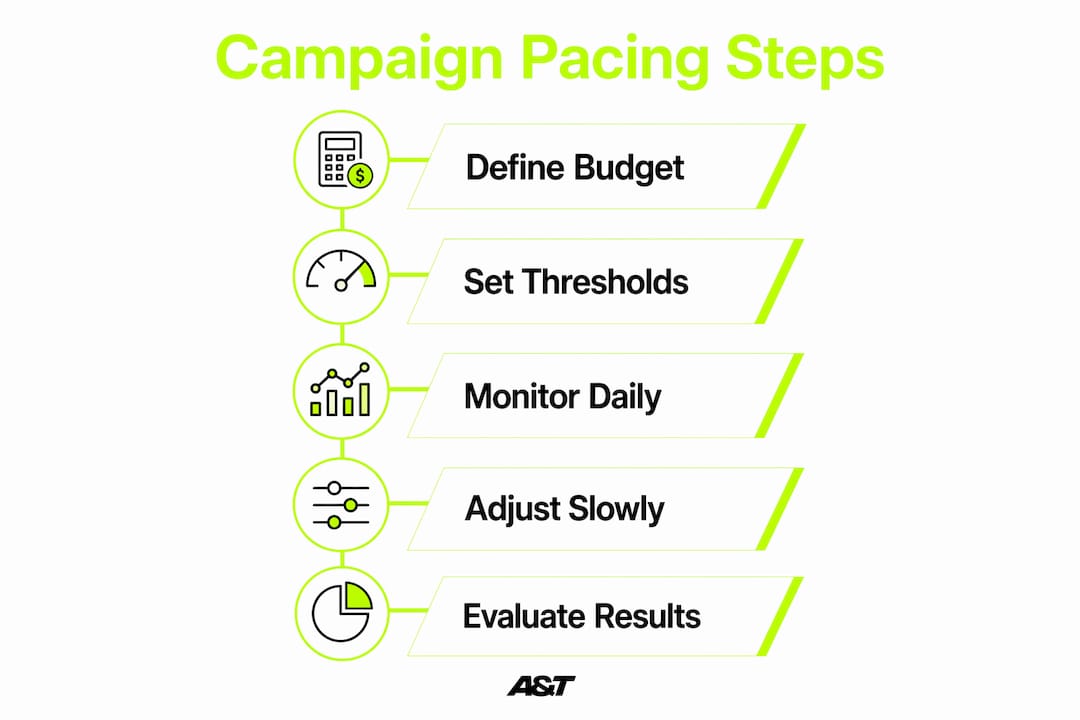
Pacing isn't just accounting. It directly determines whether your campaigns generate efficient conversions or expensive noise. Even daily pacing — treating every hour and day as equal — can increase CPA by 15–40% compared with opportunity-based approaches, because it forces spend into low-intent windows and holds back during high-conversion periods.

Front-loading spend aggressively creates a different problem. Algorithms see a flood of early data, often from a non-representative audience mix, and optimize toward the wrong signals. That instability widens CPA ranges and makes week-two performance look worse than it actually is. The campaign hasn't failed — the pacing has.
Here's where the tradeoffs sit:
Under-spending with strong efficiency: You're leaving conversions on the table. The algorithm has room to scale, but the budget ceiling is holding it back.
Over-spending with declining efficiency: You're buying impressions the algorithm wouldn't have chosen. Pull back before the CPA damage compounds.
Over-spending with strong efficiency: A signal to unlock more budget, not to cut. This is the window where active reallocation pays off.
Under-spending with poor efficiency: Don't scale. Diagnose the creative, audience, or bid strategy first — more budget won't fix a broken funnel.
Pacing also protects algorithmic learning. Smart Bidding needs 3–5 days to stabilize after major budget edits. Frequent small changes create noise that widens CPA ranges and makes reliable pacing decisions harder. Treat the algorithm as a partner that needs consistent inputs, not a dial you adjust daily.
Which pacing strategy fits your campaign type?
There's no single right approach. The right pacing strategy depends on campaign role, platform behavior, and what the business actually needs from that flight.

Linear/even daily pacing distributes budget equally across every day of the flight. It's the platform default and the easiest to explain to clients. It's also the weakest performer when conversion rates vary by day or hour, which they almost always do. Use it only when traffic is genuinely flat and the campaign goal is reach or brand awareness.
Weighted/seasonal pacing front- or back-loads spend based on known demand patterns — higher budgets on weekdays for B2B, heavier weekend spend for consumer retail, or a ramp-up into a promotional peak. This approach requires historical data to justify the weighting, but it consistently outperforms even pacing when demand is non-uniform.
Opportunity-based pacing adjusts spend in real time based on conversion probability signals. Instead of spending a fixed amount per hour, the campaign bids aggressively when intent is high and holds back when it's low. This is what Waterlevel Pacing approximates — allocating budget according to traffic patterns rather than equal time intervals — and research confirms it outperforms even pacing across multiple campaign datasets.
Portfolio/sequence pacing is the most sophisticated approach for multi-campaign accounts. Rather than running prospecting and retargeting at steady equal budgets simultaneously, you alternate dominance: prospecting heavy early in the period to build the audience pool, then retargeting heavy as the period closes to convert warm audiences. Pulse-based sequencing reduces internal competition between campaigns, lowers audience fatigue, and allows tactical front-loading where it captures the most intent.
Accelerated/front-loaded pacing burns budget as fast as possible. It's appropriate for flash sales, time-limited inventory, or launch novelty windows where early reach has outsized value. Outside those contexts, it's a liability.
Platform defaults matter. Meta's lifetime budgets let the algorithm redistribute spend across ad sets and days unevenly, making cumulative comparisons the only meaningful metric. Google can spend up to 2x the daily budget on a single day and reconcile against the monthly cap — a risk that concentrates when ad scheduling limits eligible hours. Neither platform's default is "even daily" in practice, even when that's what the setting says.
The formulas you need to monitor pacing
Good pacing decisions start with consistent math. These are the metrics and calculations that make monitoring repeatable.
Metric | Definition | Where to pull it |
|---|---|---|
Expected spend to date | (Days elapsed ÷ Total days) × Total budget | Calculate from campaign dates and budget |
Variance % | ((Actual spend − Expected spend) ÷ Expected spend) × 100 | Calculate from platform cost data |
Pacing rate | Actual spend ÷ Expected spend | Calculate from platform cost data |
Daily target burn | (Remaining budget) ÷ (Days remaining) | Calculate from platform cost data |
Coefficient of variation | Standard deviation of daily spend ÷ Mean daily spend | Pull daily cost from platform reporting or BI |
Worked example using a $30,000 monthly budget:
Total budget: $30,000 over 30 days
Day 10 actual spend: $8,500
Expected spend to date: (10 ÷ 30) × $30,000 = $10,000
Variance: ($8,500 − $10,000) ÷ $10,000 × 100 = −15% (underspending)
Daily target burn for remaining 20 days: ($30,000 − $8,500) ÷ 20 = $1,075/day
That −15% variance sits right at the lower edge of the standard 10–20% alert threshold. At this point, you investigate before you act — check impression share, bid competitiveness, and audience size before increasing the daily budget.
A moderate variance threshold is commonly used as an alert trigger across agency pacing frameworks, with lower variance considered on track, moderate variance monitored more closely, and high variance prompting action.
How to monitor pacing and decide when to act
Monitoring frequency should scale with budget size and spend volatility. Here's a practical decision model:
Accounts spending over $50,000/month: Daily check on cumulative spend, variance %, and CPA/ROAS trend. Any variance above 15% triggers a same-day review.
Accounts spending $10,000–$50,000/month: Every-other-day check, with a full weekly review that includes daily target burn recalculation and client-facing notes.
Accounts spending under $10,000/month: Weekly review is sufficient unless a specific event (promo launch, creative change) warrants a daily check.
Cross-channel accounts: Daily aggregation check to catch timezone conflicts and reconciliation differences between platforms that make single-day snapshots misleading.
Triage checklist for each review:
Are we over or under the expected spend to date?
Is the variance above the 10–20% threshold?
Is efficiency (CPA or ROAS) moving in the right direction?
What is the least disruptive adjustment that corrects the trajectory?
Action table:
Pacing status | Efficiency signal | Recommended action |
|---|---|---|
Overspending | Declining CPA/ROAS | Reduce daily budget or tighten bid caps |
Overspending | Strong CPA/ROAS | Hold or request budget increase from client |
Underspending | Strong CPA/ROAS | Unlock delivery: raise daily budget or expand targeting |
Underspending | Poor CPA/ROAS | Diagnose creative, audience, or bid strategy before scaling |
Pro Tip: Avoid frequent small budget edits. Smart Bidding re-learns over 3–5 days after any major change, so editing the budget every two or three days creates a permanent learning lag. Set a threshold — for example, only adjust when variance exceeds 15% — and document every change with the date, amount, and reason. That log becomes your defense when a client asks why CPA spiked in week two.
For a deeper look at how bidding behavior interacts with pacing decisions, the bidding and pacing relationship is worth understanding before you make any mid-flight adjustments.
When strict pacing works against you
Rigid pacing rules can hurt results in specific scenarios. Knowing when to break them is as important as knowing how to apply them.
Flash sales and time-limited promotions: A 48-hour sale doesn't benefit from linear pacing. Front-load aggressively. The cost of underspending during the window is higher than the cost of a slightly elevated CPA.
Campaign launch and learning phase: New campaigns need data fast. Front-loading spend during the first 7–14 days accelerates the learning phase and gets Smart Bidding to a stable state sooner. Strict linear pacing during launch extends the learning period and delays reliable performance signals.
RSVP-limited or inventory-constrained campaigns: When the supply of eligible impressions is finite (a specific event audience, a narrow geographic target), pacing against a linear trajectory may leave you unable to spend the budget at all. Accelerated delivery captures available inventory before it disappears.
Experimental launches: When you're testing a new creative concept or audience, you want data quickly. Throttling spend in the name of pacing slows the learning cycle and extends the time before you can make a confident decision.
The tradeoffs to communicate to clients and finance teams:
Accepting a higher CPA during a flash sale is a deliberate choice, not a failure.
Front-loading during launch may show a poor first-week CPA that improves significantly by week three.
Document the exception, the rationale, and the expected outcome before the flight starts — not after the numbers come in.
Best practices checklist for advertisers and agencies
Setup and configuration:
Set variance tolerance thresholds before the campaign launches (10% warning, 20% action) — these are the standard deviation thresholds used across most agency pacing frameworks.
Define KPIs per campaign role: CPA for lead gen, ROAS for e-commerce, CPM/reach for brand.
Centralize cross-channel spend in a single dashboard or BI view so you're comparing cumulative totals, not platform-by-platform snapshots as explained by Valiz.
Confirm platform budget type (daily vs. lifetime) and document how each platform reconciles overdelivery.
Monitoring and alerts:
Configure automated alerts for variance above threshold, daily spend drops of more than 30%, and CPA/ROAS moving outside the agreed range.
Every alert should include: current variance %, likely cause (budget cap hit, audience exhaustion, bid competition), and a recommended action.
Log every budget change with date, amount, reason, and expected outcome.
Reporting fields for weekly pacing reports:
Cumulative spend to date
Expected spend to date
Variance % (with directional arrow)
CPA or ROAS vs. target
Daily target burn for remaining period
Action taken or recommended
Client communication:
Send a brief pacing note mid-month, not just at month end. Proactive pacing checks prevent surprise conversations and protect the client relationship.
Frame variance in business terms: "We're 12% under pace, which means $3,600 needs to be deployed in the next 18 days — here's how we plan to do it."
When recommending a pacing exception (flash sale front-load, learning phase acceleration), send a one-paragraph brief before the change, not after.
For SMB-specific pacing tolerances and agency cadence guidance, the ad budget pacing guide covers the practical setup in detail.
How A&T agency operationalizes pacing: playbook and case example
At A&T Digital, pacing is a team-level system, not an individual habit. Here's how the playbook runs:
Role assignments:
Campaign owner: Sets initial pacing strategy, defines variance thresholds, and documents exceptions.
Analyst: Runs daily or every-other-day spend checks, flags variance, and updates the pacing log.
Client lead: Reviews weekly pacing reports, owns client communication, and escalates budget decisions.
Escalation thresholds:
Variance 10–15%: Analyst flags, monitors daily.
Variance 15–20%: Campaign owner reviews and decides on adjustment.
Variance above 20%: Client lead notified within 24 hours with a written action plan.
Documentation: Every budget change is logged in a shared pacing sheet with date, platform, campaign, change amount, reason, and expected outcome. That log is the source of truth for client reporting and post-flight analysis.
Anonymized case example: A mid-market e-commerce client running simultaneous prospecting and retargeting campaigns on Google and Meta was consistently underspending on prospecting while retargeting exhausted its budget by day 20. The campaigns were competing for the same audience signals, driving up CPMs across both. A&T Digital shifted to a pulse-based portfolio sequence: prospecting-heavy for the first 18 days of the month to build the audience pool, then retargeting-heavy for the final 12 days to convert warm audiences. Budget utilization moved from 78% to 97% of planned spend. CPA on retargeting dropped because the prospecting phase had built a larger, more qualified audience pool before the retargeting phase activated.
Client communication talking points when recommending a pacing change:
"We're currently at [X]% of expected pace. Here's what's causing it and what we recommend."
"This change will affect Smart Bidding for 3–5 days — here's what to expect during that window."
"The goal is to finish the month at [Y]% of planned spend while keeping CPA inside [Z] range."
Treating pacing as a credibility signal — not just a budget control — is what separates agencies that retain clients from those that lose them at renewal. Frequent pacing checks act as a safeguard that identifies budget issues early and keeps client expectations calibrated throughout the month.
Key Takeaways
Effective campaign pacing requires setting variance thresholds before launch, monitoring at a cadence that matches budget size, and treating the algorithm as a partner that needs consistent inputs to perform.
Point | Details |
|---|---|
Set thresholds before launch | Define 10% warning and 20% action thresholds per campaign before the flight starts. |
Match monitoring cadence to budget | Accounts over $50,000/month need daily checks; under $10,000/month, weekly is sufficient. |
Prefer portfolio sequencing | Pulse-based prospecting-then-retargeting sequencing improves budget utilization and CPA. |
Limit budget edits | Smart Bidding needs 3–5 days to stabilize; only adjust when variance exceeds your threshold. |
A&T Digital operationalizes this | A&T Digital applies role-based pacing playbooks and portfolio sequencing across client accounts to protect spend efficiency and hit delivery targets. |
Pacing as both defense and offense
Most teams treat pacing as a defensive control — a way to avoid overspending or underspending. That framing is incomplete. The more interesting question is: where are your competitors not spending, and can you deploy budget there to get asymmetric returns?
Opportunity-based pacing answers that question. When you hold budget back during low-intent hours and release it during high-conversion windows, you're not just protecting efficiency — you're exploiting the gaps that even-daily spenders leave open. A competitor running standard pacing burns budget at 2 AM. You spend that money on Friday afternoon when purchase intent peaks. Same budget. Different outcomes.
The agencies that understand this treat pacing as a timing strategy, not just an accounting function. They use campaign timing experiments to identify the windows where their clients' audiences convert at the lowest cost, then build pacing rules around those windows. The result is a compounding advantage: better data, more stable algorithms, and a CPA that keeps improving as the pacing model gets more precise.
The conventional wisdom is that pacing is about staying on budget. The real opportunity is using pacing to win the auction at the right moment.
A&T agency handles pacing so your budget works harder
Pacing audits, monitoring dashboards, and portfolio sequencing design are core to how A&T Digital manages multi-channel paid campaigns for SMBs and e-commerce brands. We set variance thresholds, build cross-platform spend views, and run the weekly pacing reviews so your budget hits its targets without the mid-month surprises.
What we offer:
Pacing audits that identify where current campaigns are over- or under-delivering
Monitoring dashboards with automated variance alerts
Portfolio pacing design for accounts running prospecting and retargeting simultaneously
Full campaign management across Google Ads, Meta, and TikTok
If you want to know exactly where your budget is going and why, start with a pacing audit. Reach out to A&T Digital to get one scheduled.
Useful sources and further reading
For platform documentation, research, and deeper reading on pacing frameworks:
Google Ads Budget Pacing Insights — Google's native tool for understanding monthly spend trajectories, pacing status (limited, on track, budget remaining), and conversion forecasts.
TensorOps: Budget Pacing in Programmatic Advertising — A technical deep dive into PID controllers, reinforcement learning, and production-grade pacing systems for demand-side platforms.
Improvado: Marketing Budget Pacing Guide — Covers linear pacing formulas, Google's 2x daily overspend rule, Smart Bidding re-learn windows, and cross-platform reconciliation issues.
Sagum: Budget Pacing Strategies That Actually Work — Practical guidance on opportunity-based pacing, pulse sequencing, and the CPA cost of even daily pacing.
Pathlabs: Campaign Pacing and Agency Best Practices — Agency-focused perspective on monitoring cadence, client communication, and pacing as a credibility signal.
Go Insights: Ad Spend Pacing Field Guide — Explains Meta lifetime budget behavior, CBO redistribution, and cross-platform aggregation challenges.
International Journal of Research in Marketing: Pacing Heuristics Study — Peer-reviewed comparison of Even Pacing, Modified Even Pacing, Waterlevel Pacing, and Adaptive Waterlevel Pacing across real RTB campaign datasets.
Suggested reading order: Start with the Improvado guide for formulas and platform behavior, then the Sagum piece for strategy, then the academic study for a rigorous comparison of pacing heuristics.