Ad Budget Pacing Explained for SMB Marketers
Posted on
Marketing
Posted at

Ad budget pacing compares actual spend to planned curves to prevent overspending or underuse. Monitoring spend two to three times weekly helps catch deviations early and maintain campaign performance.
Ad budget pacing is defined as the process of comparing your actual cumulative ad spend against a planned spending trajectory to prevent both budget exhaustion and underutilization. The industry term is "spend pacing," and it sits at the center of every well-run paid advertising campaign. Budget pacing precision varies by account size: small accounts under $5,000 can tolerate up to 15% variance, while enterprise accounts over $100,000 require precision within 2% to avoid costly misallocation. For marketing professionals and business owners running Google Ads or Meta campaigns, understanding pacing is not optional. It is the difference between a campaign that delivers results and one that burns out by the 15th of the month.
What is ad budget pacing and how does it work?
Ad budget pacing is the practice of controlling how your campaign spends its allocated budget across a defined time period, whether daily, weekly, or monthly. Without it, platforms like Google Ads can front-load your spend, leaving you with no budget during the highest-converting hours of the month.

The core concept is simple. You set a total budget for a period, then track whether your actual spend is running ahead of, behind, or on pace with your planned trajectory. If your $10,000 monthly budget should reach $5,000 by the midpoint of the month, but you have already spent $7,500, you are overpacing. If you have only spent $3,000, you are underpacing.
Pacing matters because ad platforms do not automatically distribute your budget evenly. They respond to auction dynamics, audience availability, and competitive pressure. Your job is to monitor the gap between planned and actual spend, then act before the gap becomes a problem. Good ad budget planning starts with understanding this gap and building a system to close it.
How is ad budget pacing calculated?
The standard formula for pacing variance is: ((Actual spend to date − Target spend to date) / Target spend to date) × 100. The result is your pacing variance percentage. A positive number means you are spending ahead of plan. A negative number means you are behind.
Here is a practical example. Your monthly budget is $9,000. By day 10 of a 30-day month, your target spend is $3,000. Your actual spend is $3,450. Your pacing variance is ((3,450 − 3,000) / 3,000) × 100 = +15%. That puts you right at the threshold where corrective action is typically required.
Most experienced marketers use a pacing ratio alongside the variance percentage. The pacing ratio is simply actual spend divided by target spend. A ratio of 1.0 means you are exactly on track. Above 1.15 or below 0.85 signals a problem worth addressing.
Pro Tip: Do not use a flat daily average as your pacing target. Ecommerce accounts tend to spend more on weekdays than weekends. Build weighted daily targets that reflect your actual demand patterns, or your pacing math will mislead you.
The table below shows how pacing variance thresholds shift based on budget scale.
Budget Scale | Acceptable Variance | Action Threshold |
|---|---|---|
Under $5,000/month | ±15% | Outside ±15% |
$5,000–$50,000/month | ±10% | Outside ±10% |
Over $100,000/month | ±2% | Outside ±2% |
Seasonality adds another layer. A campaign running through a holiday period will naturally spend faster during peak days. Your pacing model needs to account for those demand pattern shifts rather than treating every day as equal. Flat-line pacing targets are one of the most common mistakes we see in SMB campaign management.
How do Google Ads policies affect budget pacing?
Google Ads has two platform behaviors that directly affect your pacing strategy. Both require you to think at the monthly level, not just the daily level.
The first is the 2x daily budget overdelivery rule. Google can spend up to twice your daily budget on any given day. A $500 daily budget could result in $1,000 spent in a single day. If that happens repeatedly, a $15,000 monthly budget could be exhausted by day 15. This is not a bug. It is a documented platform behavior, and your pacing system needs to account for it.
The second is a 2026 update to how Google handles ad scheduling. Google Ads now targets full monthly spend regardless of your ad schedule settings. Previously, limiting active hours reduced total monthly spend proportionally. Now, Google pushes to hit your full monthly budget even if your ads only run during certain hours. This intensifies daily delivery pressure and makes early budget depletion a real risk for campaigns with restricted schedules.
Practical steps to manage these platform behaviors:
Set your daily budget based on your monthly target divided by 30.4, not by the number of days in the month.
Review cumulative spend at least every two to three days, not weekly.
If you use ad scheduling, recalibrate your daily budget downward to account for Google's push toward full monthly delivery.
Watch for sudden spend spikes after creative refreshes or audience changes, as these often trigger overdelivery.
Pro Tip: Treat your monthly budget as the true control lever on Google Ads. Daily budgets are inputs, not guarantees. Build a monthly spend tracker and check it against your trajectory at least three times per week.
What are the most common pacing problems for SMB campaigns?
Overspending early is the most visible pacing failure. It happens when daily budgets are set too high relative to the monthly target, or when platform overdelivery goes unchecked. The result is a campaign that runs out of budget in the first two weeks, leaving the second half of the month dark.
Underspending is the problem most marketers ignore. Chronic underspend causes missed conversions and leaves allocated budget unspent. It signals something deeper: bidding issues, audience exhaustion, or budget caps that are too low for available inventory. Underspend is not a safe outcome. It is a missed growth opportunity that also makes your reporting look worse than it should.
The third problem is misdiagnosing the cause. Many marketers see a pacing deviation and immediately adjust the budget cap. That is often the wrong move. Pacing is a campaign optimization tool, not just a financial control. If your campaign is underpacing, the cause might be a bid that is too low to compete in the auction, an audience that has been exhausted, or a creative that has stopped generating clicks. Fixing the budget cap without addressing the root cause just masks the problem.
The right response to any pacing deviation follows this sequence:
Identify whether the deviation is ahead or behind plan.
Check the root cause: auction competitiveness, audience size, bid strategy, creative performance.
Adjust the correct lever: bids, audience targeting, creative rotation, or budget cap.
Monitor the result within 48 hours, not at the end of the week.
Experienced marketers check pacing 2–3 times per week and treat it as an ongoing diagnostic process. Once-a-month reviews are not sufficient to prevent costly misalignments. The campaigns that perform best are the ones with the tightest feedback loops between spend data and campaign adjustments. You can use an ad optimization checklist to build that feedback loop into your weekly routine.
How to build a pacing monitoring system for SMB campaigns
A reliable pacing system does not require expensive software. It requires a clear process and consistent execution. Here is a practical framework for small and medium-sized businesses.
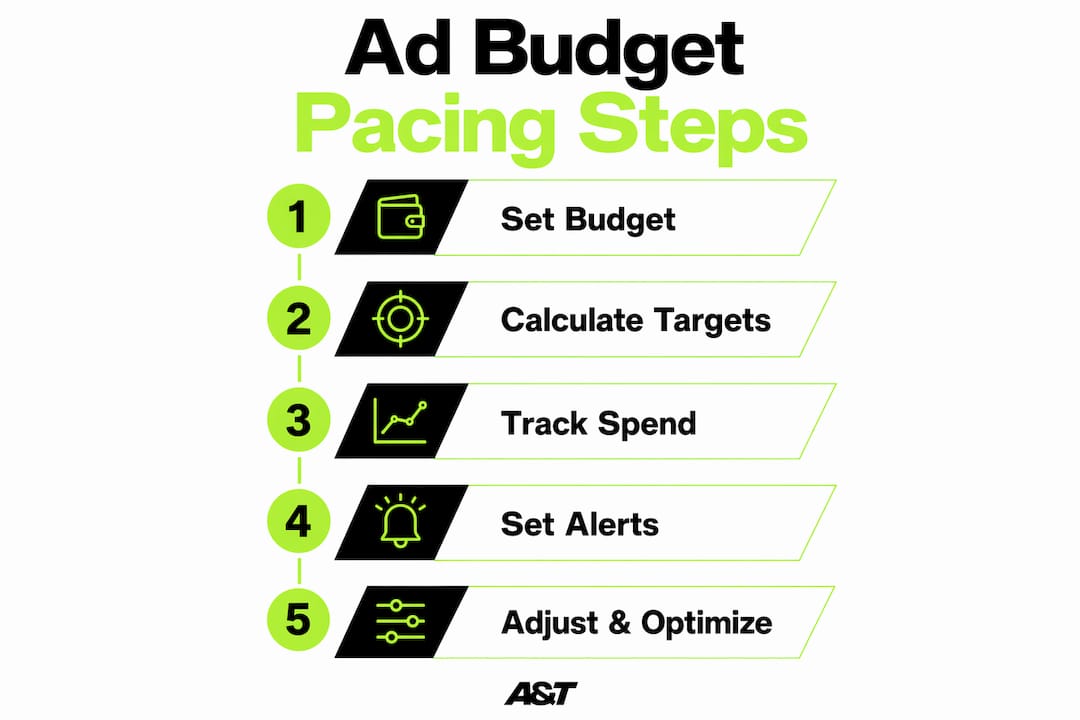
Step 1: Set weighted daily targets. Divide your monthly budget across days using demand weights, not flat averages. If your account spends 20% more on Tuesdays than Sundays, your Tuesday target should reflect that. Seasonality and day-of-week patterns are the two biggest reasons flat pacing targets fail.
Step 2: Track cumulative spend, not daily spend. Daily spend fluctuates. Cumulative spend against your weighted trajectory is the metric that tells you whether you are on course. Build a simple spreadsheet or use your platform's reporting tools to track this number every check-in.
Step 3: Set variance alerts. Use the thresholds from the table above. For most SMB accounts, a ±10% variance triggers a review. A ±15% variance triggers an immediate adjustment. Automate these alerts if your platform supports it.
Step 4: Check in 2–3 times per week. Professional budget managers rely on dynamic monitoring rather than static spreadsheets. Build check-ins into your calendar on Monday, Wednesday, and Friday. Each check-in should take less than 15 minutes if your tracking system is set up correctly.
Step 5: Communicate proactively. Month-end budget surprises damage client relationships and internal trust. If your pacing shows you will overspend or underspend by more than 10%, flag it immediately. A short weekly note to stakeholders keeps everyone aligned and prevents last-minute scrambles.
The table below shows a simple reporting cadence by campaign type.
Campaign Type | Check-in Frequency | Variance Threshold |
|---|---|---|
Brand awareness | 2x per week | ±15% |
Lead generation | 3x per week | ±10% |
Ecommerce / direct response | Daily | ±5% |
For multi-channel campaigns running across both Google Ads and Meta, consolidate your spend data into one view. Tracking each platform separately makes it easy to miss cross-channel overspend. A multi-channel spend management approach gives you a single source of truth for your total budget trajectory.
Key Takeaways
Effective ad budget pacing requires weighted spend targets, platform-aware daily budgets, and check-ins at least 2–3 times per week to catch deviations before they become costly.
Point | Details |
|---|---|
Pacing variance formula | Calculate ((Actual − Target) / Target) × 100 and act when variance exceeds ±10–15%. |
Budget scale determines precision | Accounts under $5,000 tolerate 15% variance; accounts over $100,000 need 2% precision. |
Google's overdelivery risk | A 2x daily overspend allowance can exhaust a monthly budget by mid-month if unchecked. |
Underspend is not safe | Chronic underpacing signals bidding or audience issues and causes missed conversions. |
Monitoring frequency matters | Check cumulative spend 2–3 times per week; once-a-month reviews cause costly misalignments. |
What I have learned from watching pacing go wrong
Pacing is the part of campaign management that most business owners assume is handled automatically. It is not. Platforms are built to spend your budget, not to protect it.
The mistake I see most often is treating pacing as a finance task rather than a performance signal. When a campaign underpaces, the instinct is to raise the budget cap. When it overpaces, the instinct is to cut it. Both reactions address the symptom, not the cause. A campaign that underpaces because of audience exhaustion will not fix itself with a higher cap. It needs fresh creative or a new audience segment.
The second mistake is checking pacing only at month-end. By then, the damage is done. You cannot recover two weeks of overspend in the last three days of a month. The marketers who get this right build pacing reviews into their weekly rhythm, the same way they review click-through rates or conversion costs. It becomes a habit, not a crisis response.
As campaigns scale, the stakes get higher and the margin for error shrinks. A 15% variance on a $3,000 budget is $450. The same variance on a $50,000 budget is $7,500. The pacing philosophy that works for a small account needs to tighten as budgets grow. Build the discipline early, and scaling becomes much less stressful.
— Ann
How A&T agency manages pacing for SMB clients
Managing pacing well is one of the clearest ways a performance marketing team earns its keep. At A&T Digital, we build spend tracking and pacing reviews into every campaign from day one. Our clients do not get surprised by month-end budget overruns or underperforming spend reports. We monitor cumulative spend against weighted targets across both Google Ads campaigns and Meta Ads campaigns, adjusting bids, audiences, and budgets based on real data. If you are managing ad spend without a structured pacing system, you are leaving performance on the table. We can help you fix that.
FAQ
What is ad budget pacing?
Ad budget pacing is the process of tracking actual ad spend against a planned spending trajectory to prevent overspending or underutilizing your campaign budget during a set period.
What pacing variance percentage requires action?
A variance beyond ±10–15% ahead or behind your scheduled spend typically requires corrective action, with tighter thresholds applying to larger budgets.
How does Google Ads affect budget pacing?
Google Ads can spend up to twice your daily budget in a single day and, as of 2026, targets your full monthly budget regardless of ad schedule settings, increasing the risk of early budget depletion.
How often should I check campaign pacing?
Check cumulative spend against your weighted target at least 2–3 times per week. Once-a-month reviews are not sufficient to catch and correct costly budget misalignments in time.
What causes chronic underspend in ad campaigns?
Chronic underspend usually signals bidding that is too low to compete in the auction, audience exhaustion, or budget caps set below available inventory levels.