The Role of Seasonality in Ads: A 2026 Guide
Posted on
Marketing
Posted at

Seasonality impacts consumer demand and ad auction competition, increasing costs during peak periods.
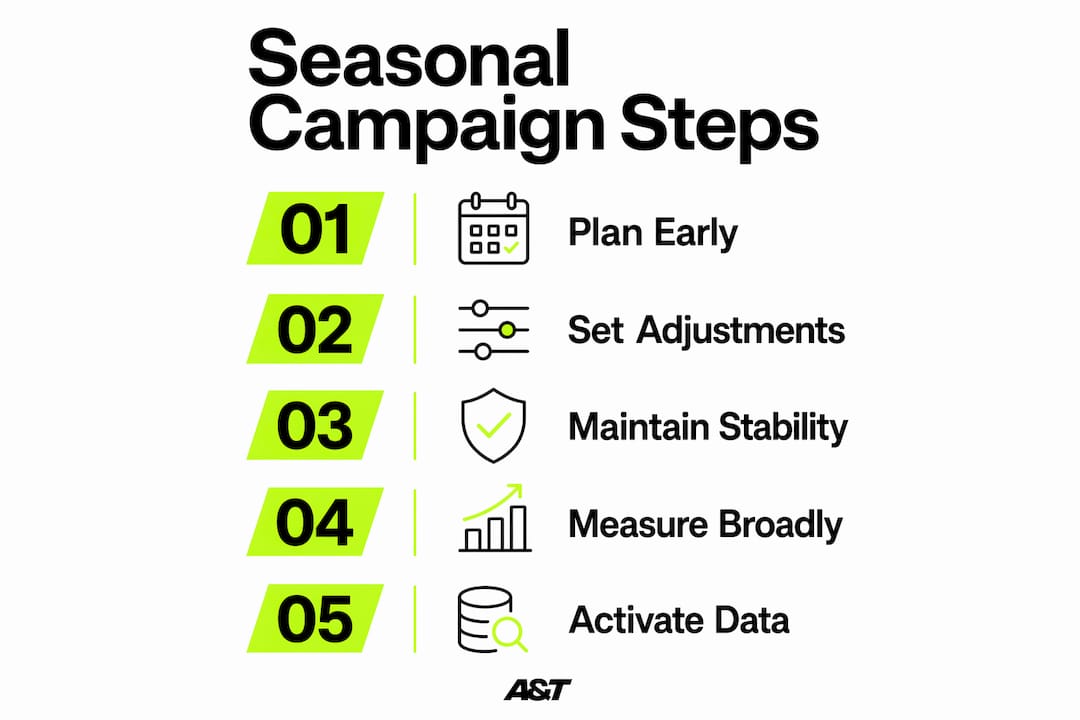
Prepared advertisers use precise tools like seasonality adjustments and early audience building to succeed.
Seasonality in advertising is defined as the predictable shift in consumer demand, purchase behavior, and ad marketplace competition driven by holidays, weather cycles, and cultural events. The role of seasonality in ads extends well beyond timing your promotions correctly. It reshapes auction dynamics, destabilizes Smart Bidding algorithms, and forces attribution models to work harder than they were designed to. Tools like Google Ads seasonality adjustments and Meta Ads audience targeting give advertisers real leverage over these cycles, but only when applied with precision. Aligning your seasonal campaign strategy with actual market conditions is the difference between scaling efficiently and burning budget at the worst possible time.
How does the role of seasonality in ads affect consumer behavior and auction competition?
Seasonal demand spikes do two things simultaneously. They increase consumer buying intent, and they flood ad auctions with competitors who all want the same clicks. Seasonal demand spikes raise CPCs and create a more hostile auction environment for advertisers who haven't prepared. That means your cost per acquisition rises even if your conversion rate stays flat.
The consumer side is well understood. Q4 holiday shopping, back-to-school in late july and august, Valentine's Day in february, and summer travel windows all produce measurable spikes in purchase intent. What gets less attention is the auction side. Every advertiser in your vertical sees the same demand signal and responds by increasing bids and budgets. The result is an attention monoculture where ads look and sound nearly identical, and standing out requires more than just showing up.
Consider these seasonal dynamics that affect ad performance:
Q4 holiday season: The most competitive window of the year across retail, e-commerce, and consumer goods. CPCs spike industry-wide from october through december.
Back-to-school: A high-intent window for education, apparel, electronics, and supplies. Competition peaks in late july and early august.
Valentine's Day: A short, high-pressure window where gift-focused advertisers compete intensely for a narrow audience over roughly two weeks.
Summer travel: A sustained seasonal window with high intent but also high advertiser volume in hospitality, airlines, and experiences.
"Top performers treat seasonal periods as distinct competitive auction events requiring precise audience targeting and creative strategy." — Sagum, Seasonal Campaign Planning That Wins
Attribution also breaks down during seasonal peaks. Gift buying, extended research cycles, and cross-device behavior all obscure which touchpoint actually drove the conversion. A shopper might click a Google Search ad on monday, see a Meta retargeting ad on wednesday, and convert through direct traffic on friday. Standard last-click models misread that journey entirely.
What are seasonality adjustments in Google Ads and when should you use them?
A Google Ads seasonality adjustment is a signal you send to Smart Bidding to communicate an expected short-term change in conversion rate. Seasonality adjustments are available for Search, Standard Shopping, Display, Performance Max, and App campaigns running on Target ROAS or Target CPA. They are not a replacement for Smart Bidding's normal seasonal handling. They are a surgical override for events that Smart Bidding cannot anticipate from historical data alone.

The recommended window is 1–7 days. Google explicitly warns that adjustments used beyond approximately 14 days perform poorly and can destabilize campaign performance. This tool is designed for discrete events, not extended seasonal periods.
When to apply a seasonality adjustment:
A 3-day flash sale where you expect conversion rates to increase by 50% or more
A product launch tied to a specific event with a clear start and end date
A promotional window that falls outside your campaign's historical data range
Any short event where Smart Bidding's standard learning would underreact to the spike
When NOT to apply a seasonality adjustment:
Routine holiday periods that appear in your historical data year over year
Extended promotional windows lasting more than two weeks
Gradual seasonal shifts like the general rise in retail intent through november
Scenario | Use adjustment? | Reason |
|---|---|---|
3-day Black Friday sale, +60% expected CVR | Yes | Short window, major CVR swing |
General Q4 holiday period | No | Smart Bidding handles from historical data |
2-week Valentine's Day campaign | No | Too long, risks destabilization |
Single-day product launch event | Yes | Discrete event outside historical range |
Pro Tip: Set your adjustment window to begin 1–2 hours before the event starts and end 1–2 hours after it closes. Imprecise boundaries are the most common cause of wasted spend and algorithmic instability during short promotional events.
The most common mistake with seasonality adjustments is inaccurately estimating the conversion-rate change window. If you set the window too wide, Smart Bidding overcorrects outside the actual event period and wastes budget. If you underestimate the magnitude of the CVR change, bids stay too conservative during the peak.
How does seasonality create challenges in ad measurement and attribution?
Seasonal peaks create measurement problems that compound quickly. Cross-device and multi-channel buyer journeys during seasonal spikes make attribution less accurate, not more. Shoppers research on mobile, compare on desktop, and convert through a branded search or direct visit. Each step looks like a separate signal to your attribution model.
Gift buying adds another layer of complexity. The person clicking your ad is often not the end user. Purchase timing shifts because buyers plan ahead, which means your conversion data lags behind your actual ad-driven demand. A campaign that looks flat in week one of december may have driven the majority of purchases that convert in week two.
Algorithmic instability is a real risk during seasonal windows. Making frequent campaign changes, pausing and restarting ad groups, or shifting bidding strategies mid-season forces Smart Bidding into relearning mode. That relearning period costs money and time you don't have during a competitive window.
Pro Tip: Freeze major campaign structural changes at least two weeks before your peak season begins. Let Smart Bidding enter the high-competition window with a stable learning base, not a fresh reset.
The practical response to attribution chaos is to widen your measurement window and look at blended metrics. Track revenue per impression share, not just ROAS by campaign. Compare year-over-year performance rather than week-over-week during the peak. Reacting to noisy short-term data during a seasonal spike is one of the fastest ways to make expensive decisions based on incomplete information.
What practical steps should advertisers take to plan for seasonal campaigns?
Seasonal campaign success is built in the weeks before the peak, not during it. Building remarketing audiences 60–90 days before your peak season gives Smart Bidding the data it needs to optimize bids before competition drives costs up. Waiting until the season starts means you're paying premium CPCs to build the audience data you should already have.
Here is a practical pre-season preparation sequence:
Audit last year's seasonal data. Identify which campaigns, ad groups, and keywords drove the highest conversion volume and lowest CPA during the equivalent period.
Build and segment remarketing audiences. Create audiences based on product page visitors, cart abandoners, and past purchasers from the previous 90 days. Load these into Google Ads and Meta Ads now.
Improve Quality Scores before CPCs rise. Higher Quality Scores lower your effective CPC in competitive auctions. Fix ad relevance and landing page experience issues before the peak window.
Plan your budget ramp. Gradual budget increases protect algorithmic learning. A 20–30% weekly increase is far safer than doubling budgets overnight.
Prepare creative variations. Seasonal windows create ad fatigue fast. Have at least three creative variants per ad set ready before the peak begins.
Plan the ramp-down. Post-season budget cuts should be gradual too. Abrupt drops trigger relearning and can damage performance heading into the next cycle.
A content calendar built around your seasonal windows keeps creative production on schedule and prevents last-minute launches that skip testing.
Post-season data is underused by most advertisers. Holiday season behavioral data contains purchase path signals, product affinity data, and intent patterns that can fuel customer lifetime value models well into the following year. The advertisers who treat seasonal spikes as data collection events, not just revenue events, build compounding advantages over time.
Pro Tip: After each peak season, export your top-converting audience segments and use them as seed audiences for lookalike modeling in Meta Ads. Seasonal buyers often represent your highest-value customer profiles.
For advanced Google Ads tactics that apply specifically to high-competition seasonal windows, the 2026 Google Ads tips guide covers bidding, audience layering, and campaign structure in detail.
Key takeaways
Seasonal advertising success requires preparation, algorithmic stability, and post-season data activation, not just bigger budgets during peak windows.
Point | Details |
|---|---|
Seasonality reshapes auctions | Seasonal demand spikes raise CPCs and increase competition, not just consumer intent. |
Adjustments are surgical tools | Use Google Ads seasonality adjustments only for 1–7 day events with major CVR swings. |
Attribution breaks down at peaks | Widen measurement windows and compare year-over-year data to avoid reacting to noise. |
Audience building starts 60–90 days early | Pre-built remarketing segments reduce cost and improve Smart Bidding performance during peaks. |
Post-season data drives long-term growth | Holiday behavioral signals fuel audience modeling and customer lifetime value strategies year-round. |
What Iʼve learned about seasonality that most guides wonʼt tell you
Most articles on seasonal advertising treat it as a demand problem. Prepare for more buyers, spend more, win more. That framing misses the real complexity.
Seasonality creates a temporary micro-market with its own auction dynamics, creative fatigue patterns, and algorithmic pressures. The advertisers who win consistently are not the ones who spend the most. They are the ones who enter the peak window with stable campaigns, pre-built audiences, and creative that doesn't look like everyone else's.
I've seen well-funded campaigns collapse during Q4 because the team made too many changes in october trying to "optimize" heading into the peak. Smart Bidding entered the most competitive window of the year in a learning state. The result was inflated CPCs and suppressed impression share at exactly the wrong time.
The uncomfortable truth is that patience is a competitive advantage in seasonal advertising. Locking in your structure early, trusting the algorithm with a stable data foundation, and resisting the urge to react to every noisy data point during the peak window is harder than it sounds. But it is what separates sustainable seasonal performance from one-off results that can't be replicated.
The best seasonal campaigns also think past the sale. Activating holiday behavioral data for long-term audience modeling is how smart teams turn a Q4 spike into a Q1 and Q2 advantage. Seasonal buyers are often your best customers. Treat the data they generate accordingly.
— Ann
How A&T agency helps you win every seasonal window
Seasonal advertising rewards teams who plan ahead and execute with precision. At Atdigiagency, we manage Google Ads campaigns with seasonality built into the strategy from day one. That means audience building starts 60–90 days before your peak, bidding adjustments are applied with the right timing and magnitude, and campaign structure stays stable when it matters most. We also manage Meta Ads campaigns with the same data-driven approach, using post-season behavioral signals to fuel year-round growth. If your seasonal campaigns are costing more and converting less than they should, we can fix that.
FAQ
What is the role of seasonality in ads?
Seasonality in ads refers to the predictable impact of holidays, weather, and cultural events on consumer demand and ad auction competition. It affects CPCs, conversion rates, attribution accuracy, and the effectiveness of bidding strategies like Smart Bidding.
When should I use Google Ads seasonality adjustments?
Use seasonality adjustments only for short events of 1–7 days where you expect a significant conversion rate change, such as a flash sale or single-day product launch. Google advises against using them for periods longer than approximately 14 days.
How does seasonality affect ad costs?
Seasonal demand spikes attract more advertisers into auctions, which drives up CPCs across the board. Advertisers who enter peak windows without pre-built audiences and stable campaign structures pay the highest costs for the least efficient results.
How early should I start preparing for a seasonal campaign?
Start building remarketing audiences and improving Quality Scores 60–90 days before your peak season. This gives Smart Bidding enough data to optimize bids before competition peaks and costs rise.
How do I use seasonal data after the peak ends?
Export top-converting audience segments and purchase path data immediately after the peak. Use these signals to build lookalike audiences in Meta Ads and to refine keyword and bidding strategies for the next seasonal cycle.