How ad testing powers better telehealth campaigns
Posted on
Marketing
Posted at

Ad testing in healthcare ensures messaging resonates, maintains trust, and complies with regulations.
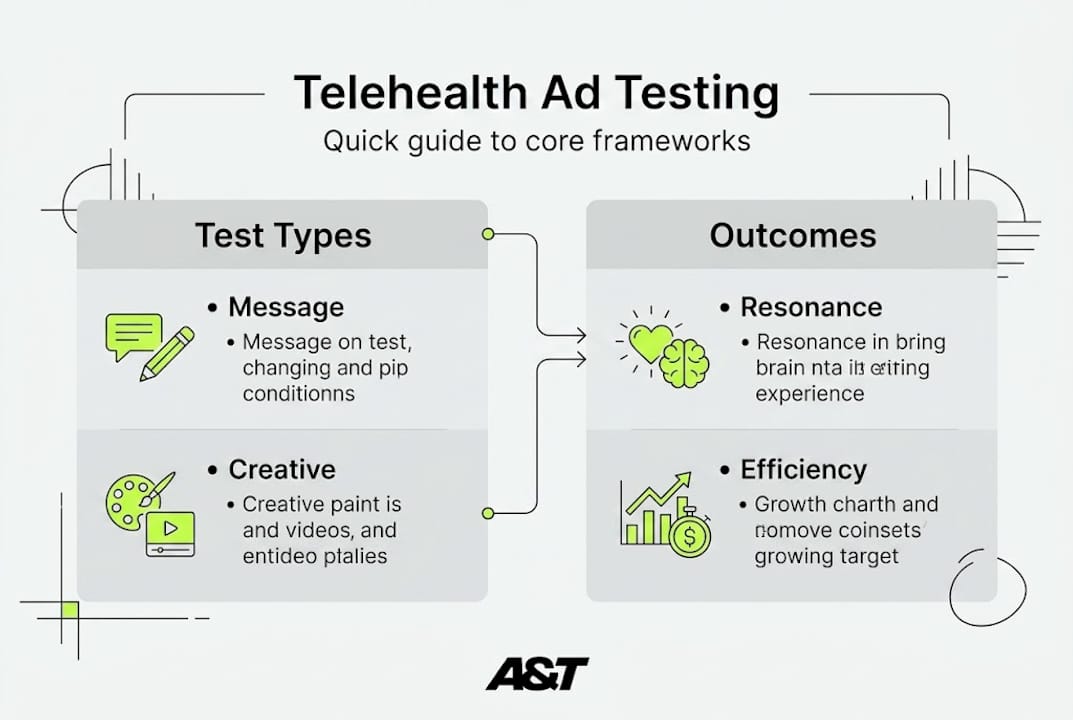
Frameworks like message, creative, and incrementality testing optimize telehealth campaigns effectively.
Proper testing aligns ad promises with clinical reality and focuses on patient acquisition and retention metrics.
How ad testing powers better telehealth campaigns
Most telehealth ads underperform not because the offer is weak, but because messages never get validated with real patients and stakeholders before launch. That gap between what your team thinks works and what actually resonates is where budget quietly disappears. Ad testing closes that gap. It gives you confidence, direction, and data before you commit full spend to a campaign. In this guide, we break down why testing is non-negotiable in healthcare, which frameworks actually work for telehealth, how to stay compliant, and what metrics tell you the truth about campaign performance.
Table of Contents
Optimizing for the real impact: Metrics and pitfalls in healthcare ad testing
Our take: What most telehealth marketers miss about ad testing
Key Takeaways
Point | Details |
|---|---|
Test with real stakeholders | Engage patients, providers, and administrators to validate your ad messages before launch. |
Use robust frameworks | Apply structured experiments and incrementality tests to uncover what drives true campaign lift. |
Protect compliance rigorously | Only test permissible ad elements and always maintain medical accuracy and regulatory approvals. |
Prioritize long-term impact | Measure metrics beyond clicks, focusing on patient engagement, retention, and workflow fit. |
Why ad testing matters in healthcare marketing
Healthcare marketing is not like selling software or sneakers. The stakes are different. Your audience is navigating real health decisions, and one poorly worded ad can erode trust in seconds. That is why ad testing is not optional here. It is a strategic safeguard.
"In healthcare marketing, ad testing is used to validate messages and creatives with specific stakeholders, including patients, providers, and administrators, before launch to avoid costly mismatches in tone, clarity, and trust."
Think about what that means in practice. A telehealth platform targeting patients with chronic conditions might craft messaging that feels empowering internally but lands as dismissive or overly clinical to the actual patient. Testing catches that before the campaign spends a dollar in live media.
Here is what ad testing actually protects you from in healthcare:
Tone mismatches: Language that feels transactional when patients need warmth and reassurance
Clarity failures: Messaging that is too technical for patients or too vague for referring physicians
Accuracy gaps: Claims that sound compelling but do not reflect the actual service offering
Trust erosion: Any creative element that signals inauthenticity to a skeptical healthcare audience
The compliance dimension adds another layer entirely. Healthcare ad testing does not just check for performance; it checks for regulatory safety. FDA-increased focus on pharma social media ads has made clear that accuracy, credibility, and avoiding misleading claims are non-negotiable edge cases that shape what can even be tested. You cannot treat ad testing in telehealth the same way you would test a retail promotion.

When you involve the right stakeholders in testing, you get layered, actionable insight. Patients tell you if your messaging makes them feel seen and safe. Providers flag clinical inaccuracies or credibility issues. Administrators identify operational promises your platform may not be equipped to keep. Each group surfaces a different failure mode, and catching any one of them pre-launch saves you from a campaign that burns budget and potentially damages brand reputation.
We always encourage telehealth teams to analyze ad results in healthcare not just post-campaign but as part of a continuous feedback loop. Testing before launch is the first move. Analyzing results after is how you sharpen the next one.
The return on investment case for ad testing is also direct. A campaign that launches with validated messaging converts at a higher rate. You reduce waste. You improve cost per acquisition. And you build campaigns on a foundation of audience insight rather than internal assumption. Understanding how testing ad copy boosts ROI is the difference between campaigns that scale and ones that stall.
Crucial ad testing frameworks for telehealth campaigns
Now that you see why ad testing is central to healthcare marketing, let us look at the practical frameworks you can apply to your telehealth campaigns. There are three core types, and each serves a distinct purpose.
1. Message and concept testing This is where you test the core idea before anything goes into production. You present different value propositions, headlines, or patient benefit statements to a representative sample. The goal is to learn which message angle creates the strongest intent to engage. For telehealth, this might mean testing "See a doctor in under 10 minutes" versus "Get care without leaving home" to see which drives stronger emotional response from your target patient segment.
2. Creative testing Once your message is validated, you test how it is expressed visually and structurally. This includes A/B testing for ads across image styles, video formats, ad copy length, and CTA button language. Creative testing in telehealth needs to account for platform context. A Facebook ad reaching a 55-year-old patient managing diabetes looks very different from a Google Search ad targeting someone actively searching for mental health support.
3. Incrementality testing This is the most overlooked framework, and also the most powerful. Incrementality testing measures causal lift to show that ad exposure, not pre-existing demand, actually drove the outcome. In a world where privacy restrictions are weakening traditional attribution, this matters enormously. Without it, you might be crediting your ads for conversions that would have happened organically.
Here is how to execute these tests responsibly in telehealth:
Start with a 20 to 30% traffic allocation to your test variant. This protects your core campaign economics while generating usable data.
Define your success metric before the test begins, not after.
Run tests long enough to capture downstream effects. In telehealth, a click today might not convert to a booked appointment for 10 to 14 days.
Use holdout groups in incrementality tests so you have a clean control population.
Document everything. Healthcare audits can happen, and your testing methodology needs to be defensible.
Telehealth ad testing requires controlled experimentation to protect economics like CAC payback timing, because conversion-to-revenue timing can be delayed and platform tests can distort comparisons if not structured correctly.
Pro Tip: Do not run message tests and creative tests simultaneously. If you change two variables at once, you cannot isolate what actually moved the needle. Sequence your tests.
For teams exploring how paid media for telehealth fits into a broader growth strategy, these frameworks are not just testing tools. They are the foundation of a scalable, repeatable campaign system.
Test type | What you learn | Timeline |
|---|---|---|
Message/concept | Which value prop resonates most | 1 to 2 weeks |
Creative | Best-performing visual and copy combo | 2 to 3 weeks |
Incrementality | True causal lift from ad exposure | 3 to 5 weeks |
Navigating compliance and ethics in healthcare ad testing
Implementing testing frameworks is only half the battle. Ensuring compliance and ethics in a tightly regulated space is equally vital. This is where many well-intentioned telehealth marketing teams make costly mistakes.
The core rule is straightforward: your ad tests must never introduce claims that are inaccurate, off-label, or misleading. That applies whether the ad is in a test phase or live. The regulatory environment does not give you a compliance holiday because something is labeled a "draft" or "test variant."
"Regulatory and ethical constraints are edge cases that materially shape what can be tested in healthcare ads, including accuracy and credibility, avoiding misleading claims or indications, and not harming vulnerable patient groups."
Here is what responsible healthcare ad testing looks like in practice:
Always get medical and legal review before any ad variant goes into a test, even small-scale tests
Never test core medical facts: The clinical information in your ad must remain consistent across all variants
Protect vulnerable populations: If your telehealth service reaches patients in mental health crises or dealing with serious illness, apply extra caution to emotional framing in test creatives
Document your review process: Keep a record of who approved each test variant and when
Flag off-label risks early: If a test variant references a condition or use case not explicitly approved for your service, pull it before it runs
What you can safely test includes tone, creative format, CTA wording, image style, and headline framing around the same compliant core message. That is a wide enough sandbox to generate meaningful data without crossing regulatory lines.
Pro Tip: Build a compliance checklist that runs parallel to your creative brief process. Every test variant gets reviewed against it before anything goes to a developer or platform. This adds one day to your process and eliminates weeks of potential remediation.
We find that teams who integrate compliance review into the testing workflow rather than treating it as a post-production gate move faster overall. Catching a problematic claim at the concept stage takes 10 minutes. Catching it after a campaign has been running costs real budget and brand credibility.
Strong campaign performance tracking in healthcare also means you can catch compliance-adjacent issues early, like ads generating unusually high complaint rates or abnormal bounce patterns that suggest message-audience mismatch. And if you are running retargeting campaigns, retargeting strategies for healthcare must be held to the same compliance standards as prospecting ads.
Optimizing for the real impact: Metrics and pitfalls in healthcare ad testing
With compliance in mind, it is essential to track the right success measures and steer clear of the most common mistakes in healthcare ad testing. The biggest mistake we see is optimizing for the wrong signal.
Clicks are not patients. Impressions are not revenue. In telehealth, the metrics that matter are the ones tied to actual patient acquisition and retention quality.
Here are the metrics that genuinely reflect ad testing success in telehealth:
Customer acquisition cost (CAC): How much does it cost to bring in one active, paying patient through a specific ad variant?
Approval rate: Of patients who clicked and initiated intake, how many were approved and serviced? A high-click, low-approval rate usually signals creative-to-clinical mismatch.
Downstream retention: Are patients acquired through this ad variant returning for follow-up appointments? Retention signals whether your message attracted the right fit patient.
Refund and support burden rate: A spike in refund requests or support tickets tied to a specific ad variant is a red flag about misleading creative.
Conversion-to-revenue lag: In telehealth, revenue from a converted patient may not appear until 21 to 35 days post-click. Your test window must account for this.
Tracking creative angles as an experimentation pipeline is a strong practice, but it needs to include workflow fit metrics like approval rate and downstream retention so you do not optimize for clicks that produce unserviceable patients.
Metric | What it signals | Review window |
|---|---|---|
CAC | Ad efficiency | 14 to 21 days |
Approval rate | Creative-to-clinical alignment | 21 to 35 days |
Retention rate | Patient quality and message fit | 30 to 60 days |
Support burden | Potential creative mislead | 7 to 21 days |
Pro Tip: Set up a post-test debrief that reviews both performance data and qualitative feedback from intake or care teams. They see the patients your ads attract. Their insight often reveals what the numbers alone cannot.
Here are the most common pitfalls to avoid:
Running tests too short: Two-week tests in telehealth rarely capture downstream conversion behavior.
Testing too many variables at once: Isolate one element per test cycle or your data becomes noise.
Ignoring statistical significance: A 5% lift on 50 conversions is not a finding. Size your test budgets accordingly.
Optimizing for platform metrics: Platform-reported conversions can be inflated. Tie your analysis to your own CRM or intake data.
We recommend pairing this approach with a dedicated ad creative testing guide that fits your specific telehealth service model. And revisiting how you analyze healthcare ad results is always worth the time investment.
Our take: What most telehealth marketers miss about ad testing
Having guided dozens of telehealth teams through ad testing, here is the honest truth: most teams treat ad testing like a creative preference exercise. They run a quick split test, see which version gets more clicks, and call it done. That is not testing. That is guessing with extra steps.
The real gap is not in the testing mechanics. It is in what gets measured. Traditional split testing ignores workflow fit entirely. It does not ask whether the patients your ad attracts can actually be serviced. It does not check whether the message maps to how a patient, a provider, and an admin each experience the care journey.
The most overlooked success factor in telehealth ad testing is alignment between your ad promise and the clinical reality of delivery. If your ad says "get care in 15 minutes" but your intake process takes 40, that creative might win a click test and still destroy retention. We have seen it happen.
Our position: optimize for incremental lift and workflow integration, not just CTR or CPA. If an ad variant drives fewer clicks but attracts patients who complete intake, return for follow-ups, and generate positive reviews, that is your winning creative. The data from Meta ads driving patient growth consistently shows that message-to-journey alignment outperforms raw click volume as a long-term growth driver. Test smarter. Measure deeper.
Amplify your telehealth growth with expert–led ad testing
Ready to move from theory to results? At A&T Digital Agency, we design and manage ad testing systems built specifically for telehealth and healthcare brands. We handle the strategy, the compliance checkpoints, the creative variants, and the performance analysis so your team focuses on patients, not platform dashboards.
Our approach to Google Ads management for telehealth and Meta Ads management for healthcare is built around measurable outcomes: lower CAC, higher approval rates, and campaigns that actually scale. We run structured experiments with real holdout groups, track downstream metrics through your CRM, and report on what actually moved revenue. No fluff. No wasted spend. Just tested, purposeful campaign execution that delivers patient growth.
Frequently asked questions
What is incrementality testing and why is it important for healthcare ads?
Incrementality testing measures true causal lift by comparing outcomes between people exposed to your ads and those who were not, proving your ads drove results beyond existing demand. It is especially critical in healthcare, where privacy changes have weakened standard attribution tools.
How long should telehealth ad tests run to get reliable results?
Effective telehealth ad tests should run at least 21 to 35 days to capture delayed conversions and downstream patient interactions like follow-up appointments and retention signals.
What ad elements can be tested in healthcare without risking compliance violations?
You can safely test tone, creative format, and CTA wording, but you must keep medical facts and approved indications unchanged across all test variants to stay within regulatory boundaries.
Why is stakeholder–specific ad validation important before telehealth campaigns?
Validating ads with representative patients, providers, and administrators ensures your message resonates across all touchpoints, and showing concepts to representative audiences reveals not just preferences but how messaging may influence actual health-seeking behavior.