Why Meta ads drive patient growth for telehealth brands
Posted on
Marketing
Posted at

Meta ads enable highly precise targeting and demand creation for telehealth patient acquisition.
Full-funnel strategies and automation reduce costs and build patient trust effectively.
Proper infrastructure and automation allow scalable, predictable growth with lower patient acquisition costs.
Traditional patient outreach, referral networks, and billboard campaigns are losing ground fast. Telehealth brands that still rely on those methods are leaving real growth on the table. Meta's AI optimization and broad targeting enable telehealth brands to acquire patients far more efficiently than traditional methods ever could. The platforms reach billions of active users, and the targeting precision is unlike anything available in offline channels. This article breaks down how Meta ads work for telehealth, why full-funnel strategy matters, where automation gives you a real edge, and which mistakes quietly kill campaign performance before it ever gets started.
Table of Contents
Maximizing efficiency: The role of AI and automation in telehealth Meta ads
Common pitfalls and advanced tips for Meta ads success in telehealth
Why most telehealth marketers overlook Meta ads' true potential
Key Takeaways
Point | Details |
|---|---|
AI-driven targeting | Meta’s automation helps telehealth marketers find and engage the right patients with less effort. |
Trust-building campaigns | Full-funnel strategies turn initial awareness into long-term patient relationships in healthcare. |
Efficient scaling | Telehealth businesses can achieve predictable, affordable growth by leveraging Meta’s optimization features. |
Avoid common mistakes | Relying on over-segmentation or skipping automation limits campaign success and ROI. |
Expert support available | Partnering with specialists accelerates results, ensuring compliance and consistent campaign improvement. |
How Meta ads transform telehealth patient acquisition
Most telehealth marketers already know Meta ads exist. Fewer understand what makes them genuinely different from every other paid channel available today. The gap between knowing and knowing how to use them well is where patient acquisition costs either shrink or spiral.
Meta's platform gives telehealth brands access to targeting that goes well beyond basic demographics. You can reach users based on health interests, life events, device behavior, and lookalike modeling built from your existing patient base. That level of specificity means your budget works harder from day one. And when you pair that with paid media for telehealth strategy, the results compound quickly.
Here is what separates Meta from other acquisition channels for telehealth:
Behavioral targeting: Reach users actively researching health conditions or telehealth services
Lookalike audiences: Build new patient pools modeled from your highest-value existing patients
Creative flexibility: Test video, static, carousel, and story formats within a single campaign
Real-time feedback: See what is working within hours, not weeks
Cross-platform reach: Serve ads across Facebook, Instagram, Messenger, and the Audience Network simultaneously
Meta's Campaign Budget Optimization (CBO) uses AI to automatically shift spend toward the best-performing ad sets in real time. Instead of manually adjusting budgets across five different audience groups, CBO handles that for you. The result is lower cost per acquisition and faster learning cycles.
"The brands winning on Meta are not the ones with the biggest budgets. They are the ones letting the machine learn fast and getting out of its way."
Compare that to the role of Google Ads in healthcare, where intent-based search captures demand that already exists. Meta creates demand. It reaches people before they have typed a single search query. For telehealth brands looking to grow beyond their current patient base, that is a significant strategic advantage.
Faster creative testing also means faster scaling. When you know which message resonates within 72 hours, you can double down with confidence. That speed reduces wasted spend and gives you a predictable path to growth.
Trustbuilding through full funnel Meta ad strategies
Targeting and budget efficiency get you in front of the right people. But in healthcare, being seen is not enough. Patients need to trust you before they will ever book an appointment. That is where a full-funnel approach changes everything.

A simple campaign sends one ad to a cold audience and hopes for a conversion. A full-funnel strategy guides prospective patients through three distinct stages: awareness, consideration, and conversion. Each stage uses different creative, different messaging, and different calls to action.
At the awareness stage, you introduce your telehealth brand through educational content. Short videos explaining a common condition, infographics about treatment options, or patient success stories all perform well here. The goal is not to sell. The goal is to be recognized as credible and helpful.
At the consideration stage, you retarget users who engaged with your awareness content. This is where you go deeper. Webinar invites, provider bios, detailed service pages, and patient testimonials move people from curious to interested. This is also where Meta ads strategy becomes critical to get right.
At the conversion stage, you serve direct response ads to warm audiences. Appointment booking offers, limited-time consultations, and strong calls to action work here because trust is already established.
Campaign type | Approach | Outcome |
|---|---|---|
Simple single-ad campaign | Cold audience, direct offer | Low trust, high drop-off |
Full-funnel strategy | Staged messaging, retargeting | Higher conversion, lower CAC |
E-E-A-T content matters here too. Experience, Expertise, Authoritativeness, and Trustworthiness are not just SEO concepts. They translate directly into ad creative. Featuring real providers, real patient stories, and clinically accurate information signals credibility. That signal is what converts a skeptical scroller into a booked patient.
Full-funnel ad strategies build the awareness and trust that healthcare audiences require before committing to a new provider. Without that foundation, even the best targeting in the world produces disappointing results.
Pro Tip: Map your ad creative to each funnel stage before launching. Sending a hard-sell conversion ad to a cold audience is one of the fastest ways to waste budget in telehealth advertising.
Maximizing efficiency: The role of AI and automation in telehealth Meta ads
Running Meta ads manually at scale is exhausting. Constant bid adjustments, creative swaps, audience refreshes, and performance checks eat up hours that most marketing teams do not have. Meta's AI-driven automation solves that problem directly.
Here is what Meta's automation handles for you:
Creative testing: Advantage+ creative automatically tests variations of your images, headlines, and copy to find top performers
Audience targeting: Broad targeting powered by AI identifies high-converting patient segments without manual audience building
Budget allocation: CBO shifts spend in real time toward the ad sets generating the lowest cost per result
Bid optimization: Meta's system adjusts bids dynamically based on conversion likelihood at any given moment
Placement selection: Automatic placements distribute your ads across Facebook, Instagram, and Audience Network based on performance data
The efficiency gains are measurable. AI automation for creative generation and real-time optimization reduces team burnout and supports scalable patient acquisition without proportionally increasing headcount.
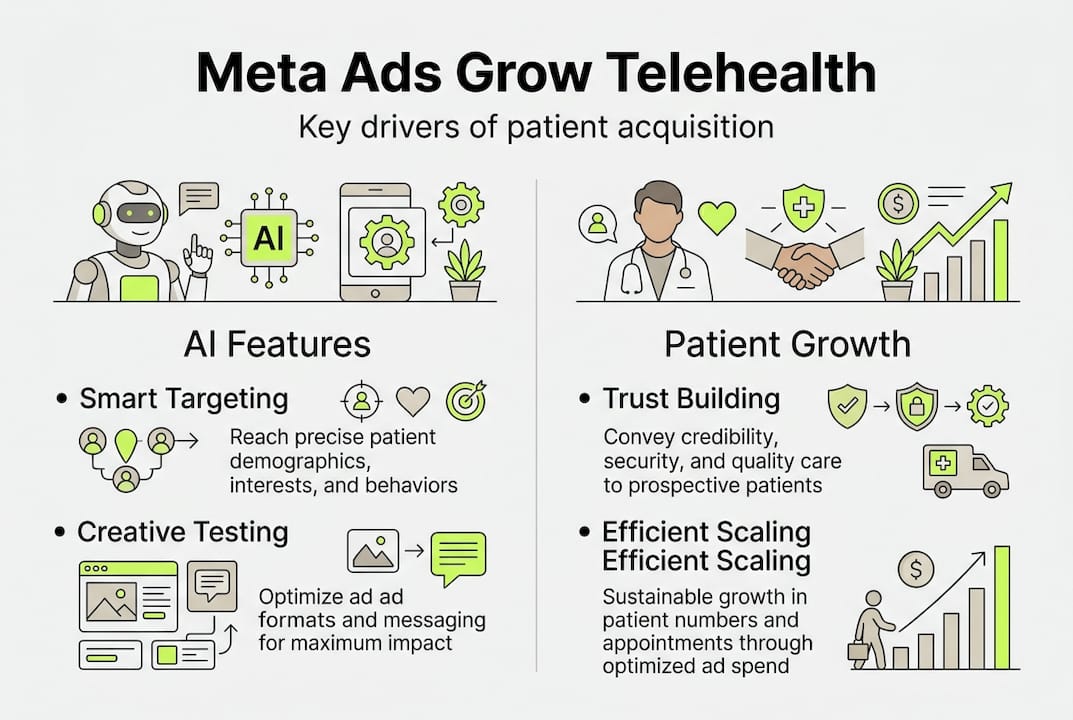
For mid-market telehealth brands, the numbers are compelling. Brands spending $30K to $50K daily with proper Meta ad infrastructure regularly achieve a cost per acquired patient between $250 and $400. That is a predictable, scalable model.
Spend level | Expected CAC range | Key enabler |
|---|---|---|
Under $5K/month | $400 to $600 | Creative testing phase |
$10K to $30K/month | $300 to $450 | CBO + broad targeting |
$30K to $50K/day | $250 to $400 | Full automation + funnel |
Automation also accelerates analyzing ad performance because the platform surfaces insights faster than manual review allows. And when it comes to optimizing ad spend, letting Meta's AI handle micro-decisions frees your team to focus on strategy and creative direction instead of daily bid management.
The brands that scale fastest are not the ones with the largest teams. They are the ones who trust the system, feed it quality creative, and stay focused on the inputs they can actually control.
Common pitfalls and advanced tips for Meta ads success in telehealth
Even with great targeting and automation, telehealth campaigns fail. Usually, the reasons are avoidable. Knowing what kills performance before it happens is worth more than any single optimization tactic.
The most common mistakes we see:
Over-segmentation: Breaking audiences into too many narrow groups starves the algorithm of data and slows learning
Ignoring automation: Manually overriding Meta's AI decisions too frequently prevents the system from optimizing properly
Static creative: Running the same ad for weeks causes audience fatigue and tanks engagement rates
Skipping the funnel: Sending cold traffic directly to a booking page without warming them up first almost never works in healthcare
Neglecting retargeting: Failing to re-engage users who showed interest is one of the most expensive mistakes in telehealth retargeting
Broad targeting supported by Meta's AI consistently outperforms over-segmentation in regulated healthcare advertising environments. The algorithm finds your best patients better than manual audience presets do, especially as privacy changes limit third-party data signals.
Pro Tip: Refresh your ad creative every two to three weeks. Even small changes, like a new headline or a different opening frame on a video, can reset performance and extend the life of a winning campaign.
For advanced campaigns, test broad versus narrow targeting head to head. Let the data tell you which wins rather than assuming narrow is safer. Most telehealth advertisers are surprised by how well broad targeting performs when the creative is strong. You can also explore Meta ads tactics from adjacent verticals to borrow proven frameworks and apply them to healthcare.
Ongoing testing is not optional. It is the engine that drives compounding ROI over time. Each test teaches the algorithm something new about your best patient profile, and that knowledge compounds with every campaign cycle.
Why most telehealth marketers overlook Meta ads true potential
Here is the honest take: most telehealth teams run Meta ads, but very few run them well. They set up narrow audience presets based on gut instinct, use static creative that never rotates, and wonder why results plateau after the first few weeks.
The real breakthrough comes from integration. Full-funnel thinking, ongoing creative testing, and trusting automation to do what it does best. Separately, each of those elements helps. Together, they produce results that feel almost unfair compared to what traditional patient acquisition costs.
We have seen telehealth brands resist over-optimization and actually improve performance. Fewer audience segments, more creative variation, and less manual interference. The counterintuitive truth is that doing less, strategically, often produces more.
Predictable scaling is achievable for telehealth brands at significant daily spend levels when the infrastructure is right. Most marketers never build that infrastructure because they are too busy managing campaigns day to day to step back and think about the system. That is the real gap. And it is exactly where paid ad solutions for telehealth make the biggest difference.
Ready to elevate your telehealth growth with Meta ads?
Everything covered in this article, from full-funnel strategy to AI-driven automation, requires consistent execution to deliver results. That is where working with a team that lives inside these platforms every day changes the outcome. Our Meta Ads management services are built specifically for brands that need performance, not just activity. We also integrate Google Ads for telehealth when search intent capture makes sense alongside your Meta campaigns. At A&T Digital Agency, we handle strategy, creative testing, compliance-aware setup, and ongoing optimization so your team can focus on patient care. No unnecessary meetings. Just campaigns that convert.
Frequently asked questions
What makes Meta ads different from Google Ads for telehealth?
Meta ads excel at creating demand through behavioral targeting and creative flexibility, while Google Ads captures existing search intent. For telehealth brands, Meta's CBO and AI often deliver lower acquisition costs by reaching patients before they start searching.
How does Meta AI improve ad performance for healthcare?
Meta's AI automates audience targeting, creative rotation, and real-time budget shifts, reducing manual workload while improving results. AI automation streamlines creative generation and optimization so campaigns improve continuously without constant manual intervention.
Is Meta advertising compliant for sensitive telehealth services?
Yes, when properly configured with appropriate content and targeting parameters. Broad targeting works effectively for regulated healthcare advertising on Meta, especially when creative avoids prohibited health claims and follows platform policies.
What is the expected cost per acquired telehealth patient with Meta ads?
With proper infrastructure and automation, telehealth brands can achieve a cost per acquired patient between $250 and $400. Predictable scaling and CAC at those levels are realistic for brands spending at meaningful daily budgets.
How can small telehealth businesses use Meta ads with limited budgets?
Start with CBO and broad targeting to let Meta's AI find your best-converting audiences efficiently. Broad targeting and CBO benefit smaller budgets by maximizing learning speed and minimizing wasted spend during the testing phase.


