How data drives digital marketing ROI for SMBs
Posted on
Marketing
Posted at

Most SMBs struggle to turn collected data into actionable marketing decisions.
Prioritize high-quality, owned data like first-party and zero-party sources over third-party data.
Regularly review a few key metrics and foster cross-team data transparency for better results.
Most marketing directors at small and medium-sized businesses already know they should be "data-driven." But knowing that and actually translating data into decisions that move revenue are two very different things. 90% of marketers attribute personalized marketing powered by data to higher profits, yet the gap between collecting numbers and acting on them stays wide for most SMBs. This guide closes that gap. We'll break down the types of marketing data that matter, how analytics frameworks help you make smarter choices, and where most businesses go wrong before they ever see a real return.
Table of Contents
Overcoming common hurdles: Data silos, AI, and privacy shifts
Our perspective: What most SMBs miss about data-driven marketing
Key Takeaways
Point | Details |
|---|---|
Leverage quality data | Prioritizing accurate, first-party data drives smarter decisions and more effective campaigns. |
Apply actionable analytics | Using descriptive, predictive, and prescriptive analysis uncovers real opportunities for business growth. |
Overcome silos and adapt | Bridging data gaps and anticipating privacy changes keeps your marketing ahead of the curve. |
Continuous improvement | Consistent measurement and feedback loops ensure your digital marketing strategy stays effective. |
Understanding the different types of marketing data
With the promise of higher profits on the table, it's vital to understand exactly what types of data and analysis underpin digital marketing success. Not all data is created equal, and treating every number as equally useful is one of the fastest ways to waste time and budget.
The four main data types
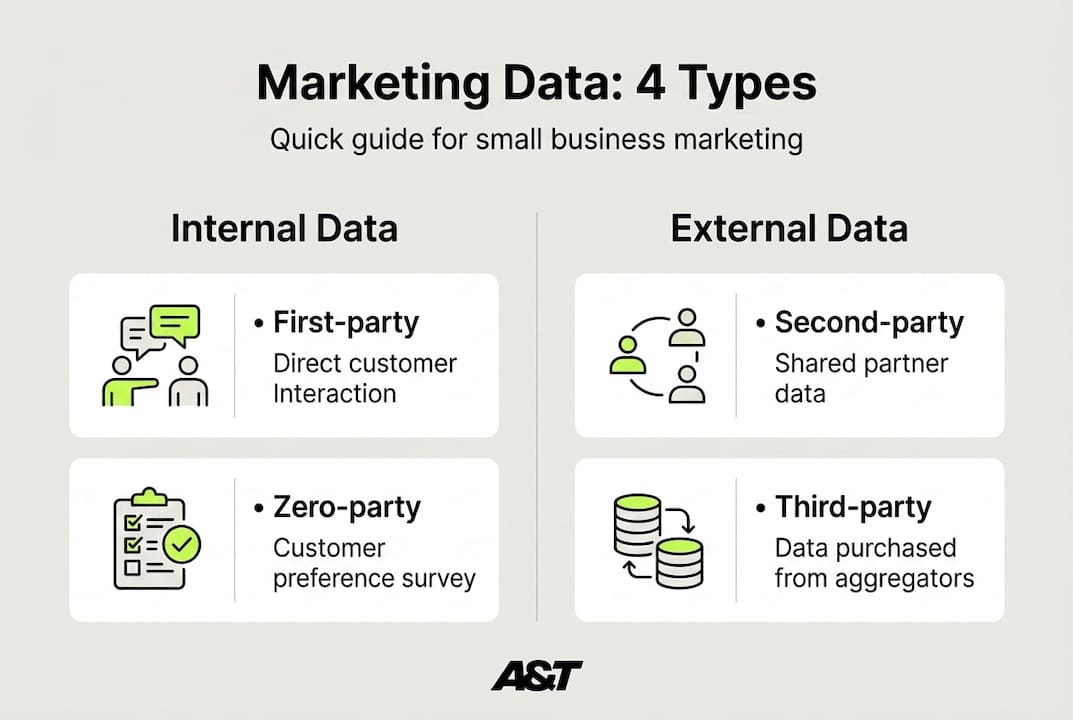
Here's a quick breakdown of the data categories every SMB marketing leader should know:
Data type | Source | Example | Privacy risk |
|---|---|---|---|
First-party | Your own channels | Website behavior, CRM records | Low |
Second-party | Direct partner sharing | Co-marketing data from a partner | Medium |
Third-party | Data brokers/platforms | Purchased audience lists | High |
Zero-party | Customer volunteers it | Survey answers, preference centers | Very low |
First-party data comes from your own touchpoints: your website, email list, ad campaigns, and CRM. It is the most reliable because you control how it's collected. Zero-party data is what customers proactively share with you through quizzes, preference settings, and direct feedback. Because the customer gives it willingly, it tends to be highly accurate and carries the least privacy risk.
Second-party data is essentially someone else's first-party data shared through a partnership agreement. Think co-branded campaigns or retail media networks. Third-party data, on the other hand, comes from external brokers and is increasingly unreliable as privacy regulations tighten worldwide.
The shift away from third-party data
The deprecation of third-party cookies has been rolling out across browsers for years, and the direction is clear: platforms and regulations are pushing marketers toward data they own or earn directly. This makes investing in first- and zero-party data collection not just smart, but necessary. Building strong data-driven marketing strategies starts with owning the data pipeline.
The four types of analytics
Beyond data types, understanding how you analyze data changes what decisions you can make. Data enables four key analytics modes in digital marketing:
Descriptive analytics: What happened? (Traffic dropped 20% last month.)
Diagnostic analytics: Why did it happen? (A landing page change reduced conversions.)
Predictive analytics: What will happen? (Based on trends, Q3 spend should increase by 15%.)
Prescriptive analytics: What should we do? (Reallocate budget from Display to Search before Q3.)
Most SMBs stop at descriptive. They look at last month's numbers and feel informed. The real competitive advantage comes from moving into diagnostic and predictive territory, where data tells you why something happened and what to do before the next cycle.
Statistic callout: Over 80% of marketers regularly use data to guide campaign decisions, yet fewer than half have a structured framework for acting on those insights.
Building that framework starts with knowing what kind of data you're working with, and what kind of questions you're trying to answer.
How quality data drives smart marketing decisions
Once you know the types of data, the next challenge is ensuring you're using quality information that leads to actionable decisions. Here's something most vendors won't tell you: more data does not mean better decisions. Cleaner, more relevant data does.
Quality vs. low-quality data: a clear comparison
Factor | High-quality data | Low-quality data |
|---|---|---|
Accuracy | Verified, consistent | Errors, duplicates |
Timeliness | Updated regularly | Stale, weeks or months old |
Relevance | Tied to business goals | Collected without purpose |
Accessibility | Centralized and shared | Siloed by team or tool |
Actionability | Drives specific decisions | Creates confusion |
High-quality data enables three things that directly impact your return: accurate targeting, personalized messaging, and reliable attribution modeling. When your audience data is clean and current, your Google Ads campaigns reach the right people. When your messaging is personalized based on real behavior, conversion rates rise. When attribution is solid, you know exactly which channel earned each sale.

Low-quality data does the opposite. It sends your budget toward the wrong audiences. It produces mixed signals that make it impossible to know what's working. And it makes your attribution model a guessing game.
The silo problem
65% of marketers strugglewith high-quality audience data, and data silos sit at the top of that challenge list. When your paid social team, your email team, and your sales team each operate from separate data sources, no one has the full picture. A customer who clicked a Meta ad, signed up for email, and then converted through a Google search gets counted as three separate interactions with no connection between them.
This fragmentation leads to overspending on channels that appear productive in isolation but are actually just part of a longer chain. Understanding the full data analysis impact on campaign outcomes requires a connected data view, not isolated reports.
"Garbage in, garbage out. AI doesn't save poor data. It amplifies it."
Vanity metrics trap
Another common mistake is using reach, impressions, and follower counts as proof of performance. These numbers feel good in a slide deck but rarely connect to revenue. Clicks without conversions, impressions without engagement, and follower growth without purchase intent are all signals that your data might be telling you a story that isn't tied to real business outcomes.
Understanding the data-driven advertising benefits only comes when you commit to measuring what actually matters to your bottom line.
Pro Tip: Focus on three to five core metrics that connect directly to revenue. Add more only when you have a team and process in place to act on the additional information.
Turning data into insights: Analytics frameworks for SMBs
Armed with accurate, reliable data, the payoff comes in how you distill that information into actionable insights. The following is a practical, step-by-step approach built specifically for SMB marketing teams that don't have enterprise-scale analytics departments.
Step 1: Map your data touchpoints
Before you can analyze anything, you need to know where your data lives. For most SMBs running paid campaigns, the primary sources are:
Google Ads (click performance, conversion tracking, search term reports)
Meta Ads Manager (audience insights, frequency, ROAS by placement)
Website analytics platform (sessions, bounce rate, goal completions)
Email marketing platform (open rates, click-through rates, revenue per email)
CRM (lead quality, sales cycle length, customer lifetime value)
Each of these tells a different part of the same story. The goal is to build a view that connects them.
Step 2: Segment your audience by behavior
Raw traffic numbers mean very little. Segmented audiences tell you what's actually happening. Group your audiences by behavior (what pages they visited, what actions they took), by demographics (age, location, device), and by intent signals (what search terms they used, how close they are to a purchase decision). Segmentation turns a blurry picture into a sharp one.
Step 3: Define and track essential KPIs
The right KPI framework for SMBs includes metrics that connect ad spend directly to business outcomes. Focus on:
CPA (cost per acquisition): What does it cost to earn one customer or lead?
ROAS (return on ad spend): For every dollar spent, how much revenue comes back?
Conversion rate: What percentage of visitors take the desired action?
LTV (lifetime value): How much is each acquired customer worth over time?
Track these weekly for paid campaigns and monthly for broader strategy review. This cadence builds the muscle for making fast, informed adjustments rather than reactive, emotional ones.
Step 4: Apply attribution models
Not all conversions happen in one step. A customer might see a Meta ad, search Google three days later, and convert on the fourth visit. Last-click attribution would give all credit to Google. Data-driven attribution, available in both Google Ads and GA4, distributes credit more accurately. Understanding which channels truly drive higher ROI through analysis is impossible without a clear attribution model.
Step 5: Use AI for predictive scoring and anomaly detection
Modern ad platforms use machine learning to predict which audience segments are most likely to convert. Smart bidding in Google Ads and advantage+ targeting in Meta both rely on your conversion data to optimize in real time. The better your data quality and volume, the more accurately these systems perform. AI is a multiplier, not a replacement for strategic thinking.
Pro Tip: Prioritize strategic KPIs over vanity metrics. If a number doesn't connect to cost, revenue, or customer behavior, it's decoration, not intelligence.
Overcoming common hurdles: Data silos, AI, and privacy shifts
Even with a strong framework in place, everyday challenges like silos and privacy laws demand proactive strategies. These aren't edge cases. They're the daily reality for most SMB marketing leaders trying to scale efficiently.
The biggest hurdles SMBs face
Fragmented tools: When your ad platform, email tool, CRM, and analytics dashboard don't communicate, every report is incomplete by definition.
Siloed teams: Sales and marketing each holding separate data without shared visibility creates blind spots in attribution and audience understanding.
Privacy regulations: GDPR, CCPA, and evolving state laws restrict how you collect, store, and use audience data. Non-compliance carries real financial risk.
AI pitfalls: Machine learning amplifies whatever data you feed it. AI can amplify poor data, producing hallucinations and noise that look like insights but lead campaigns in the wrong direction.
Breaking down data silos
The fix for fragmented data isn't always an expensive platform upgrade. Start with cross-team dashboards that pull from each major source into a single view. Tools like Google Looker Studio (free) or more advanced platforms like HubSpot or Supermetrics make unified reporting achievable for most SMB budgets. The bigger challenge is usually organizational: getting sales and marketing to agree on shared definitions for leads, conversions, and success metrics.
Building a smarter campaign strategy requires marketing and sales leadership aligned around the same numbers, not defending their own.
The cookie phase-out and first-party urgency
With third-party cookies progressively disappearing across browsers, collecting direct customer data is more essential than ever. Every email signup, every survey response, every preference center interaction is a piece of first-party intelligence you own outright. Build systems now to collect this data ethically, because the businesses that own their audience data will have a lasting advantage over those still relying on rented audiences from brokers.
"Transparency and consent are not just legal requirements. They are the foundation of sustainable customer relationships."
Privacy-first data collection, when done with genuine respect for customers, also builds trust. And trust compounds into loyalty and repeat purchases over time.
Transparency as a competitive strategy
Many SMBs treat privacy compliance as a checkbox. The smarter approach is to treat it as a relationship investment. Customers who feel respected in how their data is handled are more likely to share accurate information, engage with personalized content, and stay loyal longer. That's not idealistic thinking. It's a measurable business advantage.
Our perspective: What most SMBs miss about data–driven marketing
After working with businesses across telehealth, retail, entertainment, and health and wellness, we've seen the same pattern repeat itself. Companies invest in dashboards, hire for analytics, and set up reporting tools, then wonder why their campaigns still underperform.
The real mistake is chasing more data instead of better decisions. A business with five clean, connected metrics and a weekly review process will consistently outperform one drowning in 40 metrics across disconnected platforms.
Simple, business-focused metrics win more often than complex data stacks. When every team member understands what the numbers mean and can act on them, data becomes a shared language rather than an analyst's domain.
AI and automation are not going to rescue poorly structured data. What fixes it is cross-team transparency, agreed-upon definitions, and consistent practices. Companies that get this right treat data review as a regular working rhythm, not an annual audit.
The biggest leap we see from good to great isn't technical. It's cultural. When marketing directors make data part of weekly conversations with their teams, not just quarterly board decks, momentum builds fast. Test, learn, refine. That loop, applied consistently, is what separates the brands scaling efficiently from those stuck in the same cycles year after year. Explore practical digital advertising tips to start building that rhythm today.
Take your data–driven marketing to the next level
Ready to put a truly data-driven approach into practice? Here's how we can help.
At A&T Digital Agency, we specialize in building paid ad systems that are grounded in real performance data from day one. Whether you need to build a reliable analytics framework, clean up attribution gaps, or scale campaigns with precision, our team brings both strategic clarity and hands-on execution. Our expert Google Ads management and Meta Ads specialists work together to make every dollar of your ad spend accountable and optimized. No bloated reports. No unnecessary meetings. Just campaigns built on data that performs.
Frequently asked questions
What types of marketing data should SMBs prioritize?
SMBs should prioritize first-party and zero-party data, like customer interactions and direct feedback, because these offer the highest accuracy and remain compliant as third-party cookies phase out.
How does data improve digital marketing ROI?
Data guides targeting, personalization, and campaign optimization, directly increasing conversions and lowering acquisition costs. 90% of marketers link personalized, data-powered marketing to higher profits.
What are common mistakes businesses make with marketing data?
The most common mistakes are relying on vanity metrics, failing to integrate data across teams, and ignoring data quality. 65% of marketers cite high-quality audience data and silos as their top challenges.
How often should SMBs review their marketing data?
SMBs should monitor key metrics on a weekly basis for paid campaigns and monthly for overall strategy, creating a consistent cadence that enables fast, informed adjustments rather than reactive guesses.