What is retargeting? Unlock higher conversions in digital ads
Posted on
Marketing
Posted at

Most small and medium-sized businesses assume retargeting is a tool reserved for enterprise brands with massive ad budgets. That assumption is costing them real revenue. Retargeting is a digital advertising strategy that re-engages users who visited your site but left without converting, and it works just as powerfully for a Shopify store or a telehealth clinic as it does for a Fortune 500 company. Whether you run an e-commerce brand or a healthcare practice, this guide breaks down exactly how retargeting works, why it outperforms standard display advertising, and how to use it without crossing compliance lines.
Table of Contents
Effective retargeting strategies: Segmentation, timing, and personalization
Retargeting in practice: Compliance, measurement, and adaptation
Key Takeaways
Point | Details |
|---|---|
Retargeting boosts ROI | Serving personalized ads to past visitors can dramatically increase conversions and reduce ad costs. |
Compliance is critical in healthcare | Healthcare providers must use anonymized data and adhere strictly to HIPAA when retargeting. |
Segment and personalize your campaigns | Prioritize high-intent segments and customize ad creative to maximize retargeting effectiveness. |
Measure and adapt | Track campaign metrics and update strategies as user privacy and digital ad rules evolve. |
Retargeting explained: How it works and why it matters
At its core, retargeting is about second chances. A visitor lands on your product page, browses for a few minutes, and leaves. Without retargeting, that opportunity is gone. With it, you can follow up with a personalized ad that brings them back.
The core mechanics follow four steps: tracking via a pixel or tag placed on your site, audience segmentation based on behavior, personalized ad delivery across networks, and ongoing optimization through exclusions and frequency caps. Each step builds on the last, creating a system that gets smarter over time.
Here is why the numbers matter:
Retargeting CTR runs between 0.7% and 1.1%, roughly 10 times higher than standard display ads
Average ROAS sits at 4:1
Conversions increase by up to 150%
CPA drops by as much as 50% compared to cold traffic campaigns
Those are not projections. Those are benchmarks from real campaigns. For SMBs watching every dollar of ad spend, that efficiency gap is significant.
"Retargeting does not interrupt people. It reminds them. There is a difference, and your audience feels it."
We often see businesses treat retargeting as an afterthought. It should be a foundation. Explore top retargeting strategies and why retargeting matters for a deeper look at building this into your paid ad system from day one.
Key benefits of retargeting for SMBs and healthcare
Retargeting delivers measurable advantages across both e-commerce and healthcare, but the way you apply it differs by industry.

For SMB e-commerce, the wins are direct. Cart recovery campaigns, dynamic product ads, and audience-specific creative all drive higher conversion rates and lower CPAs. You are not guessing who to target. You are reaching people who already showed interest.
Benefit | E-commerce impact | Healthcare impact |
|---|---|---|
Cart recovery | Recovers 15-20% of abandoned carts | Not applicable |
Lower CPA | Up to 50% reduction | Reduced cost per appointment |
Audience precision | Product-level targeting | Condition-agnostic messaging |
Brand recall | Repeat exposure builds trust | Builds provider familiarity |
For healthcare providers, the picture is more nuanced. HIPAA restricts the use of protected health information in advertising. That means you cannot retarget users based on the specific condition pages they visited. You must use anonymized data and avoid placing tracking pixels on sensitive pages like appointment confirmation screens or diagnosis-related content.
Key best practices for both sectors:
Segment audiences by behavior, not assumptions
Use consent-based data collection wherever possible
Shift toward first-party data as third-party cookies phase out
Exclude existing customers from acquisition campaigns to avoid wasted spend
Pro Tip: If you are in healthcare, build your retargeting audiences from general site visitors rather than condition-specific pages. Broad audiences protect compliance and still deliver strong results.
For e-commerce, smart remarketing can dramatically lift revenue per visitor. For healthcare, learning how to track campaign performance within compliant boundaries is the first step toward scalable growth.
Retargeting vs remarketing: Is there a real difference?
These two terms get used interchangeably, but they are not identical. Understanding the distinction helps you choose the right tactic for each situation.
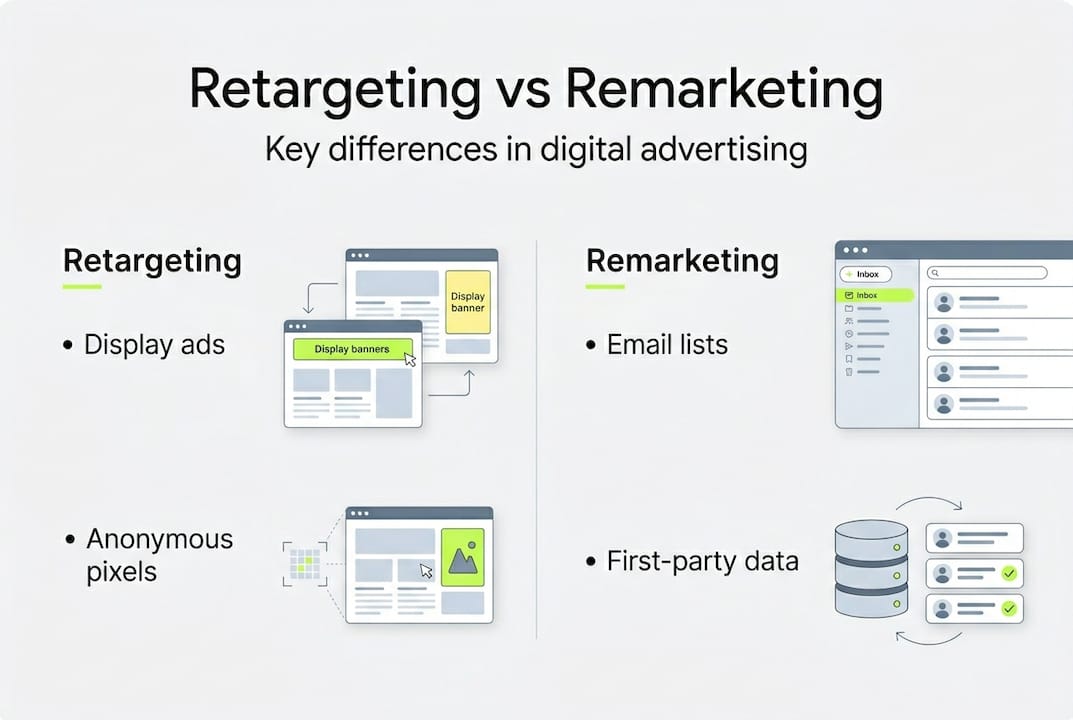
Retargeting uses display ads served across external networks, based on anonymous user behavior tracked via pixels. Remarketing, in contrast, typically relies on email campaigns and first-party data, targeting known contacts who have already shared their information with you.
Factor | Retargeting | Remarketing |
|---|---|---|
Data type | Anonymous, third-party | Known, first-party |
Channel | Display, social, search | Email, SMS |
User relationship | Past visitor | Existing contact |
Compliance sensitivity | Cookie and consent laws | CAN-SPAM, GDPR, HIPAA |
"In practice, most platforms use both terms loosely. What matters is not the label but the strategy behind it."
For SMBs, retargeting is often the faster win because it captures warm traffic without requiring an existing email list. For healthcare providers, remarketing through email to existing patients can be highly effective when done within HIPAA guidelines. In retail, remarketing in retail often combines both approaches for maximum reach.
The practical takeaway: use retargeting to recapture anonymous visitors, and use remarketing to re-engage people already in your database. Both have a place in a well-built paid ad system.
Effective retargeting strategies: Segmentation, timing, and personalization
Not all retargeting audiences are equal. A visitor who spent four minutes on your pricing page is far more valuable than someone who bounced after five seconds. Treating them the same wastes budget.
Here is a framework for building high-performing retargeting campaigns:
Segment by intent. Prioritize high-intent segments like cart abandoners, pricing page visitors, and demo requesters. These users are closest to converting and deliver the strongest ROI.
Set the right window. Test retargeting windows between 7 and 30 days depending on your sales cycle. A healthcare appointment may need a shorter window. A high-ticket e-commerce product may warrant the full 30 days.
Cap your frequency. Frequency caps and exclusions prevent ad fatigue. Showing the same ad to the same person 20 times in a week does not help. It annoys. Cap at 2 to 3 impressions per day.
Rotate your creative. Fresh visuals and copy keep your ads from going stale. Rotate at least every two to three weeks.
Personalize the message. Match the ad to where the user dropped off. Someone who abandoned a cart should see the product they left behind, not a generic brand ad.
Pro Tip: For personalizing ad campaigns, start with three audience tiers: high intent, medium intent, and general visitors. Assign different budgets and creative to each. This alone can cut wasted spend by 30% or more.
Always track ad performance metrics at the segment level, not just the campaign level. Aggregate data hides what is actually working.
Retargeting in practice: Compliance, measurement, and adaptation
Execution without measurement is guesswork. And in regulated industries, execution without compliance is a liability.
For healthcare providers, the rules are clear. Audit your pixels regularly to confirm they are not firing on sensitive pages. Use anonymized audience data. Never build retargeting lists from pages that reveal a user's health condition or treatment status. The fines for HIPAA violations are not small, and the reputational damage is worse.
For all businesses, the cookieless shift is already underway. Server-side tracking and first-party data strategies are replacing third-party cookie dependence. If you have not started building your first-party data infrastructure, now is the time.
Key metrics to track:
CTR: Are people clicking? A healthy retargeting CTR sits between 0.7% and 1.1%
Conversion rate: Are clicks turning into purchases or appointments?
CPA: Is your cost per acquisition trending down over time?
ROAS: Are you generating at least 4x return on your retargeting spend?
Frequency: Are you hitting the same users too often?
Pro Tip: When in doubt about compliance, especially in healthcare, default to broad messaging. Promote your brand or a general service rather than condition-specific content. It keeps you compliant and still builds recall.
For healthcare-specific guidance, explore healthcare campaign measurement and how to analyze ad results in healthcare. For broader budget control, digital ad spend management is a strong next read.
Unlock retargeting success with expert support
Retargeting done right is one of the highest-ROI moves available to SMBs and healthcare providers. But building compliant, well-segmented, and creatively optimized campaigns takes more than a pixel and a budget. It takes a system. We build those systems every day for e-commerce brands and healthcare clients who want results without the guesswork. Our Google Ads management and Meta Ads management services are built around data-driven retargeting strategies that are tested, purposeful, and designed to scale. If you are ready to stop leaving conversions on the table, let's talk.
Frequently asked questions
What is the main goal of retargeting in digital advertising?
Retargeting aims to re-engage past visitors who left without converting, using personalized ads to bring them back at the moment they are most likely to act.
How does retargeting differ from remarketing?
Retargeting uses display ads and anonymous data from pixels, while remarketing typically relies on email and first-party data to reach known contacts in your database.
Are there special legal considerations for healthcare retargeting?
Yes. Healthcare marketers must avoid tracking users on PHI-related pages and must use anonymized data to stay compliant with HIPAA regulations.
What metrics are most important for evaluating retargeting campaigns?
Focus on CTR, conversion rate, CPA, and ROAS. Strong retargeting benchmarks include a ROAS of 4:1 and a CPA that is up to 50% lower than cold traffic campaigns.
How can small businesses avoid ad fatigue in retargeting?
Cap ad frequency at 2 to 3 impressions per day and rotate your creative assets every two to three weeks to keep your audience engaged without overwhelming them.


