Why targeted ad spend matters: boost ROI and fuel growth
Posted on
Marketing
Posted at

Most businesses assume that spending more on ads automatically means better results. It doesn't. The average SMB click-through rate on Google Ads sits at just 6.66%, which means a significant portion of ad budgets are reaching the wrong people entirely. The real lever isn't how much you spend. It's who you're spending it on. This guide breaks down what targeted ad spend actually means, which methods work best, and how precision-focused campaigns consistently outperform raw budget in driving measurable ROI and sustainable growth.
Table of Contents
What is targeted ad spend, and why does it matter?
Core targeting methods and technologies
How targeted ad spend amplifies ROI
Avoiding common pitfalls in targeted ad spend
Applying targeted ad spend: Practical steps for SMBs
Unlock professional support for optimized targeting
Frequently asked questions
Key Takeaways
Point | Details |
|---|---|
Targeting beats raw spend | Focusing on the right audiences makes every ad dollar work harder and improves conversion rates. |
AI levels the playing field | Advanced targeting lets SMBs compete effectively with much bigger advertisers, maximizing impact per dollar. |
Mistakes can hurt ROI | Overly broad or narrow targeting wastes budget, so balance and ongoing adjustment are critical. |
Continuous optimization is key | Regularly audit, test, and refine ad targeting to stay competitive and minimize wasted spend. |
What is targeted ad spend, and why does it matter?
Targeted ad spend means allocating your budget specifically toward audiences most likely to take action, whether that's making a purchase, submitting a lead form, or booking a call. It's the opposite of the "spray and pray" model, where you push ads broadly and hope the right person sees them.
The difference in outcomes is significant. When your message reaches people who already fit your customer profile, relevance goes up, wasted impressions go down, and your cost per acquisition drops. That's not theory. That's what happens when budget follows data instead of guesswork.
Here's why this matters even more now: AI-powered targeting enables SMBs to compete with larger budgets through precision, not volume. You no longer need a Fortune 500 budget to reach the right audience at the right time. The tools exist. The question is whether you're using them.
"Precision matters more than budget size. A well-targeted $5,000 campaign will consistently outperform a poorly targeted $50,000 one."
Key advantages of targeted ad spend include:
Higher relevance: Your ads appear in front of people who actually want what you offer
Less budget waste: Fewer impressions served to unqualified audiences
Improved ROI: More conversions per dollar spent
Scalability: Proven targeting setups can be scaled with confidence
Understanding ad spend management basics is the first step toward building campaigns that actually perform.
Core targeting methods and technologies
Now that you understand why targeting matters, it's time to look at the actual tools and methods available to you. The good news is that modern platforms give SMBs access to targeting capabilities that were once reserved for enterprise advertisers.
The core targeting methods include:
Demographic targeting: Age, gender, income level, education, and job title
Geographic targeting: Country, city, radius around a location, or even specific zip codes
Behavioral targeting: Based on past purchases, browsing habits, and app usage
Lookalike audiences: Platforms find new users who resemble your existing customers
Retargeting: Re-engaging people who visited your site or interacted with your content but didn't convert
Beyond these fundamentals, AI-driven dynamic audience segments and automated bid optimization are changing the game. Platforms like Google and Meta now use machine learning to identify which users are most likely to convert and adjust bids in real time accordingly.
Choosing the right mix depends on your budget and industry. A local service business benefits most from geo and demographic targeting. An e-commerce brand typically sees strong results from behavioral and retargeting setups. A B2B company often leans on job title and industry filters.
Pro Tip: Don't choose between traditional and AI methods. Combine them. Use demographic and behavioral filters to define your audience, then let AI optimize bids and placements within that defined pool. This gives you control and efficiency at the same time.
For a deeper look at building the right setup, explore these ad targeting strategies that we've tested across multiple verticals.
How targeted ad spend amplifies ROI
With targeting strategies understood, the next step is seeing what the numbers actually look like in practice. The gap between untargeted and targeted campaigns isn't marginal. It's often the difference between a campaign that bleeds budget and one that generates consistent returns.
According to 2025 Google Ads benchmarks, the average SMB CTR is 6.66%, but high-performing industries like Arts reach 13.10%. Facebook campaigns often deliver lower cost-per-click than search, with more stable costs over time. These numbers shift dramatically when targeting is dialed in.
"Targeted campaigns don't just perform better. They make every dollar work harder, compounding gains over time as the algorithm learns what converts."
Here's a direct comparison of what untargeted versus targeted campaigns typically look like:
Metric | Untargeted campaign | Targeted campaign |
|---|---|---|
Click-through rate | 1.5% to 2.5% | 5% to 13%+ |
Cost per acquisition | $80 to $150+ | $25 to $60 |
Conversion rate | 1% to 2% | 4% to 8% |
Budget waste | High (60%+) | Low (under 20%) |
The math is straightforward. A targeted campaign with a $3,000 monthly budget can outperform an untargeted $10,000 campaign simply because the spend is going to the right people. Smaller budgets can absolutely compete when precision is the priority.

Learning how ad campaign optimization works in practice, and how cutting ad waste directly impacts your bottom line, gives you a real edge over competitors still running broad campaigns.
Avoiding common pitfalls in targeted ad spend
Targeted spending is powerful, but it's easy to get wrong. We see the same mistakes repeatedly, and they cost businesses real money. Here are the five most common ones:
Audience too broad: You're essentially back to spray and pray. No targeting setup works if your audience pool is too large and undefined.
Audience too narrow: Over-filtering kills reach. If your audience is too small, platforms can't optimize effectively and costs spike.
Underusing AI tools: Ignoring automated bidding and dynamic audience features means leaving performance gains on the table.
Ignoring campaign data: Running ads without reviewing performance weekly leads to slow budget bleed. Data tells you what's working. Use it.
Unclear KPIs: If you don't define what success looks like before launch, you can't measure it afterward. Set specific targets for CTR, CPA, and conversion rate.
Pro Tip: Think of targeting like a dial, not a switch. You're not choosing between broad and narrow. You're finding the right calibration for your specific offer, budget, and platform. Start slightly wider than you think you need, then tighten based on data.
AI targeting reduces waste and learns in real time, which means the longer a well-structured campaign runs, the better it performs. But it needs clean inputs to do that. Garbage audience settings produce garbage results, even with the best AI.
For practical guidance on minimizing wasted ad spend and optimizing paid ads step by step, we've put together resources that walk through exactly how to do this.
Applying targeted ad spend: Practical steps for SMBs
Having learned what to avoid, here's a straightforward process for putting these strategies into action. This isn't a theoretical framework. It's what we actually do when auditing and rebuilding campaigns for clients.
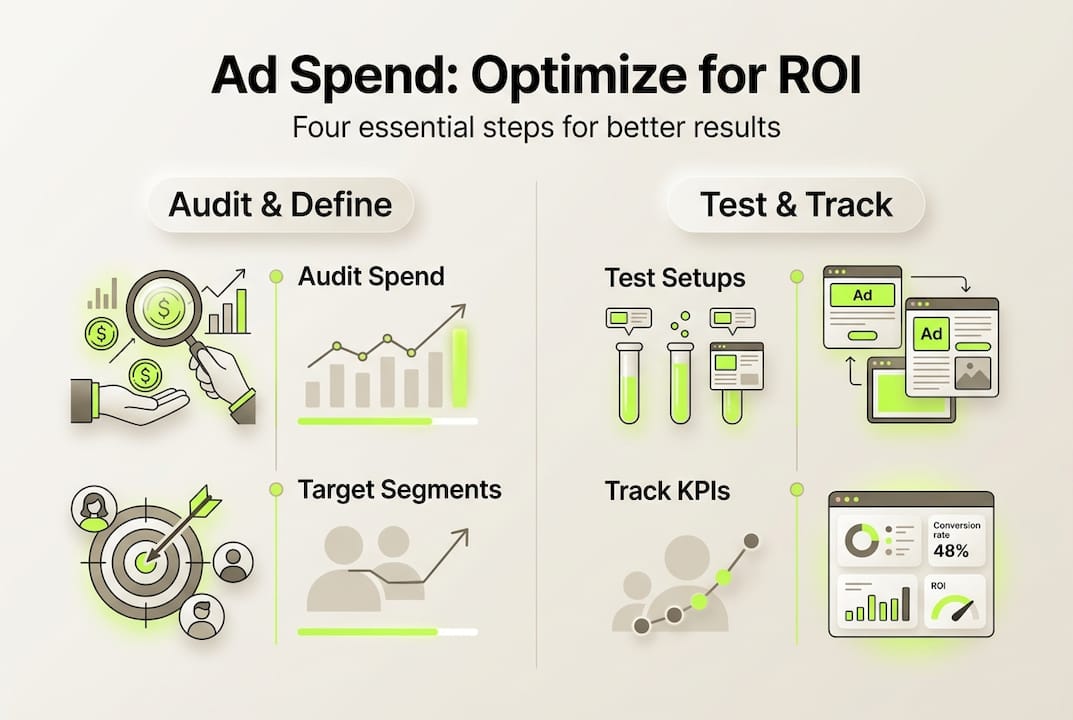
Step 1: Audit your current spend. Pull your last 90 days of campaign data. Identify which audiences, placements, and ad sets are generating conversions versus burning budget.
Step 2: Define your core target segments. Who is your best customer? Build audience profiles based on real customer data, not assumptions. Use your CRM, website analytics, and platform insights.
Step 3: Test targeting setups. Run two or three audience variations simultaneously with identical creative. Let data determine which segment performs best before scaling.
Step 4: Track the right KPIs. Focus on cost per acquisition, return on ad spend, and conversion rate. CTR matters, but it's a leading indicator, not the final measure of success.
Here's a quick reference checklist for ongoing optimization:
Action | Why it matters | Tool or tip |
|---|---|---|
Weekly performance review | Catch budget bleed early | Google Ads dashboard, Meta Ads Manager |
Audience refresh every 30 days | Audiences shift over time | Lookalike updates, new behavioral data |
Creative rotation every 3 to 4 weeks | Ad fatigue reduces CTR | A/B test new visuals and copy |
Bid strategy review monthly | Align bids with current goals | Smart bidding, target CPA settings |
Conversion tracking audit quarterly | Ensure data accuracy | Google Tag Manager, Meta Pixel |
AI enables real-time optimization, reducing waste as campaigns run. But the human layer, reviewing data, refreshing audiences, and testing new creative, is what keeps performance compounding over time.
For platform-specific guidance, our Facebook campaign best practices resource covers the Meta side in detail.
Unlock professional support for optimized targeting
If you're ready to scale results and minimize risk, professional support can accelerate your path to measurable growth. Managing targeted campaigns across Google and Meta simultaneously takes time, expertise, and constant attention to data. That's exactly what we do at A&T Digital Agency.
We build and manage Google Ads campaigns and Meta ad systems designed around your specific audience, budget, and growth goals. No generic templates. No wasted spend on audiences that don't convert. Just data-driven targeting, tested creative, and ongoing optimization that compounds over time. If you want to see what smarter ad spend looks like for your business, explore our full range of services and book a consultation. We keep it simple, focused, and results-driven.
Frequently asked questions
What is the difference between targeted and traditional ad spend?
Targeted ad spend focuses your budget on audiences most likely to convert, while traditional spend spreads your message broadly, usually resulting in lower ROI. Targeted spend maximizes relevance and efficiency over bulk exposure.
How can small businesses compete with big brands in digital ads?
Small businesses can use AI-powered targeting and real-time optimization, allowing even modest budgets to rival big spenders in ad performance. AI targeting enables SMBs to compete through precision rather than volume.
Which platforms offer the best ROI for targeted campaigns?
Google Ads and Facebook consistently deliver strong ROI thanks to advanced targeting features and competitive cost-per-click rates. The average SMB CTR on Google is 6.66%, with Facebook offering lower CPC than search in many categories.
How often should I review and adjust my targeted campaigns?
Review performance weekly and adjust targeting based on ongoing data trends for best results. AI optimizes in real time, but regular human audits are what keep campaigns improving over the long term.