Why Scale Advertising Campaigns for Growth
Posted on
Marketing
Posted at

Scaling paid advertising can feel risky for American CEOs and marketing leaders when every dollar counts toward measurable growth. With digital channels offering unmatched precision, campaigns can be monitored and refined in ways traditional methods never allowed. This guide breaks down how a strategic scaling approach lets e-commerce and healthcare brands expand reach, improve targeting, and sustain performance without losing clarity or overspending.
Table of Contents
Key Takeaways
Point | Details |
Strategic Scaling | Successful advertising scaling requires a comprehensive, data-driven approach integrating precise audience targeting, budget allocation, and continuous performance monitoring. |
Performance Measurement | Key metrics like conversion rate and return on ad spend are essential for assessing effectiveness and guiding strategic decisions. |
Risk Management | Businesses must be aware of potential risks such as resource overextension and campaign clarity loss to ensure sustained growth. |
Agile Adaptation | A disciplined methodology involving rapid iteration and adaptability in strategies is crucial for maximizing advertising effectiveness. |
Scaling Advertising Campaigns Explained
Scaling advertising campaigns represents a strategic approach to systematically expanding digital marketing efforts while maintaining cost efficiency and performance. This process involves methodically increasing ad spend, targeting, and creative strategies to drive measurable business growth across multiple channels.
Digital advertising now offers unprecedented measurement capabilities, allowing marketers to assess advertising effectiveness with precision previously unavailable. Modern businesses can leverage data-driven insights to optimize campaign performance, targeting consumers with increasingly sophisticated approaches.
Successful campaign scaling requires a multi-dimensional strategy focusing on several critical areas:
Precise audience targeting
Systematic budget allocation
Continuous performance monitoring
Rapid iteration based on real-time data
Cross-channel integration
The most effective scaling strategies recognize that growth isn’t about spending more, but spending smarter. This means developing granular understanding of audience segments, crafting hyper-relevant messaging, and using advanced tracking mechanisms to understand exactly how each advertising dollar performs.
Performance Measurement Techniques:
Click-through rate analysis
Conversion rate tracking
Return on ad spend calculations
Customer acquisition cost evaluation
Successful advertising scaling transforms marketing from a cost center into a precise revenue generation engine.
Pro tip: Start small, measure meticulously, and incrementally expand your most successful campaign strategies.
Core Strategies for Successful Scaling
Successful digital advertising campaign scaling requires a strategic, multifaceted approach that goes beyond simply increasing budget. Companies must develop comprehensive strategies that align with their specific business objectives and market dynamics, ensuring each advertising dollar generates maximum potential return.

To achieve sustainable growth, businesses should focus on developing scalable marketing strategies that adapt to changing market conditions. This means creating flexible frameworks that can quickly respond to performance data, audience insights, and emerging digital marketing trends.
Key strategic elements for a successful advertising campaign scaling include:
Precise audience segmentation
Dynamic budget allocation
Continuous performance analytics
Agile creative testing
Multi-channel campaign integration
Advanced targeting technologies
Effective scaling demands a nuanced understanding of each advertising channel’s unique characteristics. This involves developing channel-specific strategies that leverage platform-specific features while maintaining a consistent brand narrative across different media environments.
Here is a comparison of key factors to consider when scaling digital advertising across multiple channels:
Factor | Social Media Ads | Search Engine Ads |
Audience Targeting | Behavior & interests | Keywords & intent |
Creative Flexibility | High, visual formats | Limited, text-focused |
Performance Tracking | Engagement analytics | Click & conversion data |
Budget Allocation | Flexible, campaign-level | Automated or manual |
Iteration Speed | Fast creative testing | Quick keyword updates |
Critical Scaling Components:
Establish clear performance benchmarks
Implement robust tracking mechanisms
Develop flexible budget reallocation processes
Create adaptable creative templates
Successful advertising scaling transforms marketing from a reactive expense into a proactive revenue generation system.
Pro tip: Invest in data analytics capabilities and build a culture of continuous learning and optimization to drive sustainable advertising growth.
Benefits of Scaling Paid Campaigns
Scaling paid advertising campaigns offers businesses a powerful mechanism for accelerating growth and maximizing digital marketing potential. By strategically expanding campaign reach and sophistication, companies can unlock significant performance improvements that drive tangible business outcomes.
Businesses can amplify customer engagement through optimized campaigns that leverage advanced targeting and dynamic ad technologies. This approach enables precise audience segmentation, allowing marketing teams to deliver increasingly personalized messaging that resonates with specific consumer segments.
Key benefits of scaling paid advertising campaigns include:
Expanded market reach
Enhanced audience targeting
Improved conversion rates
More efficient budget allocation
Increased brand visibility
Advanced performance tracking
Successful campaign scaling goes beyond simple budget increases. It requires a sophisticated approach that combines data-driven insights, creative optimization, and strategic audience understanding. Companies that master this approach can transform their advertising from a cost center into a revenue-generation engine.
Strategic Scaling Advantages:
Reduced customer acquisition costs
Higher return on advertising spend
More granular audience insights
Faster marketing iteration cycles
Effective paid campaign scaling turns marketing from an expense into a strategic growth lever.
Pro tip: Continuously monitor campaign performance metrics and be prepared to quickly adjust targeting, creative, and budget allocation based on real-time data insights.
Risks and Challenges When Scaling Ads
Scaling advertising campaigns involves navigating complex operational challenges that can significantly impact business performance. Without careful planning and strategic execution, companies risk undermining their marketing investments and potentially damaging long-term growth potential.
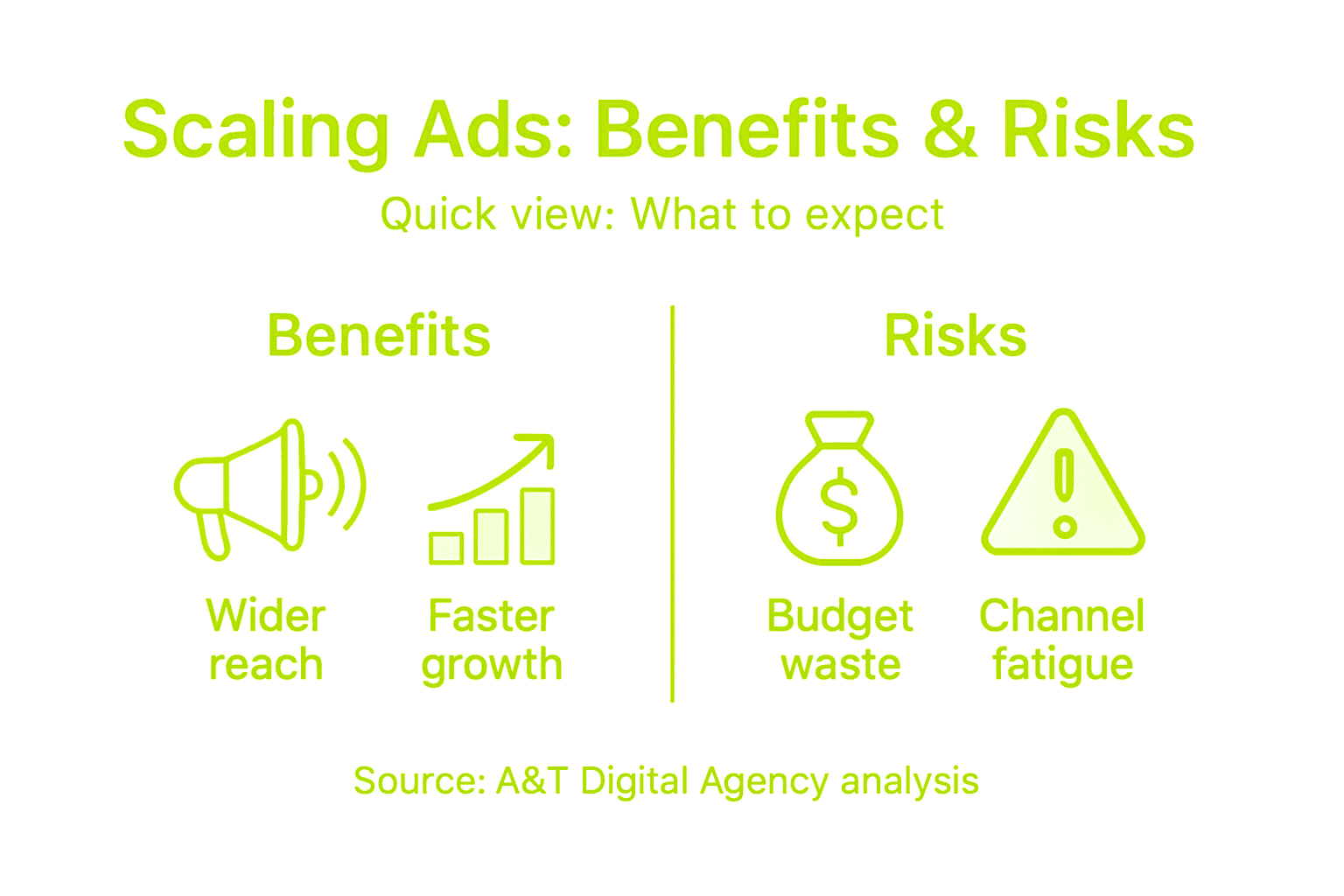
Businesses must be acutely aware of potential scaling challenges to avoid operational failures. These risks extend beyond simple budget considerations, encompassing strategic alignment, resource management, and maintaining the core effectiveness of marketing efforts.
Key risks and challenges in scaling advertising campaigns include:
Resource overextension
Loss of campaign clarity
Misalignment with core customer needs
Increased operational complexity
Diminishing return on advertising spend
Potential brand messaging inconsistency
Successful scaling requires a disciplined approach that balances aggressive growth with strategic restraint. Companies must develop robust frameworks that allow for flexible expansion while maintaining the precision and targeting that initially drove campaign success.
Critical Scaling Risks:
Budget allocation inefficiencies
Targeting strategy degradation
Team coordination breakdowns
Performance metric dilution
Scaling without a disciplined methodology transforms potential growth into potential failure.
Pro tip: Implement strict performance monitoring and create predefined exit strategies for campaign segments that fail to meet established metrics.
Key Metrics and Best Practices for Growth
Successful advertising campaign scaling demands a comprehensive approach to measuring and optimizing performance across multiple dimensions. Marketers must develop a sophisticated understanding of key performance indicators that provide meaningful insights into campaign effectiveness and growth potential.
Businesses can implement advanced marketing analytics strategies to track campaign performance with unprecedented precision. This approach enables data-driven decision-making that transforms raw metrics into actionable strategic insights.
Critical metrics for assessing advertising campaign growth include:
Conversion rate
Customer acquisition cost
Return on ad spend (ROAS)
Click-through rate
Average engagement time
Lead generation volume
Cost per lead
Effective campaign measurement requires a holistic view that tracks performance across the entire marketing funnel. This means establishing clear benchmarks for each stage of customer interaction, from initial awareness to final conversion, and continuously refining targeting and messaging based on empirical data.
The table below summarizes how critical growth metrics impact advertising campaign decisions:
Metric | Growth Impact | Optimization Focus |
Conversion Rate | Signals offer relevance | Landing page & ad creative |
Customer Acquisition Cost | Defines return thresholds | Audience & channel tuning |
ROAS | Measures profitability | Budget reallocation |
Click-Through Rate | Gauges ad engagement | Messaging refinement |
Key Performance Tracking Methods:
Multi-channel attribution modeling
Comprehensive funnel analysis
Segmented performance tracking
Real-time metric dashboards
Successful growth marketing transforms data points into strategic roadmaps for continuous improvement.
Pro tip: Create a standardized reporting framework that connects individual campaign metrics to overarching business objectives, ensuring every marketing effort is measured against meaningful growth indicators.
Unlock Growth by Scaling Your Advertising Campaigns with Expert Guidance
Scaling advertising campaigns can feel overwhelming when facing challenges like inefficient budget allocation, targeting strategy degradation, or the risk of diminishing returns. This article highlights the importance of a disciplined, data-driven approach to expand your market reach and improve conversion rates while avoiding common pitfalls. If you want to transform your marketing efforts into a precise revenue generation engine by mastering performance measurement and continuous optimization, partnering with a specialized agency is essential.
At A&T Digital Agency, we focus exclusively on building and scaling paid advertising systems that deliver measurable results. Our boutique approach combines strategic insight, creative development, and rigorous data-driven execution tailored for small to medium businesses competing in digital spaces. Whether you seek to optimize your Google Ads or Meta campaigns, we help you tackle challenges like resource overextension and campaign clarity loss while maximizing return on ad spend. Learn more about our performance marketing expertise and strategic campaign planning designed to drive lasting growth.
Ready to scale your advertising campaigns with a trusted partner committed to high ROI and personalized service? Visit A&T Digital Agency today and start your journey toward smarter, more efficient paid marketing that accelerates growth and fuels success.
Frequently Asked Questions
Why is scaling advertising campaigns important for business growth?
Scaling advertising campaigns is crucial for business growth because it allows companies to expand their market reach, enhance audience targeting, and improve conversion rates, ultimately transforming marketing efforts into strategic revenue generators.
What are the key components of a successful advertising campaign scaling strategy?
Key components include precise audience segmentation, dynamic budget allocation, continuous performance analytics, agile creative testing, and multi-channel campaign integration to ensure a comprehensive and effective approach.
How can businesses mitigate risks when scaling advertising campaigns?
Businesses can mitigate risks by implementing strict performance monitoring, developing predefined exit strategies for underperforming campaigns, and maintaining alignment with core customer needs to ensure effective scaling without compromising effectiveness.
What metrics should be tracked to measure the success of scaled advertising campaigns?
Important metrics include conversion rate, customer acquisition cost, return on ad spend (ROAS), click-through rate, and average engagement time, which provide valuable insights into campaign effectiveness and growth potential.


