Ad Fatigue: How to Diagnose and Prevent It
Posted on
Marketing
Posted at

Ad fatigue happens when the same audience sees the same creative too many times, and performance starts to fall. CTR drops, CPC rises, and ROAS quietly erodes before most dashboards flag anything. If you suspect it's happening right now, run these three checks first:
Check frequency. Pull the last 7 days. If any ad is averaging a few impressions per person, fatigue is likely already underway.
Check CTR trend. Compare this week to last week. A noticeable CTR drop over a week or two is the earliest reliable signal.
Check spend share. If a creative that used to capture a large share of campaign spend has substantially decreased, the algorithm has already started pulling back. That's a leading indicator, not a lagging one.
Acting on these signals early preserves budget. Waiting for ROAS to collapse means you've already paid for the lesson.
Table of Contents
What Is Ad Fatigue, and What Isn't It?
How to Recognize Ad Fatigue: Metrics, Thresholds, and Diagnostic Checks
How Fast Does Ad Fatigue Set In by Channel?
How to Prevent and Mitigate Ad Fatigue: The Operational Playbook
How to Confirm the Problem Is Ad Fatigue and Not Something Else
Creative Fatigue vs. Audience Fatigue: Different Problems, Different Fixes
When to Retire an Ad and How to Schedule Creative Audits
Key Takeaways
The Signal Most Advertisers Miss
A&T Digital Runs the Playbook So You Don't Have to
Useful Sources
What Is Ad Fatigue, and What Is not It?
Ad fatigue is the measurable decline in ad performance that occurs when the same audience is repeatedly exposed to identical creative. The mechanism is straightforward: novelty drives attention, and repetition kills it. Once a person has seen your ad enough times to recognize it without engaging, performance deteriorates in a predictable pattern.
Three subtypes matter here, and they require different fixes.
Creative fatigue is asset-specific. A single video or image has run too long against the same segment. The creative is the problem, and a fresh asset solves it. Audience fatigue is segment-level. The entire audience pool has been saturated, regardless of which creative you run. Swapping visuals won't help; you need to expand or change who you're targeting. Format fatigue (sometimes called banner blindness) is different again. It's not about your specific ad or audience. It's about a format becoming invisible because users have trained themselves to ignore that placement entirely. Banner blindness is format-level ignoring, while ad fatigue is creative-level wear-out. The remedy for banner blindness is a placement or format change, not a creative refresh.
A real campaign scenario: a prospecting campaign on Meta runs a strong static image for three weeks. Week one, CTR is solid. Week two, it dips slightly. By week three, frequency has climbed past 4, CTR has dropped 22% from peak, and the creative's share of campaign spend has slid from 50% to 18%. That's creative fatigue in motion.
Why it matters beyond the numbers:
CTR falls because familiar ads get skipped faster
CPC and CPA rise as the algorithm pays more to reach increasingly unresponsive users
ROAS degrades, often sharply, once the leading signals have been ignored for too long
Wasted budget compounds daily when fatigued creatives stay live
How to Recognize Ad Fatigue: Metrics, Thresholds, and Diagnostic Checks
The metric map
Metric | What to watch | Signal of fatigue |
|---|---|---|
Frequency | Average impressions per person, 7-day window | Above 3–5 per person |
CTR | Week-over-week trend | Drop of 10–20% over 7–14 days |
CPM | Rising cost per thousand impressions | Sustained upward trend with flat reach |
CPC | Cost per click | Rising alongside falling CTR |
CPA | Cost per acquisition | Rising after CPC climbs |
ROAS | Return on ad spend | Declining after CPA worsens (lagging) |
Spend share | Creative's % of total campaign spend | Sliding below historical baseline |
First-time impression ratio | % of impressions to new users | Falling as retargeting dominates |
Diagnostic checklist
The three-signal pattern of rising frequency, CTR decay, and a sliding share of spend is the most reliable early tell. Use this sequence to confirm:
Pull a 7-day frequency report. Flag any creative averaging above a few impressions per person.
Compare CTR for the same creative over the past two weeks. A moderate drop is an early warning; a larger drop is a confirmed problem.
Check the creative's spend share versus its 30-day average. A significant slide means the platform algorithm is already deprioritizing it.
Look at first-time impression ratio. If most impressions are going to people who've seen the ad before, your fresh reach is gone.
Cross-check CPC and CPA trends. If both are rising while CTR falls, you're past the warning stage.
Confirm the creative has been live for at least 7 days with sufficient volume before acting. Small sample sizes produce noisy data.
Leading vs. lagging indicators
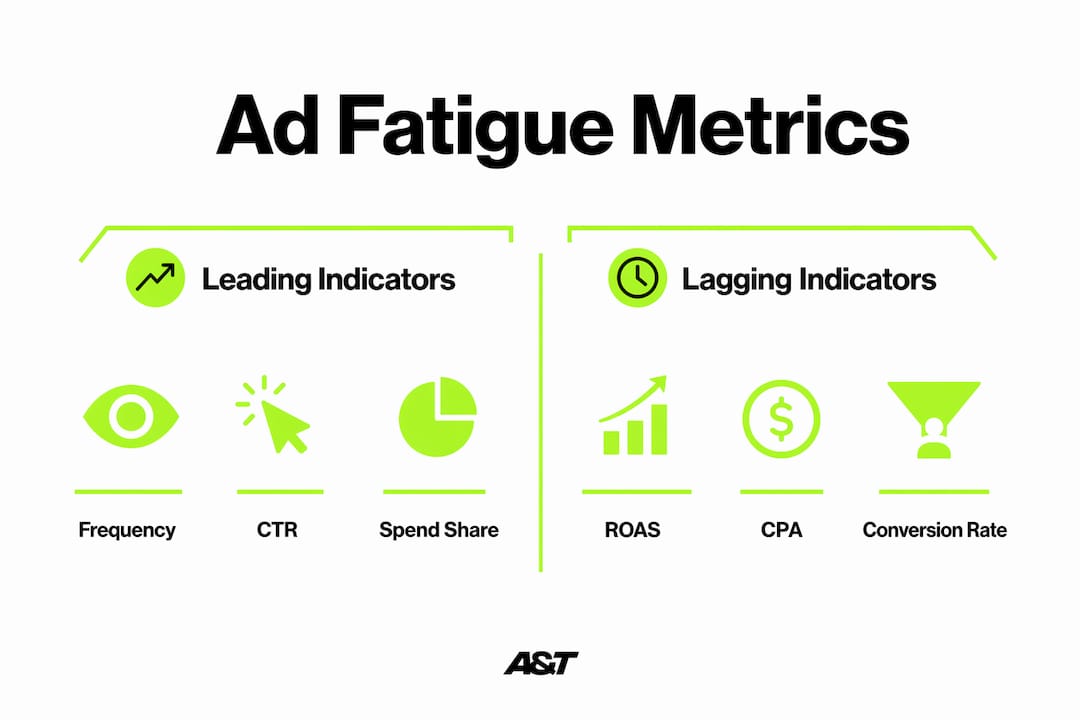
Frequency, CTR, and spend share are leading indicators. They move first, often several days before ROAS or CPA visibly degrades. ROAS and CPA are lagging indicators. By the time they show a problem, you've already burned budget. Build your monitoring around the leading signals, and treat ROAS as confirmation, not the trigger.
How Fast Does Ad Fatigue Set In by Channel?
Channel architecture determines how quickly saturation hits. Audience size, ad density, and algorithmic delivery all vary, and so does the speed of fatigue.
Social feed (Meta, TikTok): Fastest to fatigue. Small audiences and high delivery frequency mean a creative can wear out in 7–14 days. Meta's algorithm is aggressive about serving winning creatives to the same users repeatedly. TikTok moves even faster for trend-driven content. Ad frequency is the primary lever to watch here.
Display and programmatic: Moderate fatigue speed. Audiences are larger and placements more varied, but banner blindness compounds the problem. Refresh cadence of 3–4 weeks is typical.
Search (text ads): Slowest to fatigue in the traditional sense. Users are actively searching, so intent drives engagement more than novelty. Headline and description rotation matters more than visual refresh.
Video and CTV: Fatigue depends heavily on ad length and skip behavior. Pre-roll video can fatigue quickly if frequency is uncapped. CTV audiences are smaller and more captive, so frequency caps are critical.
Retargeting: Highest fatigue risk. By definition, you're showing ads to people who've already seen your brand. Frequency caps of 1–2 per day are standard practice; without them, retargeting becomes the fastest path to audience exhaustion.
Pro Tip: Set refresh cadence by objective, not just channel. Awareness campaigns can sustain a creative longer (3–4 weeks) because the goal is recognition. Conversion campaigns need fresher creative every 1–2 weeks because the audience is smaller and the ask is higher.
How to Prevent and Mitigate Ad Fatigue: The Operational Playbook
Six step prevention plan
Set up monitoring rules before launch. Configure automated alerts in Meta Ads Manager or Google Ads for frequency above 3.5 and CTR drops exceeding 15% week-over-week. Don't wait to check manually.
Apply frequency caps from day one. On Meta, cap delivery at 3–5 impressions per person per week for prospecting. Retargeting caps should be tighter: 1–2 per day. On Google Display, use frequency capping at the campaign level.
Run a structured creative testing cadence. Test roughly 20 new creative variations per week, with 70% entirely new concepts and 30% incremental variations. Expect about a 5% hit rate. This pipeline ensures you always have fresh winners ready to replace fatigued assets.
Manage audience size deliberately. Audiences under 500,000 on Meta fatigue faster. For small audiences, rotate creatives more aggressively or use Advantage+ audience expansion to widen the pool.
Rotate creatives on a schedule, not just when performance drops. Proactive rotation prevents fatigue from starting. Schedule a creative swap every 2–3 weeks for conversion campaigns, every 3–4 weeks for awareness.
Use dynamic creatives and automation. Dynamic ad copy and Meta's dynamic creative feature automatically combine headlines, images, and CTAs, reducing perceived repetition without requiring a full creative rebuild.
Creative refresh checklist
When refreshing an asset, change at least one of these:
Hook (first 3 seconds or headline): The most impactful change. A new opening resets attention even if the offer is identical.
Visual or video format: Switch from static to video, or from lifestyle to product-focused.
CTA phrasing: Small copy changes can meaningfully shift click behavior.
Keep these consistent across refreshes:
Brand colors and logo placement
Core offer and value proposition
Landing page destination
Sample creative calendar
Week | Action |
|---|---|
Week 1 | Launch 3–5 creative variations; begin monitoring frequency and CTR daily |
Week 2 | Identify top performer; pause bottom 20% by CTR |
Week 3 | Introduce 2–3 new concepts; scale the winner |
Week 4 | Full creative audit; retire any asset with high frequency or significant CTR drop from peak. |
Ongoing | Maintain 70/30 new-concept-to-variation ratio; review spend share weekly |
Dos and don'ts:
Do rotate creatives before performance drops, not after
Do test new hooks first; they drive the biggest lift
Don't edit a live fatigued ad and expect recovery; the platform's learning resets and performance rarely returns
Don't pause and reactivate the same creative; start fresh under a new ad ID
How to Confirm the Problem Is Ad Fatigue and Not Something Else
Performance drops have multiple causes. Misdiagnosing fatigue wastes time on creative swaps when the real issue is a broken pixel or a bid strategy change. Work through this sequence first.
Check tracking integrity. Verify that conversion events are firing correctly in Meta Events Manager or Google Tag Manager. A sudden CPA spike with no creative change is often a tracking break, not fatigue.
Check for seasonality or external events. Did a holiday, news event, or competitor promotion shift demand? Compare year-over-year and week-over-week benchmarks.
Check bid and budget changes. A budget cut or automated bid strategy shift can reduce reach and inflate CPC without any creative issue.
Check placement and audience shifts. Did a placement exclusion change? Did an audience overlap increase? These can mimic fatigue symptoms.
Look for creative-specific signals. If one creative is underperforming while others in the same campaign hold steady, that's creative fatigue. If all creatives are declining simultaneously, the problem is likely audience-level, bidding, or external.
Run a control test. Pause the suspected creative and launch a fresh one to the same audience. If performance recovers, fatigue is confirmed. If it doesn't, the issue lies elsewhere.
Two quick scenarios: A conversion rate drops sharply while CTR holds. That's a landing page or offer problem, not a creative one. A tracking break in Google Tag Manager causes reported CPA to spike overnight with no change in actual clicks. That's a measurement issue. Neither is ad fatigue, and treating them as such wastes creative resources.
Creative Fatigue vs. Audience Fatigue: Different Problems, Different Fixes
The distinction between creative fatigue and audience fatigue is the single most important diagnostic call you'll make. Getting it wrong means applying the wrong remedy and losing more time.

Creative fatigue is asset-specific. One video or image has saturated its audience. The audience is still reachable; the creative is just worn out. A single new asset, especially with a fresh hook, typically restores performance within days.
Audience fatigue is segment-level. Every creative you run against that audience is underperforming. The pool is exhausted. A new creative won't help if the same 50,000 people have seen your brand 20 times across multiple assets. The fix is expanding the audience, loosening targeting parameters, or moving to a lookalike or interest-based segment.
Tactical matrix
Problem | Fastest fix | Medium-term fix |
|---|---|---|
Creative fatigue | Launch a new creative under a new ad ID | Build a 4–6 week creative rotation pipeline |
Audience fatigue | Expand audience size or add new segments | Develop new prospecting audiences; test lookalikes |
Both | New creative + audience expansion simultaneously | Restructure campaign with separate ad sets per audience tier |
Pro Tip: Watch spend share at the creative level, not just the campaign level. Platforms quietly reallocate spend away from weakening creatives before ROAS changes. A creative losing spend share is the algorithm's early vote of no confidence.
One agency scenario for each: A single video ad drops CTR by 25% over 10 days while a second video in the same ad set holds steady. That's creative fatigue. Swap the underperformer. In a separate case, all three creatives in a retargeting ad set decline simultaneously after two weeks, despite strong CTR in the prospecting campaign. That's audience fatigue. The retargeting pool is saturated; expanding the audience window from 30 days to 60 days restores delivery.
When to Retire an Ad and How to Schedule Creative Audits
Retirement rules
Apply these as hard triggers, not guidelines:
CTR has dropped 20% or more from the creative's peak performance over any 14-day window
Frequency has exceeded 5 impressions per person in a 7-day period
Spend share has fallen below 10% of campaign budget for 5 days in a row
CPA has risen significantly above the campaign target with no external explanation
When any of these triggers fire, stop the ad. Editing a fatigued ad rarely recovers performance. The platform's learning phase resets on that ad ID, and you lose whatever signal history existed. Launch a replacement under a new ad ID instead.
Audit schedule
Budget level | Daily check | Weekly check | Quarterly audit |
|---|---|---|---|
Large (>$10K/month) | Frequency, CTR, spend share | Full metric review; retire underperformers | Full creative library review; archive vs. reuse decisions |
SMB (<$10K/month) | Not required | Frequency, CTR trend, CPA vs. target | Creative refresh planning; test new formats |
For SMBs running ad creative examples on tighter budgets, weekly checks are sufficient. The key is consistency. A missed week on a small account can mean two weeks of wasted spend on a fatigued creative.
Tweak vs. kill: Tweaking a live ad (changing copy, swapping an image within the same ad ID) resets the learning phase and rarely restores performance. The only exception is a minor copy correction on a healthy ad. For any ad showing fatigue signals, kill it and launch fresh.
Key Takeaways
Ad fatigue is a leading-indicator problem: frequency, CTR decay, and spend-share loss signal it days before ROAS falls, and acting on those signals early is what separates efficient campaigns from wasted budgets.
Point | Details |
|---|---|
Watch leading indicators first | Monitor frequency, CTR trend, and spend share weekly — these signal fatigue before ROAS degrades. |
Know which fatigue type you have | Creative fatigue needs a new asset; audience fatigue needs a new or expanded segment. |
Use hard retirement rules | Retire any creative with a 20%+ CTR drop from peak, frequency above 5, or spend share below 10% for 5 days. |
Test creatives continuously | Aim for a steady pipeline of new concepts (70%) and variations (30%) to always have a fresh winner ready. |
A&T Digital manages this for you | A&T Digital runs structured creative testing, automated monitoring, and retirement rules across Google Ads and Meta campaigns. |
The Signal Most Advertisers Miss
Ad fatigue gets treated as a creative problem. Most teams respond by making a new ad. Sometimes that's right. But the more expensive mistake is treating every performance dip as a creative issue when the real problem is audience exhaustion or a structural campaign flaw.
The spend-share signal is the one I see ignored most often. Platforms like Meta and Google are constantly running internal auctions between your own creatives. When a creative starts losing those internal auctions, its spend share slides quietly, well before CTR or ROAS shows anything dramatic. Teams that only check CTR and ROAS are reading the last chapter of a story that started two weeks earlier.
The other underappreciated point: frequency caps are not a defensive measure. They're an offensive one. Capping frequency at 3–5 per week on prospecting campaigns doesn't just protect the audience from fatigue. It forces the algorithm to find new users, which expands your effective reach and keeps acquisition costs lower over time. Teams that run uncapped campaigns and then scramble to fix fatigue are solving a problem they created.
The diagnose-and-prevent playbook in this article works, but it only works if you build the monitoring habits before you need them, not after the ROAS has already fallen.
A&T agency Runs the Playbook So You Donʼt Have to
Running a structured creative testing cadence, monitoring spend share weekly, and applying hard retirement rules takes real operational discipline. Most SMB teams don't have the bandwidth to do it consistently alongside everything else. That's the gap A&T Digital fills.

We manage Google Ads and Meta campaigns with built-in creative testing rhythms, automated performance alerts, and clear retirement rules baked into every engagement. When a creative starts losing spend share, we catch it before the ROAS drops. When audience fatigue hits a retargeting pool, we expand targeting before the CPA climbs. You get campaigns that stay efficient longer, without the manual monitoring overhead.
If your campaigns are showing any of the signals in this article, reach out. We'll take a look at your account and tell you exactly what's happening.
Useful Sources
Ad fatigue — Wikipedia: Covers the definition of ad fatigue and distinguishes it from banner blindness; useful for understanding the format-level vs. creative-level distinction.
Ad Fatigue: Definition, How It Works — theStacc Glossary: Clear definition with core symptoms (CTR drop, rising CPC/CPA); good starting reference for the basic diagnostic framework.
Ad fatigue early-warning signals — Segwise: Explains the three-signal pattern (frequency, CTR decay, spend-share drop) that precedes ROAS degradation; the most practical early-detection resource available.
What Is Ad Fatigue and How to Fix It — Scalemate: Covers operational thresholds (10–20% CTR drop, frequency above 3) and the creative testing cadence recommendation of ~20 variations per week.
Ad fatigue guidance — Amazon Advertising: Amazon's own guide distinguishing creative fatigue from audience fatigue and the different remedies for each.
Ad fatigue: detection and fixes — Rule1: Practitioner guidance on why editing a fatigued ad fails and why launching under a new ad ID is the correct approach.
What is ad fatigue and how to spot it early — Adrio: Explains how fatigue announces itself through leading indicators several days before dashboard metrics show ROAS or CPA changes.