
Why Scale Paid Ads for Sustainable Growth
Posted on
Marketing
Posted at

Scaling paid ad campaigns can seem straightforward, yet many United States businesses hit unexpected hurdles when growth outpaces results. For CEOs and founders aiming for better ROI in e-commerce or telehealth, understanding paid media means moving beyond myths like assuming increased spending always leads to better returns. This article unpacks the realities of optimizing paid ad strategies and reveals smarter approaches for sustainable growth.
Table of Contents
Defining Paid Ad Scaling And Common Myths
Types Of Scaling Strategies For Paid Ads
How Paid Ads Drive Revenue And Growth
Risks, Costs, And Mistakes When Scaling Paid Ads
Real-World Examples And Key Use Cases
Key Takeaways
Point | Details |
Understanding Paid Ad Scaling | Paid ad scaling involves a strategic increase in advertising budget and reach while optimizing performance metrics, countering common myths that can derail efforts. |
Tailoring Strategies to Markets | Effective scaling strategies require a nuanced approach, including audience segmentation and platform diversification to maximize impact across varied industries. |
Continuous Optimization is Key | Successful paid ad campaigns should focus on continuous performance tracking and creative adaptations rather than merely increasing the budget. |
Recognizing Risks and Mistakes | Marketers should be vigilant about potential pitfalls, such as misallocation of budgets and ineffective targeting, to maintain growth and resource efficiency. |
Defining Paid Ad Scaling and Common Myths
Paid ad scaling represents a strategic approach to expanding digital marketing efforts beyond basic advertising campaigns. At its core, scaling involves systematically increasing ad budget and reach while maintaining or improving performance metrics. Paid media involves marketing efforts that require direct payment to display promotional content across digital platforms like social media, search engines, and websites.
Understanding paid ad scaling requires debunking several persistent myths that often mislead marketers. These misconceptions can derail growth strategies and waste valuable marketing resources. Here are the most common myths surrounding paid ad scaling:
Myth 1: Simply increasing ad spend guarantees better results
Myth 2: Scaling works identically across all industry verticals
Myth 3: More impressions automatically translate to higher conversions
Myth 4: Technical complexity is irrelevant to ad performance
The reality of paid ad scaling is far more nuanced. Efficiently sharing user representations across multiple ad models requires sophisticated technical infrastructure and deep audience understanding. Successful scaling isn’t about spending more—it’s about spending smarter.
Here’s a breakdown of common paid ad scaling myths and the realities behind them:
Myth | Why It’s Misleading | Reality |
Spending always improves results | Assumes money alone drives success | Strategic optimization is essential |
All industries scale the same | Ignores sector-specific variables | Approaches must be tailored |
More impressions equal conversions | Overlooks audience quality | Targeting beats mere exposure |
Technical complexity doesn’t matter | Minimizes backend challenges | Effective scaling requires sophistication |
Marketing professionals must recognize that scaling paid ads involves complex user modeling, precise targeting, and continuous optimization. This means developing strategies that go beyond simple budget increases and focus on:
Audience segmentation
Performance tracking
Creative adaptation
Technical model refinement
Pro tip: Treat paid ad scaling as a precision instrument, not a blunt financial tool—measure, adapt, and optimize continuously.
Types of Scaling Strategies for Paid Ads
Paid ad scaling is not a one-size-fits-all approach but a nuanced strategy involving multiple sophisticated techniques. Multichannel marketing requires marketers to develop flexible, adaptable strategies that can evolve with changing digital landscapes and audience behaviors. Successful scaling demands a comprehensive understanding of different methodological approaches that extend beyond simple budget increases.
Several core scaling strategies emerge as critical for sustainable paid advertising growth:
Incremental Budget Scaling: Gradually increasing ad spend while closely monitoring performance metrics
Geographic Expansion: Targeting new markets and regions systematically
Audience Segmentation: Creating highly targeted campaigns for specific demographic groups
Platform Diversification: Spreading advertising efforts across multiple digital channels
Multichannel approaches combining different platformsrepresent a sophisticated strategy for expanding advertising reach. These techniques involve careful integration of various digital marketing channels to create a cohesive, comprehensive advertising ecosystem.

Advanced scaling strategies also incorporate sophisticated targeting techniques that optimize campaign performance. These include:
Scaling Strategy | Unique Advantage | When It’s Most Effective |
Incremental Budget Scaling | Reduces risk with gradual increases | Testing new campaigns or platforms |
Geographic Expansion | Opens up fresh markets | When local markets saturate |
Audience Segmentation | Enables message precision | Engaging diverse audience segments |
Platform Diversification | Spreads risk and amplifies reach | Reducing dependency on one channel |
Compare different paid ad scaling strategies and what makes each effective:
Retargeting potential customers who have previously interacted with your brand
Developing lookalike audiences to expand reach
Implementing rigorous A/B testing protocols
Leveraging machine learning for predictive audience modeling
Pro tip: Develop a scalable paid ad strategy by treating each campaign as a learning opportunity, continuously refining your approach based on data-driven insights.
How Paid Ads Drive Revenue and Growth
Paid advertising represents a powerful mechanism for generating sustainable business revenue by transforming digital interactions into measurable financial outcomes. Digital marketing fundamentally reshapes how businesses connect with potential customers, creating targeted pathways that directly influence purchasing decisions and brand perception.
The revenue generation process through paid ads involves several critical mechanisms:
Increasing brand visibility across digital platforms
Attracting precisely targeted audience segments
Driving high-intent traffic to conversion points
Generating measurable return on advertising investment
Creating opportunities for customer relationship development
Digital marketing’s impact on revenue generationdemonstrates how strategic advertising can systematically transform audience engagement into tangible business growth. Successful paid ad campaigns leverage sophisticated targeting technologies that match specific consumer behaviors with tailored marketing messages.
Paid advertising drives revenue through multiple strategic approaches:
Precision audience targeting
Conversion-optimized landing pages
Compelling visual and textual ad design
Continuous performance measurement and optimization
Strategic retargeting of interested consumers
Effective paid ads transform casual browser interest into committed customer action, creating a direct pipeline between marketing investment and revenue generation.
Pro tip: Treat your paid advertising strategy as a living system, continuously adapting and refining based on real-time performance data and emerging consumer insights.
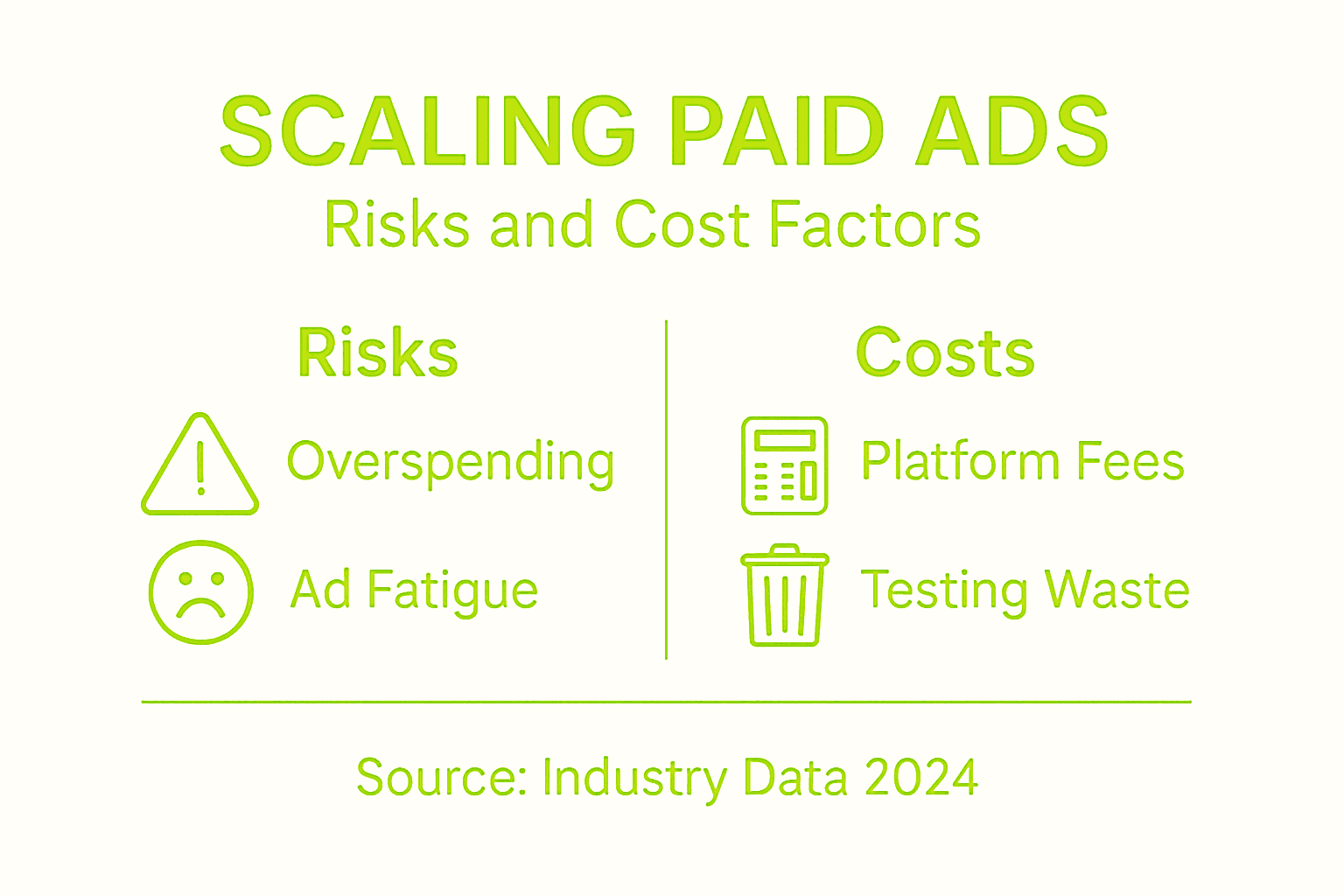
Risks, Costs, and Mistakes When Scaling Paid Ads
Scaling paid advertising is not a straightforward process, but a complex strategic endeavor fraught with potential pitfalls that can rapidly erode marketing budgets. Digital marketing requires meticulous planning and continuous monitoring to avoid costly mistakes that can derail growth efforts and waste valuable resources.
The most significant risks in scaling paid ads include:
Misallocation of marketing budget
Ineffective audience targeting
Diminishing returns on advertising spend
Increased vulnerability to platform algorithm changes
Potential brand reputation damage
Overestimating digital advertising effectivenesscan lead to substantial financial losses. Many businesses incorrectly assume that increased ad spend automatically translates to proportional revenue growth, overlooking critical nuances in campaign performance and audience engagement.
Specific mistakes that can undermine paid ad scaling efforts include:
Neglecting comprehensive performance analytics
Failing to update targeting strategies
Ignoring audience saturation points
Using generic, non-personalized ad content
Inconsistent brand messaging across platforms
Not all ad impressions are created equal—quality targeting matters more than quantity.
Pro tip: Implement a strict 20% rule: regularly pause and reassess 20% of your ad spend to ensure continuous optimization and prevent budget erosion.
Real–World Examples and Key Use Cases
Paid ad scaling isn’t an abstract concept but a tangible strategy that businesses across multiple industries successfully implement to drive growth. Digital transformation has enabled companies to leverage sophisticated advertising technologies that dramatically improve marketing performance and user acquisition strategies.
Key industries demonstrating effective paid ad scaling include:
Healthcare technology platforms
E-commerce marketplaces
Software-as-a-service (SaaS) companies
Direct-to-consumer digital brands
Financial technology startups
AI-driven advertising tools enable efficient campaign scalingacross diverse business environments. These advanced technologies allow organizations to optimize targeting, personalize messaging, and continuously refine marketing approaches with unprecedented precision.
Specific real-world scaling scenarios reveal powerful strategic approaches:
Telehealth platforms expanding patient acquisition through targeted geographic campaigns
E-commerce brands using lookalike audience modeling
Technology companies implementing cross-platform retargeting strategies
Consumer wellness brands creating segmented marketing funnels
Financial services are developing personalized digital advertisement workflows
Successful digital scaling requires intelligent adaptation, not just increased spending.
Pro tip: Develop a modular advertising approach that allows rapid experimentation and data-driven optimization across different audience segments and marketing channels.
Unlock Sustainable Growth by Scaling Your Paid Ads the Right Way
The challenge of scaling paid ads lies not just in pouring more budget into campaigns but in mastering strategies like audience segmentation, performance tracking, and creative adaptation. This article highlights common pitfalls businesses face, such as wasted ad spend, ineffective targeting, and ignoring the importance of technical sophistication. At A&T Digital Agency, we specialize in transforming these complex challenges into measurable wins by building focused Google Ads and Meta campaigns tailored to your unique business needs. Our boutique team prides itself on delivering personalized service that emphasizes strategic planning, smart scaling, and relentless optimization to drive revenue and leads efficiently.
Are you ready to move beyond myths and start scaling with precision? Explore how our performance marketing expertise can help you manage ad spend wisely and maximize ROI. Visit A&T Digital Agency to see real case studies across telehealth, wellness, and retail.
Get started today by partnering with a team that combines creativity with data-driven execution. Experience personal campaign strategy, launch, and optimization designed to grow your business sustainably. Take the first step toward smarter paid ad scaling now at https://atdigiagency.com.
Frequently Asked Questions
What is paid ad scaling?
Paid ad scaling is a strategic approach that involves systematically increasing your advertising budget and reach while maintaining or improving performance metrics.
Why is it important to scale paid ads?
Scaling paid ads is crucial for sustainable growth because it helps expand your audience, increase brand visibility, and ultimately drive revenue without solely relying on increased spending.
What are some common myths about scaling paid ads?
Common myths include the belief that simply increasing ad spend guarantees better results, that all industries scale the same way, and that more impressions automatically lead to more conversions. Each of these misconceptions can hinder effective scaling strategies.
What strategies can be employed for effective paid ad scaling?
Effective strategies for paid ad scaling include incremental budget scaling, geographic expansion, audience segmentation, and platform diversification, allowing for a comprehensive approach to enhancing advertising efforts.