How analytics drives better ROI in digital marketing
Posted on
Uncategory
Posted at

Digital marketing analytics provides measurable insights to optimize campaign targeting and channels.
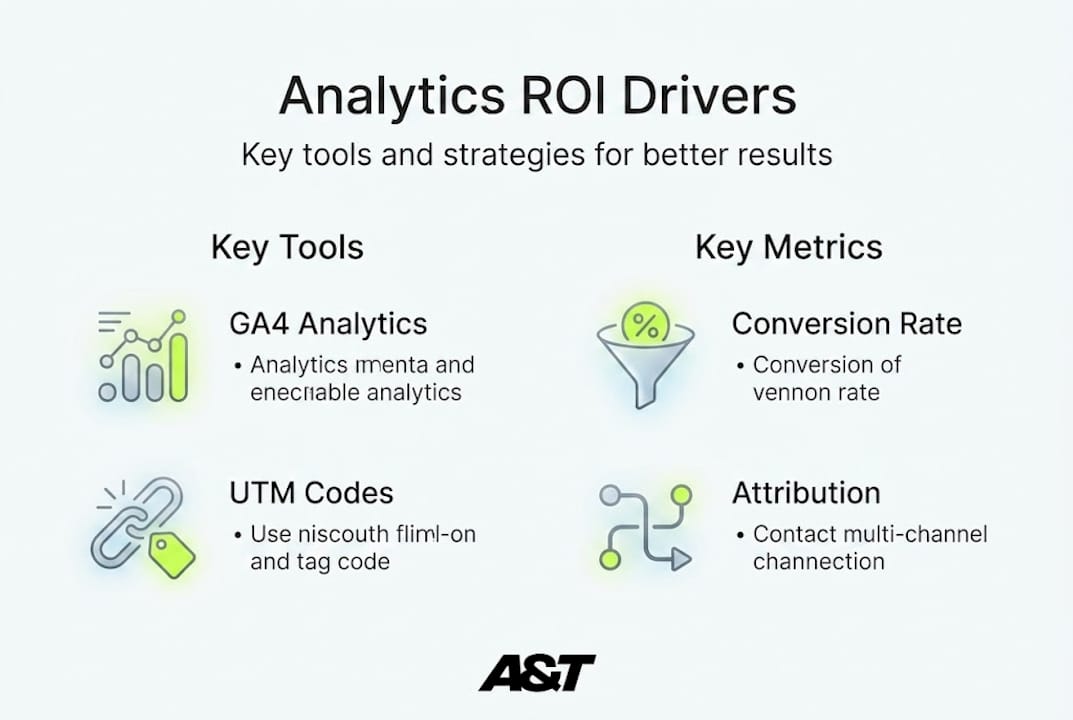
Tools like GA4 and UTM parameters are essential for accurate attribution and performance tracking.
Combining data with human expertise leads to better decision-making and higher ROI.
Creativity gets attention. But data wins budgets. Too many marketing managers at small and medium-sized businesses pour money into Google Ads and Meta campaigns guided by instinct, aesthetic preferences, or what worked two years ago. The reality is that digital marketing analytics gives you something creativity alone never can: a clear, measurable picture of what is actually driving results. In this guide, we break down the essential tools, metrics, and strategies you need to stop guessing and start optimizing with confidence.
Table of Contents
Moving past vanity metrics: Multi-channel measurement and attribution
Turning insights into action: Campaign optimization in the real world
The uncomfortable truth about analytics: Why human insight still matters
Key Takeaways
Point | Details |
|---|---|
Analytics drive ROI | Using analytics enables smarter decisions and tangible marketing results. |
Tools like GA4 and UTM | Essential analytics tools make tracking and optimization easier for every business. |
Measure what matters | Focusing on multi-channel metrics over vanity stats improves campaign performance. |
Human insight required | Even advanced analytics need experienced marketers to interpret and act on data. |
Why analytics are essential in digital marketing
Good creative still matters. Great copy still matters. But neither one saves a campaign that is targeting the wrong audience, running at the wrong time, or spending its biggest budget on the lowest-converting channel. Analytics fixes that. It takes the subjective out of your decision-making and replaces it with something you can act on.
For SMBs especially, this matters more than ever. You do not have the luxury of wasting $10,000 testing what a Fortune 500 company might consider a rounding error. Every dollar needs to work. Analytics tells you which dollars are working and which ones are quietly burning.
Here is what solid analytics practice actually does for your campaigns:
Tracks performance across every channel so you know whether your leads are coming from Google, Meta, email, or organic search
Identifies underperforming segments before they drain the entire budget
Surfaces patterns in audience behavior that no creative brief would ever catch
Builds a paper trail for ROI accountability, which matters when you are reporting to leadership or clients
Enables faster pivots because you see problems early, not after the campaign ends
"In marketing like in chess, those who calculate their moves ahead win. Analytics is how you calculate."
GA4 and UTM parameters are the backbone of this entire system, handling campaign tracking, attribution modeling, funnel analysis, and A/B testing across your paid channels. If you are not using them correctly, you are flying blind.
Pro Tip: Before your next campaign launches, confirm that UTM parameters are applied consistently to every ad link. Missing or inconsistent UTMs are the single most common reason attribution data falls apart at the reporting stage.
When you optimize campaign performance using real data rather than assumptions, the compounding effect is significant. Campaigns get sharper. Spend gets more efficient. And results become predictable instead of random.
Key tools and metrics: GA, UTM, and beyond
Understanding the "why" leads naturally into the "how." Let's look at the essential tools and numbers powering data-driven marketing.
Google Analytics 4, known as GA4, is the current standard for web and campaign analytics. Unlike its predecessor, GA4 is built around events rather than sessions, meaning it tracks specific user actions rather than just page visits. This shift gives you far more granular data on how users interact with your site after clicking an ad.

UTM parameters are short text codes added to your campaign URLs. They tell GA4 where a visitor came from, which campaign sent them, and which specific ad they clicked. Without UTMs, all that paid traffic often lumps together under "direct" or "unassigned," making attribution almost impossible.
Together, attribution and funnel analysis through GA4 and UTM tagging give you the foundation for understanding your full customer journey, not just the last click before conversion.
Beyond those two foundational tools, there are several metrics every SMB marketing manager should monitor closely:
Metric | What it measures | Why it matters |
|---|---|---|
Conversion rate | Percentage of visitors who complete a desired action | Shows if your landing page and offer are connecting |
Cost per acquisition (CPA) | Total ad spend divided by conversions | Tells you the real cost of each customer or lead |
Return on ad spend (ROAS) | Revenue generated per dollar of ad spend | Core profitability metric for paid campaigns |
Engagement rate | Interactions relative to impressions or reach | Gauges creative and audience relevance |
Click-through rate (CTR) | Clicks divided by impressions | Signals ad relevance and messaging strength |
Bounce rate | Users who leave after one page | Flags landing page and audience mismatch issues |
Most businesses track a few of these. The best businesses track all of them together and look for patterns across channels.
Statistic callout: Companies that use data-driven strategies report five to eight times the ROI on marketing spend compared to those that do not. That gap is not accidental. It reflects what happens when measurement becomes a discipline, not an afterthought.
If you explore analytics in advertising, you will find that the difference between a campaign that scales and one that stalls usually comes down to the quality of measurement in place. Not the budget. Not even the creative. The measurement.
One practical step many teams skip: setting up conversion events in GA4 that actually match your business goals. Tracking "page views" is not a conversion event. Tracking "form submission" or "purchase completed" is. Make sure your events are mapped to outcomes that represent real value to your business.
Moving past vanity metrics: Multichannel measurement and attribution
With the right tools in hand, it is essential to measure what actually drives results, not just what looks impressive at a glance.
Vanity metrics are the impressive-looking numbers that do not connect to revenue. Impressions. Follower counts. Raw click totals. These feel good in a report but they do not tell you whether your campaigns are making money. The real work of analytics is getting past them.
The most common pitfall we see with SMB campaigns is overreliance on last-click attribution. This model gives 100 percent of the credit for a conversion to the final touchpoint before the sale, typically a branded search or a retargeting ad. The problem? It completely ignores the awareness-stage Facebook ad, the YouTube pre-roll, and the email nurture sequence that built the relationship. Last-click attribution makes retargeting look like a genius and makes every other channel look useless.
Web analytics versus digital marketing analytics is an important distinction here. Web analytics focuses on what happens on your site. Digital marketing analytics spans the full customer journey across multiple channels, applying attribution models that reflect reality more accurately.
Here is a quick comparison of attribution models and when each makes sense:
Attribution model | How credit is assigned | Best used when |
|---|---|---|
Last-click | 100% to final touchpoint | Short, simple purchase cycles |
First-click | 100% to first touchpoint | Focus on awareness and reach |
Linear | Equal credit to all touchpoints | Long journeys with multiple channels |
Time-decay | More credit to recent touchpoints | Short sales cycles with strong retargeting |
Data-driven | Credit distributed by actual conversion patterns | High-volume campaigns with enough data |
To move past shallow metrics, follow this approach:
Audit your current attribution model. Know which model you are using and whether it matches your actual sales cycle.
Map your customer journey. Identify every touchpoint from first exposure to conversion and make sure each one is tracked.
Switch to a multi-touch model. Even linear attribution is more accurate than last-click for most SMB campaigns.
Benchmark CPA and ROAS per channel. Understand the true cost and revenue contribution of Google, Meta, email, and any other active channels.
Review monthly, not quarterly. Attribution data becomes more useful when you act on it faster.
Pro Tip: If you are running both Google Ads and Meta simultaneously, use a shared UTM naming convention across both platforms. This makes cross-channel comparison inside GA4 far cleaner and prevents hours of data cleanup at reporting time.
When you examine advertising analytics with a multi-channel lens, patterns emerge that single-channel reporting hides entirely. You might discover that Meta is your best awareness driver but your worst converter. Or that branded Google Search has a ROAS of 12 while non-branded campaigns barely break even. These are actionable insights. Last-click data alone would never surface them.
Turning insights into action: Campaign optimization in the real world
With advanced measurement in place, the real power comes from putting analytics to work. Here is how that happens day-to-day.
Analytics data without action is just a report. The teams that win consistently are the ones who build a rhythm of analyzing, testing, and improving on a short cycle. Not quarterly. Not monthly. Weekly, for active campaigns.
Funnel analysis is one of the most powerful and most underused tools available. A marketing funnel analysis maps the journey from first click to final conversion and shows you exactly where people drop off. If 500 users click your ad, 300 land on your page, 80 start the checkout process, and only 12 complete it, your problem is not your ad. It is what happens after the click. Analytics reveals that. Guessing does not.
Here is where funnel analysis typically uncovers the biggest leaks:
Ad to landing page: High CTR but low engagement suggests a mismatch between the ad promise and what users find on the page
Landing page to lead form: Low form starts often point to unclear value propositions or too much friction
Form start to submission: Abandonment here usually means the form is too long, confusing, or asking for too much too soon
Lead to conversion: Drop-off at this stage often signals a sales process issue, not an advertising problem
"The data does not lie. If people are clicking but not converting, your funnel has a hole. Analytics shows you where it is. The fix is yours to make."
Funnel analysis and A/B testing work together as a system. Funnel analysis identifies where the drop-offs are. A/B testing gives you a structured way to fix them. You create two versions of an ad, landing page, headline, or call-to-action, show each to a different segment of your audience, and measure which performs better against a specific conversion goal.
Effective A/B testing for ads follows a few simple rules. Test one variable at a time. Run the test long enough to reach statistical significance, typically at least 100 conversions per variant. And never declare a winner based on CTR alone if your actual goal is purchases or leads.
Here is what an ongoing optimization rhythm looks like in practice:
Weekly: Review conversion rates, CPA, and CTR by campaign and ad set. Pause or reduce budget on underperformers.
Bi-weekly: Check funnel drop-off points. Launch one or two A/B tests targeting the biggest leaks.
Monthly: Review attribution data across channels. Reallocate budget based on true ROAS per channel.
Quarterly: Audit your entire analytics setup. Confirm UTMs are tracking correctly, conversions are firing accurately, and your attribution model still fits your current sales cycle.
Pro Tip: Do not run A/B tests on campaigns that are still in the learning phase on Google or Meta. Let the platform exit the learning phase first, typically after 50 conversions per ad set, before drawing conclusions from test results.
This rhythm is not complicated. But it requires consistency. Most SMBs start it and then let it slide during busy periods. That is where the gap between average campaigns and excellent ones opens up.
The uncomfortable truth about analytics: Why human insight still matters
Here is something we believe strongly, even as a performance marketing team that lives inside data every day: analytics is not the answer. It is the input.
We have seen campaigns with perfect tracking setups fail because the team interpreted the data wrong. They saw a low CTR and blamed the audience when the real issue was the creative. They saw a high conversion rate on one ad set and scaled it aggressively, not realizing the audience was nearly exhausted and performance was about to fall off a cliff.
AI and automation tools are genuinely impressive. Google's Performance Max campaigns and Meta's Advantage+ use machine learning to optimize delivery in ways no human could match at scale. But they optimize for the metrics you give them. If your conversion event is set up incorrectly, the algorithm will optimize brilliantly toward the wrong goal. Garbage in, garbage out.
The best results we see across our client campaigns come from a combination of rigorous data discipline and experienced human judgment. Data tells you what is happening. Experience tells you why. And strategic thinking tells you what to do about it.
There are questions that analytics dashboards cannot answer on their own. Why did performance drop this week? Was it a competitor, a seasonal shift, audience fatigue, or a creative that simply stopped resonating? A machine flags the drop. A skilled marketer diagnoses the cause.
When you use analytics for better decisions, the goal is not to let data make every call. It is to make sure your judgment is informed, tested, and grounded in reality rather than assumption. The teams who win in competitive markets are not the ones with the most data. They are the ones who ask better questions of their data.
That is what we mean when we say performance marketing is both a science and a craft.
Maximize your ROI with expert analytics support
If this guide has made one thing clear, it is that analytics only delivers ROI when it is set up correctly, monitored consistently, and interpreted by people who know what they are looking for. That is exactly what we do at A&T Digital Agency. We build and manage paid ad systems on Google Ads and Meta Ads that are grounded in data from day one. From UTM architecture to funnel analysis to ongoing A/B testing, we handle the measurement layer so you can focus on your business. No unnecessary meetings. Just campaigns built to convert and optimized to scale. If you are ready to stop guessing and start growing, let's talk.
Frequently asked questions
What is the difference between web analytics and digital marketing analytics?
Web analytics focuses on website data such as page views and sessions, while digital marketing analytics covers multi-channel campaign tracking and attribution for a broader picture of marketing performance.
How can small businesses get started with campaign analytics?
Start by setting up GA4 and applying UTM parameters to your campaign links. GA4 and UTM parameters are the core tools for tracking campaign performance and understanding which channels drive conversions.
Are data-driven attribution models always better than last-click?
Data-driven models are often more accurate because they distribute credit based on actual conversion patterns, but they require enough conversion volume to function reliably and are more complex to interpret.
Can AI replace marketers in analyzing digital campaigns?
No. AI boosts efficiency in data processing and automated optimization, but human oversight and strategic thinking remain essential for correctly interpreting insights and making high-stakes campaign decisions.


