The Role of Automation in Ad Buying for SMBs
Posted on
Marketing
Posted at

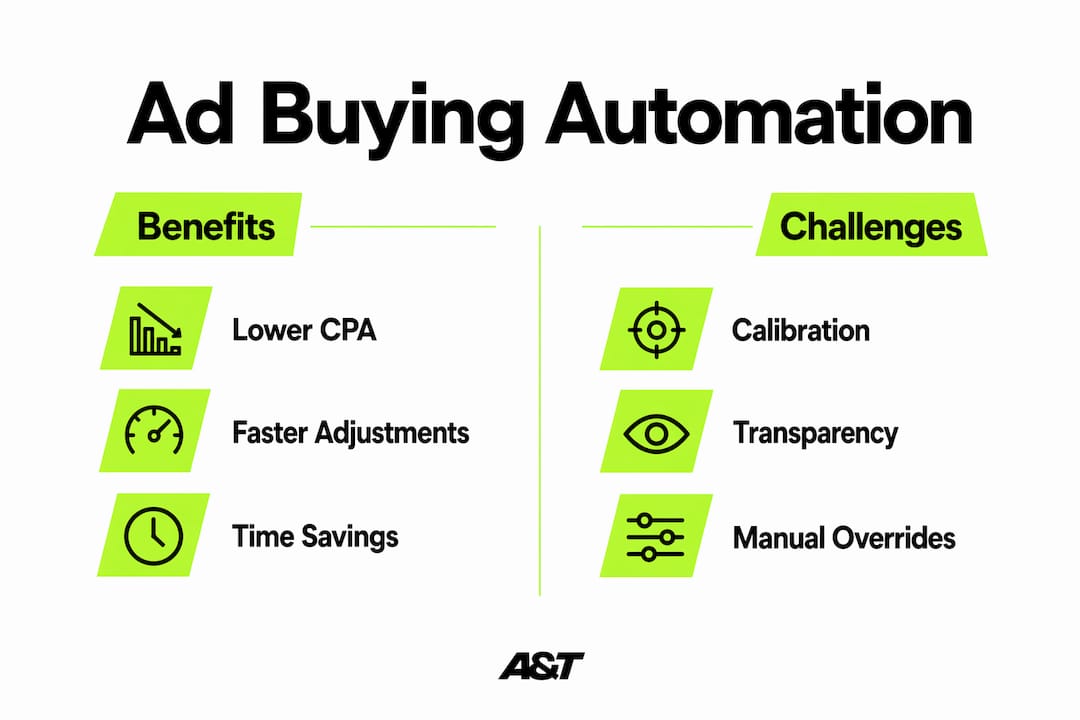
Automation in ad buying uses machine learning and rule-based systems to optimize bids, budgets, and creative delivery. It improves efficiency by acting on performance data instantly, reassigning 20-30% of work from manual tasks to strategy and creative development. Marketers must carefully calibrate, monitor cross-platform transparency, and treat automation as a co-pilot to maximize ROI and maintain control.
Automation in ad buying is defined as the use of machine learning algorithms and rule-based systems to manage bids, budgets, and creative delivery without constant human input. The role of automation in ad buying has shifted from a nice-to-have feature to a core performance driver. Marketing automation delivers $5.44 for every $1 invested over three years. That return comes from 24/7 bid monitoring, real-time budget reallocation, and consistent creative rotation that no manual process can match at scale. For small and medium-sized businesses running paid campaigns on Google Ads or Meta, understanding how automation works is no longer optional.
How does automation improve ad buying efficiency and ROI?
Automation improves ad buying by acting on performance data the moment it changes. A human media buyer checks campaigns a few times per day. An automated system checks and adjusts bids every few seconds based on signals like device type, time of day, audience behavior, and conversion probability. That speed gap is where most of the ROI lives.

The practical gains are measurable. Teams that adopt ad automation reallocate 20–30% of their workweek away from manual tasks and toward strategy and creative work. That shift matters for SMBs especially, where the marketing team is often one or two people wearing multiple hats.
Here is what automation handles that manual management struggles with:
Bid adjustments at the auction level, factoring in dozens of real-time signals simultaneously
Budget pacing to prevent overspend early in the day and underspend at peak hours
Creative fatigue detection, pausing ads that show declining click-through rates before they waste budget
Audience exclusions, automatically removing converters from retargeting pools
Automated media planningalso accelerates plan creation by 50%. That speed advantage compounds when you run campaigns across Google, Meta, and other channels simultaneously.
Pro Tip: Track cost per acquisition (CPA) and return on ad spend (ROAS) weekly during the first month of automation. These two metrics tell you faster than anything else whether the system is learning correctly.
What types of automation are commonly used in advertising?
Automation in advertising operates at two distinct levels: rule-based systems and agentic AI systems. Understanding the difference helps you choose the right approach for your budget and goals.
Rule based automation
Rule-based automation follows fixed if-then logic. If CPA exceeds $50, pause the ad set. If ROAS drops below 2x, reduce budget by 20%. These rules are predictable and transparent. They work well for basic guardrails but cannot adapt to patterns they were not programmed to recognize.
Agentic AI automation
Agentic automation acts independentlywithin defined boundaries, learns from campaign signals over time, and makes decisions without a human writing each rule. It notices signal drift, identifies emerging audience segments, and adjusts strategy accordingly. This is a meaningful leap beyond static rule sets.
The table below shows how these two approaches compare across key dimensions:
Dimension | Rule-based automation | Agentic AI automation |
|---|---|---|
Decision logic | Fixed if-then rules | Machine learning from live signals |
Adaptability | Low, requires manual updates | High, learns and adjusts over time |
Transparency | Fully visible | Requires explainability features |
Best for | Simple guardrails and alerts | Complex, multi-signal optimization |
Setup complexity | Low | Moderate to high |
AI-powered ad automationcovers bidding, creative rotation, budget rules, and cross-platform orchestration. Platform-native AI on Google and Meta handles bidding and audience allocation well. However, compound budget rules and creative automation across platforms require third-party tools or API integrations. SMBs running campaigns on more than one platform will hit this ceiling quickly with native tools alone.
The most sophisticated teams prefer explainable AI that provides clear reasoning behind each recommendation before a marketer approves it. This human-in-the-loop model builds trust and keeps brand decisions in human hands.
What challenges should marketers consider with automated ad buying?
Automation is not autopilot. The challenges of automated ad buying are real, and ignoring them leads to wasted budget and poor results.
The first challenge is the calibration period. Successful ad automation requires a 2–4 week learning phase where the algorithm builds a baseline from real performance data. Marketers who make frequent manual changes during this window disrupt the learning process. The algorithm never gets clean data, and performance stays flat or declines.
Pro Tip: Set a firm internal rule: no manual bid or budget changes for the first three weeks of a new automated campaign. Let the system collect data. Review results at week four before making any adjustments.
The second challenge is cross-platform transparency. Platform-native automation improves performance within each walled garden but creates blind spots across channels. Google's automation does not talk to Meta's automation. Without a unified reporting layer, you cannot see how the two systems interact or whether they are cannibalizing each other's audiences.
The third challenge is financial integration. Closed-loop ad automation that connects planning, execution, and billing reduces operational errors and accelerates invoice collection by 15%. Disconnected finance and media tools create reconciliation errors that distort your true cost per result.
Key risks to monitor actively:
Over-reliance on platform recommendations that favor platform revenue over advertiser ROI
Budget consolidation errors when automation moves spend between campaigns without human review
Creative lock-in, where automation keeps serving the same winning ad until it burns out the audience
Governance gaps when no single person owns the automation rules across all channels
How can SMB marketers implement ad buying automation effectively?
SMB marketers can adopt automation without a large team or a large budget. The key is starting with clear objectives and building from there.
Choose platforms with integrated planning and billing. A single platform that connects media planning, campaign execution, and financial reconciliation removes the manual work of stitching data together. This is where campaign automation for small businesses pays off most directly.
Set performance thresholds before launch. Define your target CPA, minimum ROAS, and maximum daily spend before the campaign goes live. These thresholds become the guardrails for your automation rules. Without them, the system has no definition of success.
Protect the calibration window. Commit to the 2–4 week learning phase. Resist the urge to adjust bids or budgets based on early data. Early volatility is normal and expected.
Use automation to free up time for creative work. The biggest long-term benefit of automation is not the bid savings. It is the hours your team gets back to write better copy, test new angles, and build stronger offers. Teams that boost PPC ROI consistently are the ones investing that reclaimed time into creative quality.
Monitor explainability features weekly. Check why the system made its top three decisions each week. If you cannot explain a budget shift or audience change to a client or stakeholder, the automation is operating as a black box. That is a governance risk.
Pro Tip: Build a simple weekly automation review: check top spend changes, top audience shifts, and top creative performance changes. This 30-minute review keeps you in control without micromanaging the system.
Despite the clear benefits, only 29.1% of agencies use AI for media planning and 22.1% for media buying strategy. That low adoption rate means SMBs that move now gain a real competitive advantage before automation becomes table stakes.
Key Takeaways
Automation in ad buying delivers the strongest ROI when marketers treat it as a co-pilot, not a replacement for strategic thinking, human oversight, and quality creative work.
Point | Details |
|---|---|
Automation ROI is proven | Marketing automation returns $5.44 per $1 invested over three years when applied consistently. |
Calibration period is non-negotiable | Allow 2–4 weeks without manual changes so algorithms can learn true performance signals. |
Two automation types serve different needs | Rule-based systems handle guardrails; agentic AI adapts and learns from live campaign data. |
Cross-platform gaps require active governance | Platform-native automation creates blind spots; unified reporting and human oversight close them. |
SMB adoption is still low | Only 29.1% of agencies use AI for media planning, giving early adopters a clear edge. |
The shift I think most SMBs are still missing
The conversation around automation in advertising almost always focuses on efficiency. Save time, cut CPA, improve ROAS. Those outcomes are real. But the more important shift is what automation does to the role of the marketer.
Automation transforms media buyers from tactical executors into strategic operators. That sounds like a positive spin on job displacement, but it is actually a genuine upgrade. When a system handles bid adjustments and budget pacing, the marketer's job becomes choosing the right audience strategy, writing the creative that actually converts, and reading the data with enough context to know when the algorithm is wrong.
The marketers I see struggling with automation are the ones who handed it the keys and walked away. The ones winning are treating it like a junior analyst. They review its decisions, question its logic, and override it when the brand context requires it. That is exactly what explainable AI architectures are built to support.
For SMBs, the practical implication is this: automation does not replace the need for a clear strategy. It amplifies whatever strategy you already have. A weak strategy automated at scale produces weak results faster. A clear, well-tested strategy automated at scale compounds returns in ways manual management never could.
The 2026 advertising trends point toward more autonomous execution, not less. Programmatic ad spend is projected to hit $220 billion in 2026, and an estimated 25% of ad buys will be autonomously executed by 2028. SMBs that build their automation literacy now will be positioned to compete with larger budgets through smarter execution, not just bigger spend.
— Ann
How A&T agency builds automation into every paid campaign
Atdigiagency runs multi-channel paid ad management that puts automation to work inside a structured, human-reviewed system. Every campaign includes performance thresholds, weekly automation reviews, and creative rotation built into the process from day one. We work with SMBs across Google Ads and Meta to build paid ad systems that produce consistent, measurable results without requiring a full in-house team to manage them. If you want campaigns that run with precision and scale without constant manual oversight, our performance marketing team is ready to build that system with you.
FAQ
What is the role of automation in ad buying?
Automation in ad buying manages bids, budgets, and creative delivery using machine learning and rule-based systems. Its primary role is to act on performance data faster and more consistently than manual management allows.
How long does it take for ad automation to work?
Ad automation requires a 2–4 week calibration period to learn performance signals. Avoid manual changes during this window so the algorithm can build accurate baseline data.
What are the main benefits of ad automation for SMBs?
The main benefits are lower cost per acquisition, faster budget adjustments, and time savings. Teams reallocate 20–30% of their workweek from manual tasks to strategy and creative work.
What are the biggest challenges of automated ad buying?
The top challenges are cross-platform transparency gaps, premature manual interventions that disrupt algorithm learning, and disconnected finance and media tools that create billing errors.
How does agentic AI differ from rule-based ad automation?
Rule-based automation follows fixed if-then logic set by the marketer. Agentic AI acts within defined boundaries, learns from live campaign signals, and adapts its decisions over time without requiring manual rule updates.


