Defining Conversion Optimization: A Practical Guide for Marketers
Posted on
Marketing
Posted at

Conversion optimization is the data-driven process of increasing the share of website visitors who complete a desired action, raising revenue per visitor without necessarily buying more traffic. The industry term is conversion rate optimization, or CRO. CRO improves the percentage of visitors who complete goals such as purchases, signups, or form submissions by removing friction and testing what works. The payoff is direct: the same traffic budget produces more customers, more leads, and more revenue.
Common conversions include:
A visitor completing a purchase on an e-commerce product page
A prospect submitting a lead form to request a demo or consultation
A user signing up for a free trial or newsletter
Experimentation platforms such as Optimizely and VWO are standard tools practitioners use to run and measure these tests. We'll cover both in detail below.
Table of Contents
Why does conversion optimization matter for your business?
What metrics should you track for conversion optimization?
How does the conversion optimization process actually work?
Which CRO tactics consistently move the needle?
What testing methods and tools do practitioners use?
What do real CRO improvements look like?
What are the most common CRO mistakes to avoid?
How do you get started with CRO in 30, 60, and 90 days?
How A&T Digital approaches CRO alongside paid media
Key Takeaways
Who should own CRO: marketing or product?
A&T Digital turns your traffic into revenue
Why does conversion optimization matter for your business?
Rising ad costs and AI-driven search behavior in 2026 make extracting more value from existing visitors more urgent than ever. When you improve your conversion rate, every dollar you already spend on Google Ads, Meta campaigns, or SEO produces a better return. That is the core logic of CRO: work smarter with the traffic you have.
A modest lift compounds fast. If your site converts 2% of 10,000 monthly visitors, you get 200 customers. Push that to 3% and you get 300, a 50% revenue increase from the same traffic. No additional ad spend required.
The business outcomes stack up quickly:
Lower customer acquisition cost (CAC): More conversions from the same traffic means you pay less per customer.
Higher lifetime value (LTV): Better-qualified leads and smoother onboarding tend to retain longer.
Improved campaign ROI: A higher conversion rate lowers cost per lead and improves ROAS across paid and organic channels.
Reduced dependence on traffic growth: You scale revenue without scaling ad spend proportionally.
Retargeting is one channel where this plays out clearly. When your landing pages convert well, retargeting campaigns become significantly more efficient because warm visitors hit a page built to close.
What metrics should you track for conversion optimization?
Conversion rate is the foundation. The formula is straightforward: divide the number of conversions by the number of visits (or sessions), then multiply by 100. For transactional sites, sessions are typically the right denominator. For subscription products, unique users or accounts often make more sense because one person might visit multiple times before converting.
Beyond the headline rate, track these:
Micro-conversions: Smaller actions (add to cart, video play, scroll depth) that signal intent before the main conversion.
Macro-conversions: The primary goal, such as a purchase or a signed contract.
Average order value (AOV): Revenue per transaction. Optimizing for conversion rate while AOV drops can hurt total revenue.
Customer lifetime value (CLV/LTV): The total revenue a customer generates over their relationship with you.
CAC: What you spend to acquire one customer. CRO's job is to push this number down.
One critical caution: optimizing for conversion rate alone can harm profit if you ignore margin or CLV. A promotion that drives a flood of low-margin orders can raise your conversion rate while shrinking your bottom line. Always tie your optimization goals to unit economics.
On statistical significance: sites with fewer than 5,000–10,000 monthly visitors will struggle to reach statistical significance with formal A/B testing. For those sites, qualitative methods and high-impact quick wins deliver better ROI than waiting for test results that may never be reliable. Analytics-driven measurement is the backbone of any credible CRO program, regardless of traffic volume.
How does the conversion optimization process actually work?
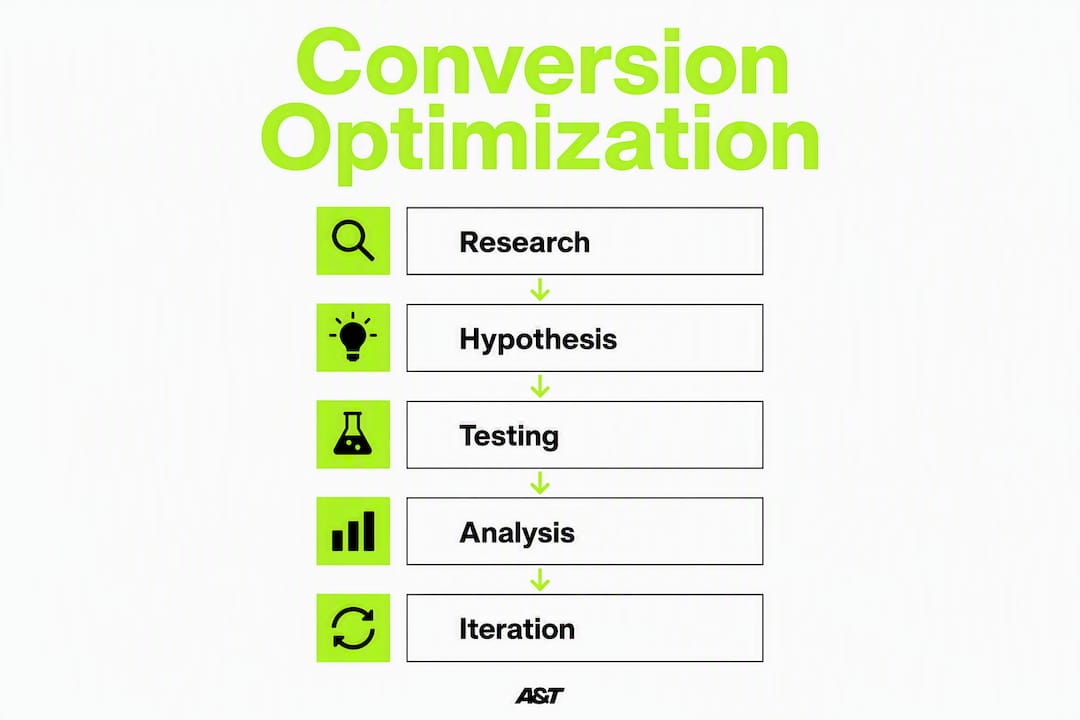
CRO is a structured, iterative processthat blends data analysis, hypothesis formation, prioritized testing, and rollout of winning variations. Here is the workflow we use and recommend:
Define goals. Identify the primary conversion event and the micro-conversions that lead to it. Tie each goal to a business metric (revenue, CAC, LTV).
Gather quantitative data. Pull traffic reports, funnel drop-off rates, and heatmaps from tools like Google Analytics 4, Hotjar, or Microsoft Clarity.
Gather qualitative data. Run user surveys, session recordings, and usability tests. Ask why visitors leave, not just where.
Form hypotheses. Write each hypothesis in a structured format: "If we [change X], then [metric Y] will improve because [reason Z]."
Prioritize tests. Use a scoring framework such as PIE (Potential, Importance, Ease) or RICE (Reach, Impact, Confidence, Effort) to rank experiments by expected return.
Run experiments. Launch A/B or multivariate tests with a pre-set sample size and significance threshold (typically 95%).
Analyze results. Measure lift against the control. Check for segment-level differences (device, traffic source, new vs. returning).
Implement and iterate. Roll out winners, document learnings, and feed insights back into the next hypothesis cycle.
Some teams favor heavy hypothesis testing; others invest in deep audience research before running a single experiment. Both approaches work. The key is committing to a repeatable process rather than one-off tweaks.
Pro Tip: For small teams with limited traffic, skip formal A/B testing on low-volume pages. Instead, implement one high-confidence change at a time, document the before/after metrics, and treat each change as a learning. Speed of iteration beats statistical purity when your sample size is too small to trust the math.

Which CRO tactics consistently move the needle?
The tactics that produce the most reliable lifts share one thing: they reduce friction. Here is where to focus first, along with the principle behind each:
CTA clarity and placement: Vague CTAs ("Submit," "Click here") underperform specific ones ("Get my free audit," "Start my trial"). Place the primary CTA above the fold and repeat it at natural decision points.
Form reduction: Every additional field you ask for reduces completion rates. Cut fields to the minimum required to qualify the lead.
Page speed: Slow load times kill conversions before a visitor even sees your offer. Aim for a Largest Contentful Paint (LCP) under 2.5 seconds per Google's Core Web Vitals standard.
Mobile UX: Mobile traffic dominates most sites. Buttons must be tap-friendly, text readable without zooming, and checkout flows designed for thumbs, not mice.
Social proof: Reviews, testimonials, trust badges, and case study references reduce purchase anxiety at the moment of decision.
Value proposition clarity: Your headline should answer "What do I get and why should I care?" within three seconds of landing on the page.
A quick audit checklist before you run any test: headline clarity, CTA prominence, trust signals visible above the fold, load time under 2.5 seconds, and mobile layout on a real device. Practical CRO checklists consistently surface these five items as the highest-impact starting points.
For SMBs, simple high-impact changes to CTAs, forms, and page speed often produce double-digit lifts without heavy testing infrastructure. Start there before building a full experimentation program.
Pro Tip: Personalization sounds powerful, but it multiplies test complexity fast. Before segmenting by audience, device, or behavior, make sure your baseline experience is solid. A well-optimized universal page almost always outperforms a poorly optimized personalized one.
What testing methods and tools do practitioners use?
A B testing, multivariate, and bandit methods
A/B testing compares one variation against a control. It is the most common method and works well when you have a clear hypothesis and enough traffic to reach significance. Use it for single-element changes: a headline, a CTA, an image.

Multivariate testing (MVT) tests multiple elements simultaneously to find the best combination. It requires significantly more traffic than A/B testing and is best suited for high-volume pages where interaction effects between elements matter.
Bandit testing (multi-armed bandit algorithms) dynamically shifts traffic toward better-performing variations during the test, reducing the cost of showing visitors a losing variant. It trades statistical precision for speed, making it useful when you need fast learning cycles or when traffic is moderate.
Server-side experiments run in the back end and are invisible to ad blockers and browser extensions. They are more reliable for testing pricing, personalization logic, or feature flags. Client-side experiments inject changes via JavaScript and are faster to set up but can cause visual flicker.
Method | Best for | Traffic needed | Speed vs. precision |
|---|---|---|---|
A/B test | Single-element changes | Moderate | High precision |
Multivariate | Multi-element combinations | High | Lower speed |
Bandit test | Fast learning, moderate traffic | Moderate | High speed |
Server-side | Pricing, features, personalization | Any | High reliability |
Optimizely is an enterprise-grade experimentation platform covering A/B testing, feature flags, and full-stack server-side experiments. It integrates with analytics stacks and supports both marketing and product teams. VWO (Visual Website Optimizer) targets marketing teams with a visual editor, heatmaps, session recordings, and A/B testing in one platform, making it accessible for teams without deep engineering resources.
For analytics, Google Analytics 4 remains the baseline. Pair it with a heat-mapping tool (Hotjar, Microsoft Clarity) and your chosen experiment runner for a complete measurement stack.
What do real CRO improvements look like?
Concrete examples ground the theory. Here are the kinds of before/after outcomes practitioners document:
Headline rewrite: Changing a generic headline ("Welcome to our platform") to a benefit-led one ("Cut your reporting time in half") on a SaaS landing page. Outcome: measurable lift in trial signups, often in the 10–25% range depending on baseline quality.
CTA button move: Relocating the primary CTA from below the fold to above it on a lead generation page. Outcome: form completion rates typically improve when the action is visible without scrolling.
Form field reduction: Removing three non-essential fields from a contact form (company size, phone number, job title) while keeping name, email, and message. Outcome: completion rates rise because the perceived effort drops.
Realistic expectations matter here. Most A/B tests produce modest lifts, often in the single digits. The power of CRO is compounding: a 5% lift on your lead form, a 3% improvement on your checkout page, and a 10% gain on your email signup together move the revenue needle significantly over a quarter. For more conversion tactics with documented results, the pattern is consistent: small, friction-reducing changes add up.
What are the most common CRO mistakes to avoid?
Most CRO programs fail not because the tactics are wrong, but because the process breaks down. Watch for these pitfalls:
Chasing vanity metrics: A high click-through rate on a CTA means nothing if the downstream conversion rate is low. Track the full funnel, not just the top.
Underpowered tests: Ending a test early because it "looks like" a winner is one of the most common errors. A test with insufficient sample size will produce false positives. Set your sample size before you start and do not peek.
Ignoring CLV and margins: As noted above, a conversion rate lift on low-margin products can reduce overall profit unless unit economics are factored in. Always ask: "Is this conversion worth the same as our average customer?"
No rollback plan: Deploying a winning variation without a rollback mechanism is a risk. If a change breaks something downstream, you need to revert fast.
Over-personalizing too early: Personalization before you have a solid baseline experience creates complexity without a reliable foundation to build on.
Misreading significance: A 90% confidence level means a 10% chance the result is noise. For high-stakes decisions, require 95% or higher.
The corrective for most of these is the same: document your hypothesis, pre-register your success metric, set your sample size, and do not declare a winner until the math supports it.
How do you get started with CRO in 30, 60, and 90 days?
A phased approach keeps small teams from getting overwhelmed. Here is a practical starter plan:
Days 1–30: Measure and audit
Confirm Google Analytics 4 is tracking key events (form submissions, purchases, button clicks).
Install a heat-mapping tool (Hotjar or Microsoft Clarity, both have free tiers).
Identify your top three highest-traffic pages and run a quick audit: headline clarity, CTA prominence, trust signals, load time, mobile layout.
Set a baseline conversion rate for your primary goal.
Days 31–60: Quick wins and first experiment
Implement one high-confidence change per top page (rewrite a vague headline, move a CTA above the fold, remove form fields).
Document before/after metrics for each change.
Design your first formal A/B test: write the hypothesis, define the success metric, calculate the required sample size.
Launch the test if traffic supports it; use qualitative methods if it does not.
Days 61–90: Analyze, iterate, and plan
Analyze test results and document learnings in a shared experiment log.
Roll out winners; archive losers with notes on why they failed.
Build a prioritized experiment backlog using PIE or RICE scoring.
Review the SMB conversion guide for your next round of hypothesis ideas.
Quick wins to implement immediately, regardless of traffic level:
Rewrite your primary CTA to be specific and benefit-led
Add one trust signal above the fold (review count, security badge, client logo)
Check your page speed with Google PageSpeed Insights and fix the top two issues
Test your checkout or lead form on a real mobile device
How A&T agency approaches CRO alongside paid media
At A&T Digital, we treat conversion optimization as inseparable from paid media performance. Running Google Ads or Meta campaigns to a page that leaks conversions is like filling a bucket with a hole in it. Our workflow maps directly to the CRO process:
Research phase: We audit landing pages, review analytics data, and identify the highest-friction points before a campaign launches.
Experiment design: We build hypothesis-driven creative and landing page variations, using analytics to connect campaign performance to on-site conversion data.
Creative testing: Ad creative and landing page copy are tested together, because a mismatch between ad promise and page delivery is one of the most common conversion killers.
Measurement: We track CAC and ROAS at the campaign level, not just conversion rate, so every optimization decision ties back to unit economics.
Knowledge transfer: When we work with client teams, we document every experiment, hypothesis, and result. Outsourcing CRO creates a knowledge drain risk if the client does not internalize the experimentation roadmap. We build the process so clients can own it.
Pro Tip: Before you scale ad spend, audit your landing page conversion rate. If it is below your industry baseline, every dollar you add to media budget is amplifying a leaky funnel. Fix the page first, then scale.
For additional tactical depth, the digital marketer's CRO guide covers practical checklists that complement this workflow well.
Key Takeaways
Conversion rate optimization works by removing friction from the path to conversion, and the compounding effect of small, consistent lifts is what makes it one of the highest-ROI activities in digital marketing.
Point | Details |
|---|---|
CRO definition | CRO increases the share of visitors who complete a desired action, raising revenue without more traffic. |
Tie to unit economics | Always evaluate conversion lifts against CAC, CLV, and margins to avoid counterproductive wins. |
Traffic thresholds matter | Sites with fewer than 5,000–10,000 monthly visitors should prioritize qualitative methods over formal A/B tests. |
Start with a 30-day audit | Instrument events, audit top pages, and implement one high-confidence quick win before running formal experiments. |
A&T Digital's approach | A&T Digital integrates CRO with paid media management, tying every experiment to CAC and ROAS outcomes. |
Who should own CRO: marketing or product?
The honest answer is that it depends on where the conversion happens, and most organizations get this wrong by defaulting to one team entirely.
Marketing should own CRO when the conversion happens on campaign-specific assets: paid search landing pages, Meta ad destinations, email click-throughs. These pages exist to convert traffic from a specific source, and the team managing that traffic should control the page. Misalignment between ad creative and landing page is almost always a marketing-side problem.
Product should own CRO when the conversion is embedded in the core user flow: onboarding sequences, in-app upgrade prompts, checkout within a product. Product teams have the engineering access and the user research context to run server-side experiments on these flows without breaking the experience.
Shared ownership works when both teams document their experiments in a single log and agree on which metrics each team is accountable for. The breakdown happens when marketing runs a landing page test that contradicts a product-side onboarding change, and neither team knows the other is testing. That kind of overlap produces unreliable results and organizational friction.
When you bring in an agency for CRO support, plan the knowledge transfer from day one. The experiment roadmap, hypothesis log, and test results should live in your systems, not the agency's. An agency that builds a process you can internalize is worth far more than one that creates dependency.
A&T agency turns your traffic into revenue
Most businesses spending on Google Ads or Meta campaigns are leaving conversions on the table, not because the ads are wrong, but because the pages they send traffic to are not built to close. A&T Digital's performance marketing engagements include conversion tracking setup, landing page audit, creative testing, and ongoing campaign optimization, so your paid media and your on-site experience work together.
Clients typically see improvements in lead quality, lower CAC, and higher revenue per visitor when paid media and conversion work are managed as one system rather than two separate workstreams. We keep teams small, communication direct, and reporting tied to the metrics that actually matter to your business.
Ready to see where your funnel is losing revenue? Review our Google Ads management services or explore our Meta Ads management to start a conversation about what a conversion-focused engagement looks like for your business.