Patient Acquisition Strategy Guide for Healthcare Marketers
Posted on
Marketing
Posted at

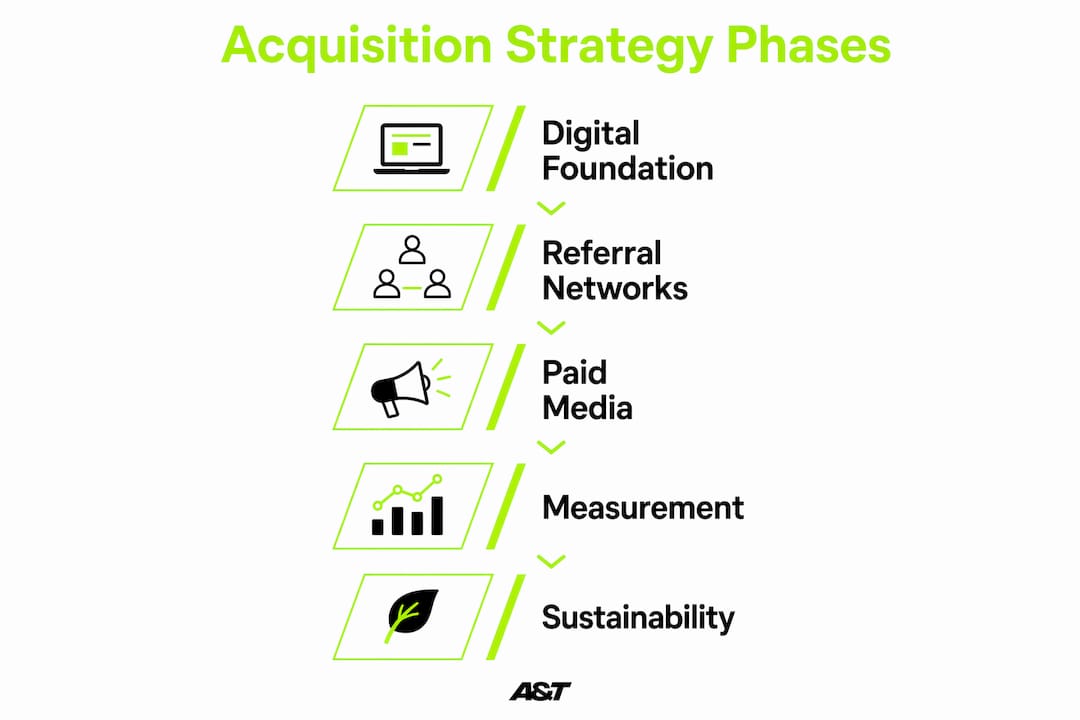
A patient acquisition system involves building a digital foundation, developing referral networks, and adding paid media. It depends on tracking metrics like patient acquisition cost and lifetime value to ensure sustainable growth. Most failures come from operational gaps, not marketing, emphasizing organizational alignment and strong infrastructure.
A patient acquisition strategy is a systematic approach to attracting, converting, and retaining new patients through coordinated digital, referral, and paid marketing efforts. The industry term for this discipline is patient acquisition management, and it sits at the center of every sustainable healthcare marketing plan. This guide covers the full sequence: digital foundation, referral development, paid media layering, and the metrics that tell you whether it is working. Healthcare advertising spend is projected to reach $67.87B by 2033, growing at 5.4% CAGR from $44.56B in 2025. That growth signals intensifying competition, and practices without a structured acquisition system will lose ground fast.
What is a patient acquisition strategy guide for healthcare?
A patient acquisition strategy guide is a sequenced playbook that moves through three phases: build a digital foundation, develop referral networks, then add paid amplification. Systematic sequencing is the key to efficient budget use and sustainable growth. Skipping phase one and going straight to paid ads is one of the most common and costly mistakes healthcare marketers make. Each phase depends on the previous one to work properly.
Two metrics anchor every phase of this system. Patient Acquisition Cost (PAC) measures what you spend to bring in one new patient. Lifetime Value (LTV) measures the total revenue that patient generates over their relationship with your practice. A sustainable PAC-to-LTV ratio stays under 20%, meaning if a primary care patient has an LTV of $1,500 to $3,500, your PAC should not exceed $300 to $700. Specialty patients carry LTVs of $5,000 to $15,000 or more, which gives you more room to spend on acquisition.
What foundational digital presence elements must healthcare marketers establish first?
Your digital presence is the infrastructure that every other tactic runs on. Without it, referral programs underperform and paid ads waste budget. 75% of people judge a business by its website design, which means a slow, outdated, or mobile-unfriendly site actively drives patients away before they ever book.
The non-negotiables for a healthcare digital foundation include:
Mobile-optimized website with fast load times, clear service pages, and online booking
Local SEO targeting condition-specific and location-based keywords
Google Business Profile with accurate hours, services, and recent patient reviews
Consistent NAP data (name, address, phone) across all directories including Healthgrades, Zocdoc, and WebMD
Content that builds trust, such as provider bios, patient education articles, and FAQ pages
Local SEO carries outsized weight in healthcare. Ranking in Google's local 3-Pack increases appointment requests by 3 to 5 times compared to page 2 listings. That gap is not marginal. It is the difference between a full schedule and an empty one.
Reputation management is equally critical. A practice with fewer than 10 Google reviews or an average below 4.0 stars loses patients to competitors before a single ad runs. Respond to every review, positive or negative, and build a system for requesting reviews at checkout or via post-visit text.
Pro Tip: Set up a Google Business Profile post schedule. Publishing weekly updates about services, hours, or health tips signals activity to Google's algorithm and keeps your listing competitive in local search results.
Brand consistency across every touchpoint, from your website to your email signature to your waiting room signage, builds the kind of trust that converts a first visit into a long-term patient relationship.
How can referral networks and patient personas enhance acquisition and retention?
Referral programs are the highest-ROI acquisition channel most practices underuse. Physician referral networks and patient referral programs together create a compounding growth loop that paid ads cannot replicate on their own.
Build your physician referral network with these steps:
Map your current referral sources. Identify which physicians already send you patients and how frequently.
Reach out with value, not just requests. Share clinical updates, co-host CME events, or offer fast consultation turnaround as a differentiator.
Assign a referral coordinator. One dedicated person tracking referral relationships dramatically improves follow-through.
Create a patient referral program. Offer existing patients a simple, compliant incentive such as a wellness gift card for referring a friend or family member.
Track referral source data in your EHR or CRM. You cannot grow what you do not measure.
Patient personas are the tool that makes all outreach more effective. A persona is a detailed profile of your ideal patient type, including age, insurance status, primary health concern, preferred communication channel, and decision-making triggers. Personalized patient messaging boosts engagement by up to 80% compared to generic outreach. That number reflects a fundamental truth: patients respond to communication that feels relevant to their specific situation.
Pro Tip: Build at least three distinct patient personas for your practice. A 45-year-old managing a chronic condition has different concerns and search behaviors than a 28-year-old seeking preventive care. Separate messaging for each persona outperforms a single generic campaign every time.

Combining physician referral networks with persona-driven patient outreach creates a referral flywheel. Referred patients also tend to have higher LTV and lower churn, which directly improves your PAC-to-LTV ratio over time.
What are the best paid media tactics for patient acquisition?
Paid media is the amplification layer. It works best after your digital foundation is solid and your referral system is generating data. Launching Google Ads or Meta campaigns before those foundations exist means paying to send traffic to a leaky bucket.
Channel | Best use case | Avg. PAC range |
|---|---|---|
Google Search Ads | High-intent patients searching specific conditions | $50–$150 |
Meta (Facebook/Instagram) Ads | Awareness and retargeting for elective services | $40–$120 |
Performance Max (Google) | Multi-surface reach with AI-driven placement | $60–$160 |
Programmatic Display | Brand awareness in defined geographic areas | $30–$90 |
Google Search Ads capture patients already searching for care. A patient typing "orthopedic surgeon near me" is ready to book. Google Ads for healthcare campaigns targeting condition-specific keywords consistently deliver the lowest PAC for high-intent services.
Meta ads serve a different function. They build awareness for elective services like cosmetic dermatology, fertility treatment, or weight loss programs where patients are not yet actively searching. Meta ads drive patient growth for telehealth brands by reaching patients in their social feed before they reach Google. Retargeting website visitors with Meta ads is one of the most cost-efficient tactics available.
Performance Max campaigns use Google's AI to serve ads across Search, Display, YouTube, Gmail, and Maps simultaneously. They work well for practices with enough conversion data to train the algorithm. Without sufficient data, they can burn budget on low-quality placements.
Key rules for paid media in healthcare:
Never run paid campaigns without conversion tracking in place
Keep ad messaging compliant with HIPAA and FTC guidelines
Align ad spend to maintain your PAC-to-LTV ratio below 20%
Test at least two creative variants per ad set before scaling
Pro Tip: Review your paid advertising options for clinics before committing budget to a single channel. Channel mix depends on your service type, geography, and growth stage.
How to measure and sustain your patient acquisition system over time?
Measurement is what separates a campaign from a system. A campaign runs, ends, and gets replaced. A system generates data, improves with each cycle, and compounds results over time.
Track these metrics monthly:
PAC by channel: Know exactly what each channel costs per new patient
LTV by patient type: Primary care, specialty, and elective patients have very different revenue profiles
Conversion rate by funnel stage: From ad click to appointment booked to first visit completed
Referral source attribution: Which physicians or patients are sending the most valuable referrals
Front desk booking rate: The percentage of inbound calls that result in a scheduled appointment
Auditing clinical white space and front desk throughput is a step most marketing teams skip. If your campaigns generate 200 inbound calls per month but your front desk converts only 40% of them, you are losing 120 potential patients. No amount of ad spend fixes a broken intake process.
Collaborating with compliance teams earlyproduces better messaging and fewer campaign delays. Compliance reviews that happen after creative development waste time and budget. Bring compliance into the briefing stage, not the approval stage.
Starvation marketing is the pattern where leadership underfunds marketing, sees weak results, and cuts the budget further. It is a self-reinforcing failure cycle. Executive commitment to a defined marketing budget is not optional. It is the prerequisite for building any acquisition system that works.
Use analytics platforms like Google Analytics 4 and your CRM to build a monthly performance dashboard. Review it with your team, identify the lowest-performing channel, and reallocate budget toward what is working. Tracking campaign performance in healthcare requires connecting ad platform data to actual appointment bookings, not just clicks or form fills.
Key Takeaways
A sustainable patient acquisition system requires a sequenced build: digital foundation first, referral development second, and paid media third, all anchored by a PAC-to-LTV ratio kept below 20%.
Point | Details |
|---|---|
Sequence your phases | Build digital presence before referrals, and referrals before paid ads. |
Track PAC and LTV together | A PAC-to-LTV ratio above 20% makes scaling unprofitable. |
Local SEO drives bookings | Google 3-Pack ranking increases appointment requests by 3 to 5 times. |
Personalize all outreach | Tailored messaging lifts patient engagement by up to 80% over generic campaigns. |
Audit operational capacity | Front desk conversion rates determine whether marketing spend turns into revenue. |
What most patient acquisition guides get wrong
Most guides treat patient acquisition as a marketing problem. It is actually a systems problem. The marketing is the easy part. The hard part is aligning your clinical capacity, front desk operations, compliance team, and executive leadership around a shared growth goal.
I have seen practices spend $15,000 a month on Google Ads while their front desk let 40% of inbound calls go to voicemail. The campaigns were performing. The system was broken. No patient acquisition strategy survives that kind of operational gap.
The 'Tower of Power' concept, which prioritizes core messaging and digital presence as an executive-level commitment before any tactics launch, is the right mental model. It reframes acquisition from a marketing department task to an organizational priority. That shift changes everything, from budget allocation to how quickly compliance reviews happen to whether the front desk gets trained on converting inbound calls.
AI-driven ad formats like Performance Max and Google's AI-powered search ads are changing the paid media layer fast. They reduce the manual work of keyword management and bid optimization. But they amplify whatever foundation exists beneath them. A weak digital presence with poor conversion tracking fed into Performance Max will spend your budget efficiently on the wrong outcomes.
The practices that will win patient acquisition in 2026 are the ones that treat it as a permanent operational function, not a quarterly campaign. That means a dedicated budget, a clear measurement framework, and leadership that understands why a strong PAC-to-LTV ratio matters more than raw patient volume.
— Ann
Ready to build a patient acquisition system that actually scales?
At Atdigiagency, we build and manage paid acquisition systems for healthcare organizations across Google Ads and Meta. We do not run generic campaigns. We build channel-specific strategies based on your practice type, growth stage, and PAC-to-LTV targets. Our team has run campaigns for telehealth brands, health and wellness clinics, and specialty practices, and we know what moves the needle in competitive healthcare markets. If you are ready to stop guessing and start scaling, our Google Ads management and Meta ads management services are built for exactly this. Let us show you what a real acquisition system looks like.
FAQ
What is patient acquisition cost (PAC)?
Patient Acquisition Cost is the total marketing spend divided by the number of new patients acquired in a given period. Practices typically achieve a PAC of $50 to $150 per new patient depending on the channel used.
What PAC–to–LTV ratio is considered healthy?
A PAC-to-LTV ratio under 20% is the benchmark for sustainable growth. Spending above this threshold makes scaling unprofitable over time.
How does local SEO affect patient acquisition?
Ranking in Google's local 3-Pack increases appointment requests by 3 to 5 times compared to listings on page 2. Local SEO is the highest-leverage free channel for most practices.
When should a practice start running paid ads?
Paid ads perform best after a solid digital foundation and referral system are in place. Launching paid campaigns without conversion tracking or a mobile-optimized website wastes budget on traffic that does not convert.
How do patient personas improve acquisition results?
Personas allow you to tailor messaging to specific patient types. Personalized outreach boosts engagement by up to 80% compared to generic campaigns, which directly lowers PAC and improves booking rates.