What is ad copywriting? Boost your ads results
Posted on
Marketing
Posted at

Most business owners assume that clever, polished language is what makes an ad perform. It isn't. The words you choose matter, but the structure, intent, and strategic alignment behind those words matter far more. 2026 e-commerce ad benchmarks reveal striking differences in click-through and conversion rates across platforms, and the gap almost always traces back to messaging quality. Whether you run an e-commerce store or a service-based business, this guide breaks down what ad copywriting actually is, why it drives measurable results, which frameworks work best, and how to apply them to your campaigns starting today.
Table of Contents
Key Takeaways
Point | Details |
|---|---|
Ad copy’s business impact | Expertly written ad copy can increase click-through and conversion rates, boosting ROI. |
Frameworks drive results | Using emotional, rational, and modular angles makes messaging more persuasive. |
Context shapes copy length | Choose short or long copy depending on audience temperature and offer complexity. |
Data beats guesswork | Regularly A/B test and refine your ad copy for continuous improvement. |
UGC’s power | User-generated copy can outperform polished ads, especially on social channels. |
What is ad copywriting?
Ad copywriting is the craft of writing text for paid advertisements with one goal: persuading the right person to take a specific action. It is not about sounding impressive. Every word serves a conversion purpose.
General content writing informs or entertains. Ad copy converts. That distinction changes everything about how you write. A headline on a blog post can be curious and open-ended. A headline in a paid ad must stop the scroll, communicate value, and earn the click in under three seconds.
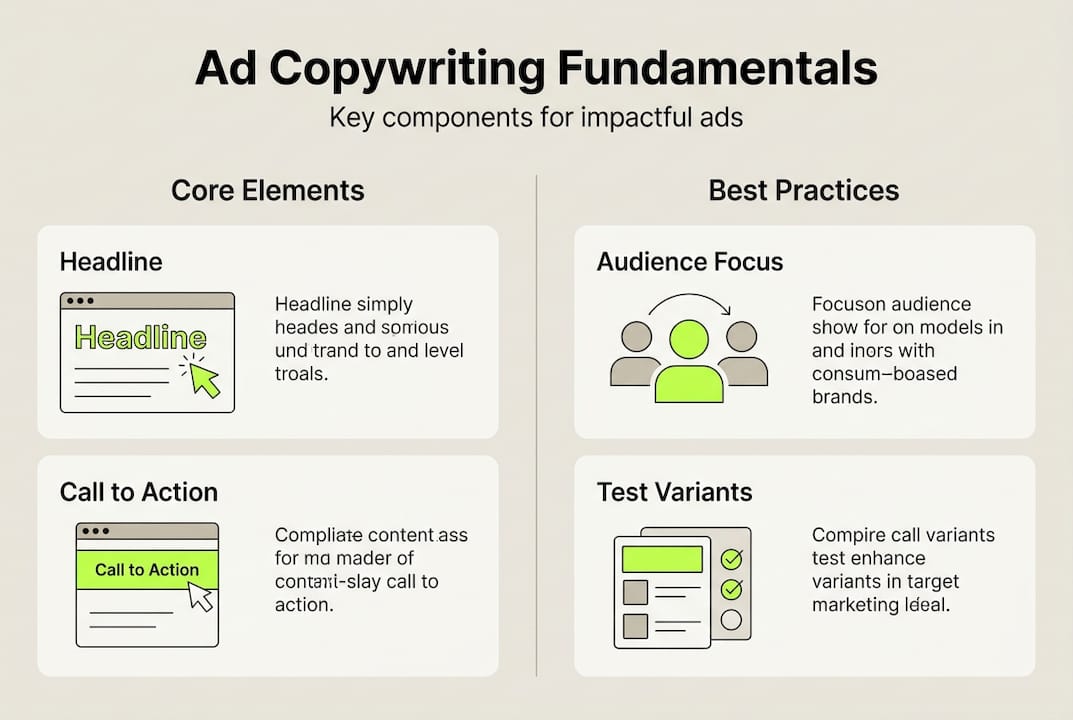
The core elements of any paid ad include:
Headline: The first thing people read. It must hook attention and signal relevance immediately.
Primary text: Expands on the headline, addresses pain points, and builds desire.
Call to action (CTA): Tells the reader exactly what to do next. "Shop now," "Get a free quote," "Book today."
Value proposition: The specific reason your offer is worth their time and money.
For an e-commerce brand, this might look like: "Flash sale ends tonight. Get 40% off our bestselling skincare bundle. Shop now before it's gone." For a local HVAC company: "AC broken in the heat? We fix it same day. Call now for a free estimate."
Platform context also shapes your copy. Google Search ads reward precision and intent-matching. Meta ads (Facebook and Instagram) reward emotional resonance and scroll-stopping hooks. Display ads need ultra-short, visual-first messaging. As long-form copy vs short-form copy research confirms, copy length and tone must align with ad objective, traffic temperature, and platform norms. Understanding the full range of types of paid ads helps you match your copy style to the right channel from the start.
Why ad copy matters: The data behind the results
Good copy is not a nice-to-have. It is a performance lever. And the numbers prove it.

Here is how the major platforms compare on key metrics for e-commerce advertisers in 2026:
Platform | Average CTR | Average CVR | Average ROAS |
|---|---|---|---|
Google Shopping | 4.2% | 2.81% | 4.2x |
Meta (Facebook/Instagram) | Up to 1.93% | 2.7% | 3.4x |
Top-performing stores | Above average | 5% to 10% CVR | Varies |
Source: 2026 e-commerce ad benchmarks
Those top-performing stores are not spending more. They are writing better. A 1% improvement in CTR on a $5,000 monthly ad budget can mean dozens of additional conversions without adding a single dollar in spend. For SMBs where every dollar counts, that is the difference between a campaign that breaks even and one that scales.
"User-generated content outperforms polished creative by 48% in CTR." This single insight reshapes how many brands should think about creative production entirely.
The implication is clear: authentic, audience-first messaging beats corporate polish. When you optimize ad spend with copy that actually resonates, you are not just improving one metric. You are compounding gains across CTR, CVR, and ROAS simultaneously. Consistent tracking of ad performance metrics is what separates businesses that grow from those that guess.
Core frameworks: What makes ad copy effective?
Knowing that copy matters is one thing. Knowing how to write it is another. These frameworks give you a repeatable system.
Emotional vs. rational appeal: When to use each
Appeal type | Best used when | Example |
|---|---|---|
Emotional | Upper funnel, brand awareness, impulse buys | "Finally, skincare that actually works for sensitive skin." |
Rational | Lower funnel, high-ticket, comparison shoppers | "Save $300 per year vs. your current provider. Switch in 10 minutes." |
As long-form copy vs short-form copy research shows, emotional hooks capture attention while rational arguments close the sale. The best ads often layer both.
Key frameworks every ad writer should know:
AIDA: Attention, Interest, Desire, Action. A classic sequence that guides the reader from awareness to conversion.
PAS: Problem, Agitate, Solution. Identify the pain, make it feel urgent, then present your offer as the fix.
Modular design: Write copy in interchangeable blocks (hook, body, CTA) so you can swap angles without rebuilding the whole ad.
UGC integration: Incorporate real customer language, reviews, or testimonials directly into your ad copy for instant credibility.
Modular angles are especially powerful for preventing ad fatigue. Instead of running one message until it dies, you rotate across angles like status ("Join 10,000 customers who switched"), savings ("Cut your monthly bill in half"), convenience ("Done for you in 24 hours"), and problem-solving ("Stop losing leads to slow follow-up"). Prioritizing monthly testing of 20+ creatives using these angles keeps your campaigns fresh and your data actionable.
Pro Tip: Rotate at least 20 copy variants per month. It sounds like a lot, but modular design makes it manageable. Swap one angle at a time and let the data tell you what resonates. Understanding the role of creative in ads and reviewing ad creative examples from similar businesses can accelerate your learning curve significantly.
Short vs. long copy: Choosing the right approach
There is no universal answer to how long your ad copy should be. The right length depends on your audience, your offer, and where they are in the buying journey.
When to use short copy:
Your audience already knows your brand or product category.
The offer is simple, low-risk, or impulse-driven (a sale, a free trial, a discount).
You are running retargeting ads to warm audiences who have already visited your site.
The platform favors brevity, such as Google Search or Instagram Stories.
When to use long copy:
You are targeting cold traffic with no prior brand awareness.
The product or service is complex, high-ticket, or requires explanation.
You need to overcome objections before asking for the click.
You are running lead generation campaigns where trust must be built in the ad itself.
As short vs. long copy research confirms, short copy works best for warm audiences and simple offers, while long copy wins with cold traffic and complex or high-ticket products. The mistake most SMBs make is defaulting to short copy everywhere because it feels easier to write.
UGC-style copy is a special case. It outperforms polished creative by 48% CTR in upper-funnel, social proof-driven placements. It reads like a real person talking, not a brand broadcasting. That authenticity is what makes it work.
Pro Tip: When you are unsure which length to use, test both. Run a short version and a long version to the same audience with the same budget. Let the data decide. Your creative ad strategy process should always include length as a variable worth testing.
How to create and refine high performing ad copy
Writing great ad copy is a process, not a one-time event. Here is how we approach it.
Step-by-step process:
Research your audience. Pull customer reviews, support tickets, and sales call notes. Find the exact words your customers use to describe their problem and your solution. Mirror that language in your copy.
Draft multiple angles. Write at least five to ten versions of your headline and primary text using different frameworks (AIDA, PAS, emotional, rational). Do not edit while drafting.
Review against your objective. Does each version clearly communicate the value prop? Is the CTA specific and action-oriented? Does it match the platform and funnel stage?
Launch with A/B testing. Run two to three variants simultaneously. Give each version enough impressions to reach statistical significance before drawing conclusions. Learn more about A/B testing in ads to set up your tests correctly.
Audit and iterate. Auditing historical data and prioritizing testing for iterative improvement is what separates growing accounts from stagnant ones. Review performance weekly and refresh underperforming copy monthly.
Common mistakes that kill ad performance:
Ignoring performance data and relying on gut instinct alone
Running the same creative for months without rotation
Writing weak or vague CTAs like "Learn more" when "Get your free quote today" would convert better
Mismatching copy tone to funnel stage (using cold-traffic language on retargeting audiences)
Skipping the research phase and writing from assumptions instead of customer language
Data-driven optimizationconsistently outperforms intuition-only changes. The businesses that win at paid advertising are not the ones with the biggest budgets. They are the ones who test more, learn faster, and update their copy before it fatigues. Understandingwhy you should optimize ad campaignsregularly is the mindset shift that changes everything.
Take your ad copywriting to the next level
Ad copywriting is a skill that compounds over time. The more you test, the sharper your instincts become. But for many SMBs, the bottleneck is not knowledge. It is bandwidth. Writing, testing, and iterating 20-plus copy variants per month while running a business is a real challenge.
That is where we come in. At A&T Digital Agency, we build and manage paid ad systems that combine strategic copy with data-driven execution. Whether you need Google Ads management services or a full Meta ads management setup, we handle the creative, the testing, and the optimization so you can focus on running your business. No unnecessary meetings. Just campaigns that convert.
Frequently asked questions
What types of businesses benefit most from ad copywriting?
E-commerce stores and service-based SMBs relying on paid ads see the biggest lift from professional ad copywriting. High-performing copy can dramatically increase CTR, CVR, and ROAS across both Google and Meta campaigns.
What is the ideal ad copy length?
Short copy works for warm audiences and simple offers, while long copy wins with cold or complex sales. Copy length varies by audience, offer type, and funnel position, so always test both when uncertain.
How do you test if ad copy is effective?
Use A/B testing to compare versions and measure improvements in CTR, CVR, and ROAS. A/B testing is the most reliable method for data-driven copy improvements across any platform.
Why is user-generated content important in ads?
User-generated content increases CTR by 48% compared to polished creative, especially on social platforms where authenticity drives engagement and trust.


