Role of creative in ads: Boost marketing performance
Posted on
Marketing
Posted at

Most marketers believe data and targeting drive ad success, but research reveals creative drives up to 70% of effectiveness compared to audience selection alone. This article explores how creative quality shapes campaign outcomes and provides actionable strategies to leverage creative for measurable growth. You'll discover evidence-backed frameworks, quantitative impact data, and practical tactics to enhance your advertising ROI through strategic creative development.
Table of Contents
Understanding Advertising Creative: Definitions And Core Components
Common Misconceptions About Creative Effectiveness And Data Reliance
Practical Recommendations For Leveraging Creative In Performance Marketing Campaigns
Enhance Your Ad Performance With Expert Creative And Paid Ads Management
Key takeaways
Point | Details |
|---|---|
Creative dominates ad effectiveness | Quality creative content accounts for up to 70% of campaign performance, far exceeding targeting and data contributions. |
Emotional engagement drives conversions | Strategic creative triggers psychological responses that increase conversion rates by an average of 23%. |
Strategic frameworks optimize creative roles | Aligning creative functions with campaign objectives maximizes engagement and ROI. |
Testing and refresh combat fatigue | Continuous creative testing and regular asset updates sustain ad performance and prevent diminishing returns. |
Balanced approach wins | Combining creative innovation with data-driven execution delivers superior measurable results. |
Understanding advertising creative: definitions and core components
Advertising creative encompasses all visual, textual, and auditory elements that communicate your brand message and value proposition to target audiences. For performance marketers, creative includes everything from ad copy and images to video content, calls to action, and offer structures across digital platforms.
Creative roles differ significantly between digital performance channels and traditional brand advertising. Digital ads prioritize immediate response triggers and conversion optimization, while brand campaigns focus on awareness and emotional storytelling. Understanding this distinction helps you allocate resources effectively.
Key creative components include:
Copy: Headlines, body text, and calls to action that communicate value and drive action
Visual design: Images, graphics, and layout choices that capture attention and convey brand identity
Video assets: Motion content that tells stories, demonstrates products, or explains services
Value propositions: Clear articulation of benefits and differentiators that motivate customer decisions
Offer structures: Pricing, discounts, or incentives presented in compelling ways
For SMEs focused on performance marketing workflow, creative diversity matters. A telehealth company might use patient testimonial videos for trust building, while an entertainment venue relies on vibrant event imagery to drive ticket sales. Each vertical requires tailored creative approaches aligned with audience psychology and purchase behaviors.
Successful creative balances attention capture with message clarity. Overly complex designs confuse viewers, while bland assets fail to stand out in crowded digital feeds. The sweet spot combines visual appeal with straightforward benefit communication that resonates with your specific audience segment.
How creative drives consumer engagement and brand recall
Creative elements trigger emotional responses that fundamentally shape purchase decisions and long-term brand relationships. Emotional engagement triggered by creative content increases conversion rates by an average of 23% across digital ad campaigns. This psychological impact extends far beyond simple attention capture.
Human brains process visual information 60,000 times faster than text, making design choices critical for initial engagement. Color psychology influences mood and perception, with warm tones evoking urgency while cool colors communicate trust and stability. Strategic color application in your creative assets directly affects click-through behavior and conversion likelihood.
"People will forget what you said, forget what you did, but they will never forget how you made them feel." This principle applies directly to advertising creative, where emotional resonance determines whether prospects remember your brand when ready to purchase.
Storytelling mechanisms in creative content activate multiple brain regions simultaneously, improving message retention and recall. Narrative structures help audiences connect abstract benefits to concrete personal outcomes. A healthcare ad showing a patient's journey creates stronger memory anchors than listing service features.
Key psychological triggers in effective creative include:
Social proof: Testimonials, reviews, and user-generated content build credibility through demonstrated trust
Scarcity and urgency: Limited-time offers or low inventory signals activate fear of missing out
Humor and surprise: Unexpected elements create memorable moments that interrupt scroll patterns
Aspirational imagery: Visuals depicting desired outcomes help audiences envision transformation
Brand recall depends heavily on consistent creative execution across touchpoints. Repeated exposure to distinctive visual or messaging patterns builds mental availability, the likelihood consumers think of your brand when experiencing a relevant need. Strong brand examples demonstrate how creative consistency compounds recognition over time.
Beyond targeting precision, creative quality determines whether your message resonates emotionally enough to motivate action. Even perfectly targeted ads fail when creative doesn't connect with audience needs, desires, or pain points at a human level.

Common misconceptions about creative effectiveness and data reliance
Many marketers operate under the false belief that data and targeting alone determine campaign success, leading to underinvestment in creative development. Reality contradicts this assumption. Creative quality accounts for up to 70% of ad effectiveness, while audience selection and placement contribute the remaining 30%. This imbalance reveals a critical opportunity most advertisers overlook.
Overreliance on data without proportional creative investment produces stagnant results. You can target the perfect audience with surgical precision, but weak creative fails to capture attention or communicate value effectively. The combination of precise targeting with generic, uninspired creative represents wasted budget potential.
Common myths sabotaging campaign performance:
Myth: More data always improves results. Reality: Data enables optimization, but creative drives the emotional connection that converts.
Myth: Targeting sophistication matters most. Reality: Reaching the right person with the wrong message produces minimal impact.
Myth: Creative testing wastes time and budget. Reality: Systematic creative testing reveals high-impact variations that dramatically improve ROI.
Myth: One strong creative works indefinitely. Reality: Creative fatigue diminishes performance, requiring regular refresh cycles.
Myth: Professional creative development costs too much. Reality: Poor creative costs more through lower conversion rates and wasted ad spend.
Misunderstandings about creative testing prevent many marketers from discovering optimization opportunities. Testing isn't about guessing randomly; it's about systematically exploring variations in messaging, visuals, and offers to identify what resonates most powerfully with your audience segments.
Balanced strategy combines creative excellence with data-driven execution. Use data to inform creative decisions, understand audience preferences, and measure performance. Use creative to engage emotions, communicate value, and drive action. Neither element succeeds in isolation; together, they form a complete performance marketing guide approach.
Pro Tip: Allocate at least 30% of your campaign development time to creative planning, testing, and refinement. Most marketers spend 90% on targeting and tracking while neglecting the element that drives 70% of results.
Frameworks to understand and optimize creative roles in ads
Three key creative roles organize ad functions into strategic categories: attention capture, brand messaging, and conversion facilitation. Understanding these distinct roles helps you align creative efforts with specific campaign objectives for optimized performance.
Attention capture focuses on stopping scroll behavior and breaking through information overload. Visual contrast, unexpected elements, and compelling hooks serve this primary function. Without attention capture, your targeting precision becomes irrelevant because prospects never engage with your message.
Brand messaging delivers your core value proposition, positioning, and differentiation. This role builds recognition and shapes perception over time. Strong brand messaging creates mental shortcuts that reduce future conversion friction by pre-establishing trust and relevance.
Conversion facilitation removes barriers and motivates immediate action through clear calls to action, simplified offers, and risk reduction elements. This creative role directly influences bottom-funnel performance and return on ad spend.
Different campaign goals require varied creative priorities:
Campaign Type | Primary Creative Role | Secondary Role | Key Elements |
|---|---|---|---|
Brand Awareness | Brand Messaging | Attention Capture | Emotional storytelling, memorable visuals, brand identity |
Direct Response | Conversion Facilitation | Attention Capture | Clear CTAs, benefit focus, urgency signals |
Consideration | Brand Messaging | Conversion Facilitation | Social proof, detailed benefits, trust builders |
Retargeting | Conversion Facilitation | Brand Messaging | Specific offers, reminder elements, simplified action |
Implementing this framework for SME campaigns:
Define primary campaign objective: Identify whether you're building awareness, driving immediate conversions, or nurturing consideration.
Prioritize matching creative role: Allocate 60-70% of creative emphasis to the role aligned with your objective.
Support with secondary role: Use 30-40% emphasis on the complementary role to create balanced messaging.
Test role emphasis variations: Experiment with different balances to discover optimal combinations for your audience.
Measure role-specific performance: Track metrics that correspond to each creative role's intended impact.
Aligning creative strategy with business goals enhances measurable growth by ensuring every creative element serves a strategic purpose. This systematic approach transforms creative from subjective art into a strategic 2026 advertising trends lever for performance marketing ROI improvement.
Quantitative impact of creative on ad metrics and ROI
Strong creative correlates with 23% average conversion rate increases across digital campaigns. This quantitative impact translates directly to business outcomes through improved click-through rates, lower cost per acquisition, and higher return on ad spend. Data proves creative quality isn't a soft metric but a hard driver of financial performance.
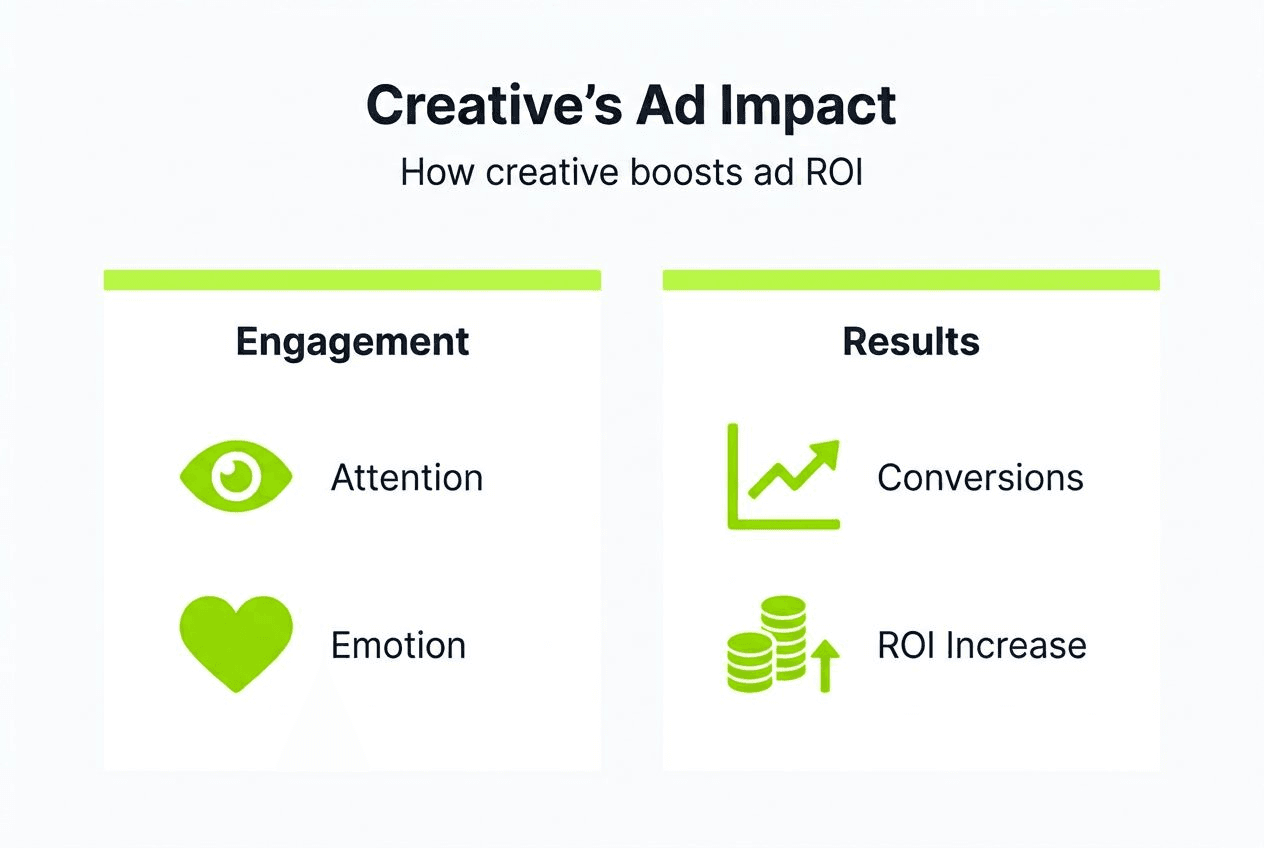
A telehealth campaign case study demonstrates creative's measurable power. The initial campaign used stock medical imagery and generic benefit language, producing a 2.3% conversion rate and $47 cost per lead. After a creative refresh incorporating patient testimonial videos, personalized benefit messaging, and emotionally resonant visuals, the same targeting and budget generated a 3.1% conversion rate and $35 cost per lead. This 35% improvement in lead efficiency came purely from creative optimization.
Creative testing and iteration yield significant ROAS improvements. Systematic A/B testing across visual styles, headline approaches, and offer presentations reveals high-impact variations that can double or triple campaign efficiency. The compounding effect of continuous creative refinement over quarters produces sustained growth trajectories.
Key metric impacts from creative optimization:
Click-through rate: Strong creative increases CTR by 40-80% compared to weak creative with identical targeting
Conversion rate: Emotionally resonant creative boosts conversions by 20-35% on average
Cost per acquisition: Better creative reduces CPA by 25-45% through improved conversion efficiency
Return on ad spend: Creative quality improvements deliver 30-60% ROAS increases without additional budget
Performance comparison before and after creative optimization:
Metric | Before Optimization | After Optimization | Improvement |
|---|---|---|---|
Click-Through Rate | 1.8% | 2.9% | +61% |
Conversion Rate | 2.3% | 3.1% | +35% |
Cost Per Lead | $47 | $35 | -26% |
Return on Ad Spend | 3.2x | 4.8x | +50% |
These improvements demonstrate creative's direct financial impact. For a $10,000 monthly ad budget, the optimization above would generate 286 leads instead of 213, an additional 73 leads monthly or 876 annually without spending more. Campaign planning and ROI must prioritize creative development as a primary growth lever, not an afterthought.
Practical recommendations for leveraging creative in performance marketing campaigns
Balance creative innovation with data-driven execution by establishing systematic processes for both development and testing. Creative innovation generates breakthrough ideas and fresh approaches, while data validation identifies which innovations actually perform. Neither alone suffices; together, they form a complete optimization system.
Implement continuous A/B testing for creative variations across all campaign elements. Test headline approaches, visual styles, offer structures, and call-to-action phrasing systematically. Start with high-impact elements like primary visuals and headlines before testing secondary components. Document results to build institutional knowledge about what resonates with your audience.
Actionable creative optimization steps:
Establish creative refresh cadence: Plan new creative assets every 4-6 weeks to combat creative fatigue in digital advertising, which occurs when repeated exposure causes diminishing engagement.
Create systematic testing matrix: Develop 3-5 creative variations monthly across different strategic dimensions (emotional vs. rational, benefit vs. feature, urgent vs. aspirational).
Align creative with audience insights: Use customer feedback, reviews, and support conversations to inform messaging angles and address actual pain points.
Prioritize mobile-first creative: Design for small screens first since mobile represents 70%+ of digital ad impressions in most verticals.
Measure creative-specific metrics: Track engagement depth, watch time, and interaction rates beyond standard conversion metrics.
Build creative asset library: Maintain organized repository of high-performing creative elements for rapid iteration and testing.
Plan regular creative refresh cycles even for high-performing assets. Performance degradation from creative fatigue happens gradually, making it hard to notice without systematic monitoring. Proactive refresh before performance drops prevents revenue loss and maintains campaign momentum.
Align creative execution with campaign objectives using the role framework from the previous section. Brand awareness campaigns need different creative approaches than direct response efforts. Misalignment between objective and creative strategy wastes budget on messaging that doesn't serve your actual goal.
Pro Tip: For SME budgets, prioritize concise messaging and strong visual contrast over production complexity. A simple, clear message with bold visuals outperforms expensive production with unclear value communication. Focus creative investment on strategic clarity before production polish.
Leverage digital ad campaign guide principles to integrate creative optimization into your broader campaign management workflow. Creative isn't a separate discipline but an integral component of every campaign element from planning through execution and analysis.
Enhance your ad performance with expert creative and paid ads management
Understanding creative's pivotal role is one thing; consistently executing high-performing creative while managing complex multi-channel campaigns is another. Professional management of creative assets and ad campaigns ensures optimized ROI through systematic testing, strategic refresh cycles, and expert optimization across platforms.
Expert A/B testing and creative refresh strategies combat fatigue and boost engagement by applying proven frameworks and avoiding common pitfalls. Specialized teams bring experience from hundreds of campaigns across verticals, accelerating your learning curve and preventing costly mistakes. They implement the systematic testing and optimization processes that transform creative from subjective guesswork into strategic performance drivers.
Multi-channel approaches covering Google Ads management and Meta ads management ensure consistent creative strategy across platforms while adapting execution to each channel's unique requirements. This coordinated approach maximizes reach and frequency effects while maintaining message coherence. Comprehensive performance marketing services translate creative strategy into sustained measurable growth tailored to SME goals and constraints.
Frequently asked questions
What is advertising creative and why does it matter?
Advertising creative includes all visual, textual, and auditory elements that communicate your brand message, value proposition, and offers to target audiences. It matters because creative drives emotional connections, captures attention in crowded feeds, and facilitates conversions through clear benefit communication. Research shows creative quality accounts for up to 70% of ad effectiveness, making it the single largest determinant of campaign success.
How can SMEs measure the impact of creative on ad performance?
Monitor click-through rate, conversion rate, and return on ad spend changes when testing creative variations while holding targeting and budget constant. Use A/B testing to isolate creative impact from other campaign factors by running identical campaigns with only creative elements changed. Track engagement metrics like video watch time and interaction rates to assess attention capture effectiveness before conversion occurs.
What are common mistakes marketers make regarding creative in ads?
Neglecting creative quality while focusing mainly on targeting and data analysis represents the most prevalent mistake. Failing to test and refresh creative assets regularly allows performance to degrade from creative fatigue and market saturation. Using generic stock imagery and boilerplate messaging that doesn't resonate with specific audience pain points wastes targeting precision by failing to connect emotionally or communicate relevant value.
How often should I refresh my ad creative?
Refresh creative assets every 4-6 weeks for active campaigns to combat creative fatigue and maintain engagement levels. High-frequency campaigns showing ads multiple times daily to the same audiences need more frequent refresh cycles. Monitor performance metrics for degradation signals like declining click-through rates or rising cost per acquisition, which indicate creative fatigue requiring immediate refresh regardless of schedule.
Does creative matter more for brand awareness or direct response campaigns?
Creative matters equally for both campaign types but serves different strategic roles. Brand awareness campaigns prioritize creative's emotional storytelling and memory-building functions to establish recognition and positive associations. Direct response campaigns emphasize creative's conversion facilitation role through clear calls to action, benefit focus, and urgency signals. Both require high-quality creative aligned with their specific objectives to maximize effectiveness.