What Is Ad Scheduling and How to Use It
Posted on
Marketing
Posted at

Ad scheduling, or dayparting, allows marketers to control when their ads run to optimize budget and performance. It enhances efficiency by focusing spend during high-conversion periods and adjusting bids accordingly. Using data-driven schedules tailored to campaign goals increases ROI and prevents wasted impressions during low-activity hours.
Most marketers assume that running ads around the clock delivers maximum results. More exposure equals more conversions, right? Not quite. What is ad scheduling, and why does it challenge that assumption? Ad scheduling, also known as dayparting, is the practice of specifying exactly which days and hours your ads appear to potential customers. Rather than burning through your budget at 3 a.m. when your audience is asleep, you concentrate spend where it counts. This article breaks down how it works, why it matters, and how to apply it across your campaigns with real precision.

Key Takeaways
Point | Details |
|---|---|
Ad scheduling controls timing | You choose which days and hours your ads run, not just who sees them. |
Dayparting protects your budget | Limiting low-value hours stops wasted spend and raises effective ROI per dollar. |
Three core strategies exist | Continuity, flighting, and pulsing each serve different goals and budget structures. |
Platform rules vary | Facebook requires a lifetime budget for scheduling; Google and Apple Ads offer different controls. |
Test and adjust continuously | Audience behavior shifts, so your schedule should evolve based on real performance data. |
What is ad scheduling and how it works
Ad scheduling, the industry term is dayparting, gives advertisers direct control over when their campaigns are active. Instead of letting the platform decide when to show your ads, you set the rules. You pick specific days of the week, specific hours of the day, or both. The platform only enters the auction during those windows.
Here is how the mechanics play out across the major platforms:
Google Ads: You set scheduling at the campaign or ad group level. Google also lets you apply bid adjustments by time slot, so you can bid 20% higher on Tuesday afternoons without turning everything else off.
Meta (Facebook) Ads: Ad scheduling requires a lifetime budget, not a daily one. Once that condition is met, you can select specific days and hours for your ads to appear across Facebook and Instagram.
Apple Ads: Scheduling lets you choose start and end dates, plus the days of the week and times of day your ads show, with campaign-level rules that can override ad group settings.
AdButler and similar platforms: Advanced scheduling controls include impression quotas, evenly paced delivery, and smooth delivery options that regulate how often ads appear within a given window.
The distinction between campaign-level and ad group-level scheduling matters. Campaign-level scheduling applies uniformly across all ad groups inside it. Ad group-level controls give you granular flexibility, letting you run certain creatives only during peak hours while others stay on all day.
Bid adjustments sit on top of scheduling as a separate layer. You are not just turning ads on or off. You are telling the platform to compete more aggressively during your highest-value windows and pull back when conversion likelihood drops. That combination of timing control and bid modulation is where the real power lives.
Pro Tip: Before setting any schedule, pull 90 days of hourly performance data from your platform. You will almost always find two or three time windows responsible for the bulk of your conversions. Start your schedule there and expand from what works.
The role and benefits of ad scheduling
The role of ad scheduling goes beyond simple timing. It reshapes how every dollar in your budget is deployed. Here is what changes when you apply it correctly:
Budget efficiency improves immediately. When you stop showing ads during hours with little to no conversion activity, your budget concentrates where it converts. The same daily spend produces more output because it is not diluted across 24 hours of uneven demand.
Audience targeting gets sharper. Reaching your audience at the moment they are most likely to engage or decide is a fundamentally different proposition than reaching them at random. A media schedule built around audience behavior outperforms one that simply buys available ad space.
Ad fatigue slows down. Serving ads continuously accelerates how quickly your audience tunes them out. Limiting continuous exposure keeps creatives feeling fresh longer and extends the effective life of your campaign before you need a refresh.
Reach and frequency become manageable. Scheduling gives you a real lever on frequency. If your audience sees your ad five times on Monday but zero times on Friday, that imbalance affects both memorability and annoyance. Controlled delivery smooths that out.
Event-driven and seasonal marketing becomes precise. A restaurant promoting a lunch special does not need prime time impressions at 9 p.m. A retailer running a weekend flash sale can concentrate every dollar from Friday evening through Sunday afternoon. Scheduling makes those decisions automatic rather than manual.
Pro Tip: Do not just schedule based on your gut feeling about when customers are active. Cross-reference your ad platform data with your website analytics. If Google Analytics shows a conversion spike between 6 p.m. and 9 p.m. on weekdays, that is your scheduling anchor.
Core scheduling strategies compared
The three main patterns in media planning give you a framework for matching timing to goals. Each one fits a different budget structure and campaign objective.
Strategy | Pattern | Best for | Budget requirement |
|---|---|---|---|
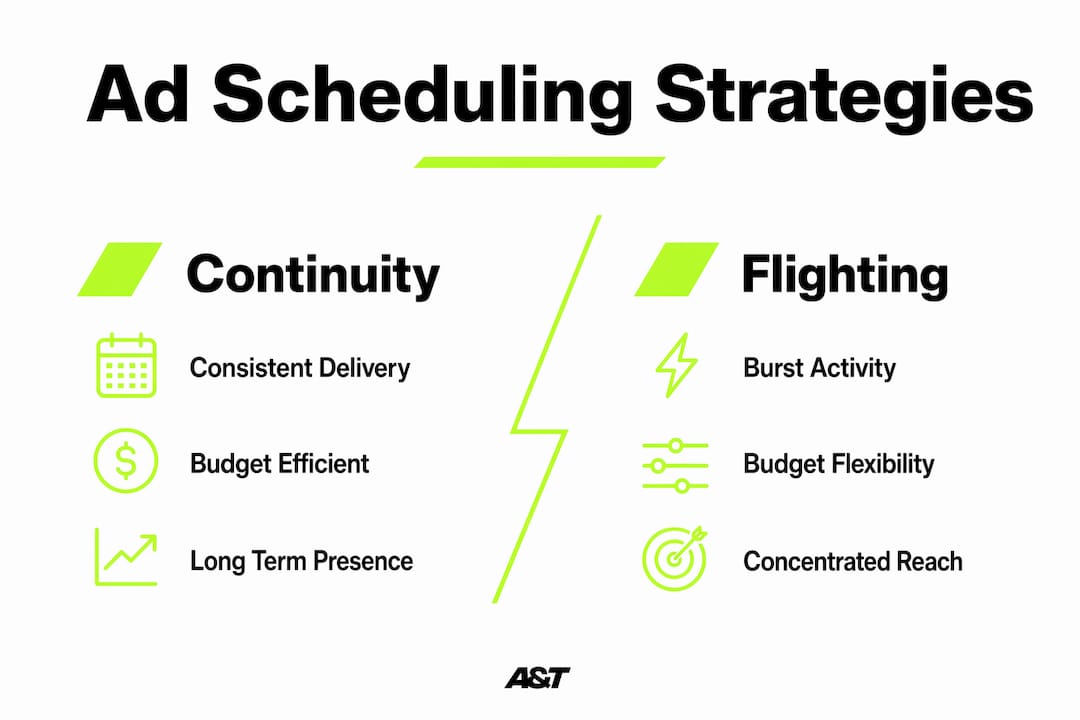
Continuity | Consistent delivery across the entire campaign period | Brand awareness, long purchase cycles | Higher, requires sustained daily spend |
Flighting | Concentrated bursts with complete off periods in between | Seasonal products, event-based campaigns | Moderate, spend concentrates in bursts |
Pulsing | Baseline delivery with intensified bursts at key moments | Products with seasonal spikes but year-round demand | Flexible, scales up and down as needed |
Continuity, flighting, and pulsing each represent a fundamentally different philosophy about how reach, frequency, and budget interact. Continuity builds memory over time through consistent presence. Flighting accepts that some periods matter far more than others and does not waste money filling the gaps. Pulsing tries to hold both ideas at once, maintaining presence while concentrating firepower when demand peaks.
For most small and mid-sized advertisers, pulsing is underused. It requires more planning upfront but tends to produce the most efficient spend across a full year. A health and wellness brand, for instance, might maintain a low baseline all year while tripling spend in January when New Year resolutions drive demand. That single timing decision can dramatically change annual ROI without changing the creative or the targeting.
Choosing between these strategies is not just a media planning exercise. It connects directly to how you structure your ad budget planning from the start of a campaign.
Practical nuances worth knowing
Ad scheduling sounds simple until you look at how it interacts with your budget settings. Several platform-specific mechanics can catch marketers off guard.
Daily budget math changes on restricted schedules. If your campaign runs only three days a week instead of seven, your effective daily spend on those three days increases significantly. A $10 daily budget across 30.4 days creates a $304 monthly cap, but restricting to fewer days concentrates that cap into a smaller window, often inflating daily spend beyond the figure you set.
Limited dayparts can exhaust budgets too early. When you compress spend into narrow windows, the platform burns through the daily budget faster. This can result in your ads going dark mid-morning if your window is the early hours and your budget is lean.
Ad pacing interacts with scheduling. Platforms like AdButler let you choose between evenly paced and smooth delivery, which controls how impressions are distributed within your active window. Choosing the wrong pacing method inside a narrow schedule can produce uneven delivery and skewed frequency data.
Facebook's lifetime budget requirement is often missed. Many advertisers try to apply scheduling with a daily budget on Meta campaigns and wonder why the option is grayed out. Scheduling on Meta requires a lifetime budget, full stop. Plan for this before launch.
Platform-level caps on schedule changes can delay results. Some platforms limit how frequently you can modify a schedule before performance data resets or enters a learning phase. Frequent changes can push campaigns back into learning, undermining the data you are trying to build.
Pro Tip: When switching to a restricted schedule, recalculate your expected daily spend by dividing your monthly cap by the number of active days, not by 30. This prevents budget exhaustion and reporting surprises.
Understanding how scheduling influences auction behavior is equally useful. For context on how timing connects to what you actually pay per impression, the mechanics of ad auction dynamics directly shape the cost efficiency of any schedule you build.
How to implement and optimize your schedule
Getting ad scheduling right is a process, not a one-time setup. Here is how to approach it from start to optimization:
Pull baseline performance data first. Export at least 60 to 90 days of hourly and day-of-week performance reports. Identify your top-converting windows and your clear dead zones. This is your scheduling foundation.
Set your initial schedule conservatively. Start by cutting your clearest dead zones, not every low-performing hour. Over-restricting early removes data you might need to understand audience patterns across different times.
Apply bid adjustments alongside your schedule. On platforms like Google Ads, use bid modifiers to bid more aggressively during your highest-value hours rather than just switching delivery on or off. This adds a second layer of precision on top of timing control.
Align your schedule with your budget structure. Confirm that your daily or lifetime budget settings match your active days. Recalculate expected spend per active day before launch to avoid overspend surprises.
Measure impact in isolation. Run your scheduled campaign for at least two to four weeks before making changes. Look at CPA, ROAS, and impression share by time slot to see whether the schedule is performing as intended.
Evolve the schedule as behavior shifts. Audience behavior changes across seasons, day-of-week patterns shift with campaigns, and platform algorithms evolve. Review your schedule data monthly and adjust. The schedule that worked in Q1 may underperform in Q3.
The goal is not to find one perfect schedule and stick to it forever. It is to build a feedback loop where performance data shapes timing decisions continuously. That approach is what separates real ad spend optimization from guesswork.
My take on scheduling after years in the field
I have seen ad scheduling either ignored entirely or over-engineered to the point where campaigns lose the data volume they need to function. Neither extreme works.
The most common mistake I encounter is marketers scheduling based on assumption. They decide their audience shops after work, so they run ads from 5 p.m. to 9 p.m. and call it done. That feels logical. But the data often tells a completely different story, especially in B2B or mobile-heavy verticals where behavior defies conventional wisdom.
What I have learned is that scheduling is most powerful when it is treated as a complement to creative and budget strategy, not a substitute for either. A tight schedule cannot rescue a weak offer. A well-timed ad still needs to say the right thing to the right person. The timing just determines whether you are spending money to say it to someone who is actually ready to listen.
The lesson that has stuck with me most: start with data, restrict lightly, measure carefully, and expand or contract from there. The marketers who win on timing are the ones who never stop questioning whether their current schedule still reflects how their audience actually behaves.
— Ann
Ready to put your ad schedule to work?
Ad scheduling is one piece of a larger paid advertising system. When it is built correctly alongside bid strategy, creative, and audience targeting, it compounds results across every campaign you run. At A&T Digital, we build and manage Google Ads campaigns and Meta Ads campaigns with scheduling baked into the strategy from day one. We handle the data analysis, the platform mechanics, and the ongoing optimization so your budget works when your audience is ready to convert. No wasted impressions at 3 a.m. Just purposeful spend, measured results, and campaigns built to scale.
FAQ
What is ad scheduling in marketing?
Ad scheduling, also called dayparting, is the practice of controlling which days and hours your paid ads are eligible to show. It lets advertisers concentrate budget on high-value time windows rather than running continuously.
Why use ad scheduling if my budget is already limited?
Limited budgets benefit most from scheduling. Restricting ads to your highest-converting windows means every dollar competes where it is most likely to produce a result, rather than spreading spend across low-activity hours.
Does ad scheduling work the same on all platforms?
No. Google Ads allows bid adjustments by time slot alongside scheduling controls, while Facebook requires a lifetime budget to activate scheduling. Apple Ads supports day and time selection at both the campaign and ad group level.
What are the main ad scheduling strategies?
The three standard patterns are continuity (consistent delivery), flighting (concentrated bursts with off periods), and pulsing (a baseline with intensified bursts at key moments). Each suits different campaign goals and budget structures.
Can ad scheduling increase my effective daily spend?
Yes. Restricting your schedule to fewer days concentrates your monthly budget cap into fewer active days, which raises the effective daily spend beyond your original setting. Always recalculate expected daily spend based on active days, not calendar days.