What Is Contextual Advertising? A 2026 SMB Guide
Posted on
Marketing
Posted at

Contextual advertising places ads based on webpage content, not user data, making it privacy safe. AI enhances this by analyzing tone and intent, improving relevance and effectiveness. It offers SMBs lower costs, higher engagement, and better brand recall without legal or technical barriers.
Contextual advertising is defined as the practice of placing ads based on the content of the webpage a person is currently viewing, not on their browsing history or personal data. It is the industry's most direct answer to two converging pressures: tightening privacy regulations and the collapse of third-party cookies. 63% of consumers prefer ads that match what they are actively reading or watching. That single statistic explains why contextual targeting has moved from a backup plan to a primary channel for performance marketers who need results without the legal and technical baggage of behavioral data.
What is contextual advertising and how does it differ from behavioral targeting?
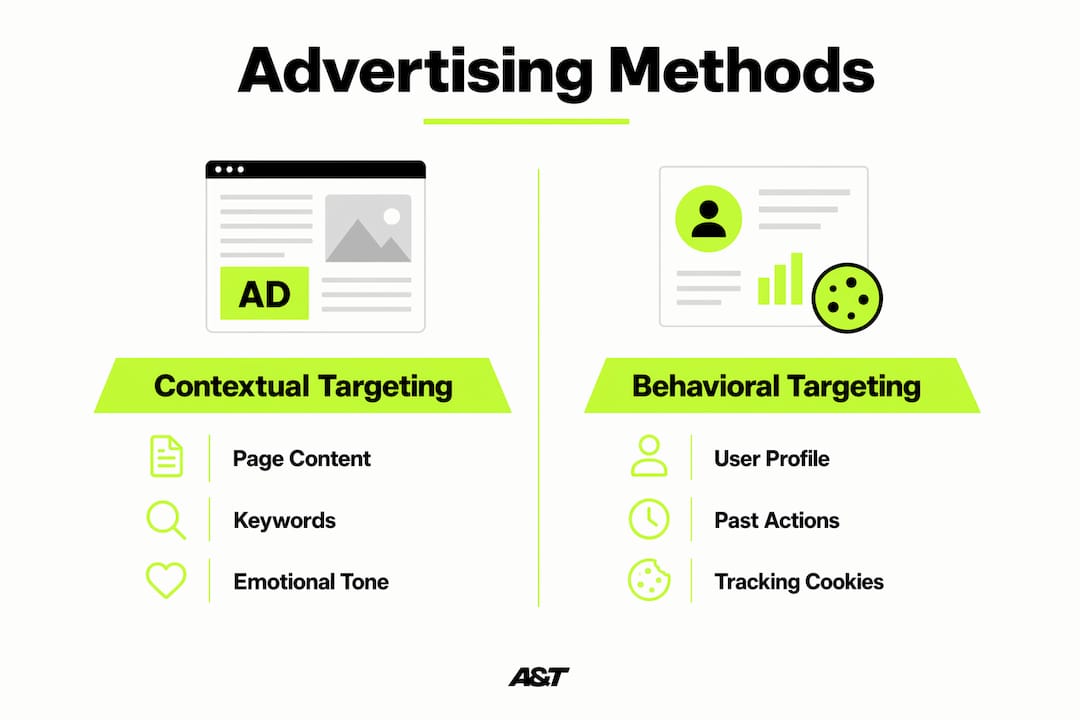
Contextual advertising places your ad on a page because the page content matches your offer. A running shoe brand appears on a marathon training article. A tax software ad runs alongside a small business finance guide. The match is content-to-ad, not user-to-ad.

Behavioral targeting works the opposite way. It tracks a user across websites, builds a profile from past actions, and serves ads based on inferred interests. That approach requires cookies, consent banners, and compliance with laws like GDPR and CCPA. Contextual targeting requires none of those things.
The table below shows where the two methods diverge on the factors that matter most to SMB marketers.
Factor | Contextual targeting | Behavioral targeting |
|---|---|---|
Data used | Page content, keywords, tone | User history, cookies, device IDs |
Privacy compliance | Built-in, no consent needed | Requires consent and data agreements |
Cookie dependency | None | High |
Brand safety | High, content-controlled | Variable, profile-based |
Cross-browser reliability | Consistent | Blocked by Safari and Firefox |
The contrast is stark. Behavioral targeting gives you a profile. Contextual targeting gives you a moment. For most SMBs, the moment is more valuable because it reflects real-time intent.
How does contextual advertising work with AI and semantic analysis?
Modern contextual targeting goes far beyond matching keywords. AI-powered systems now combine keyword matching with semantic analysis to understand tone, sentiment, and real-time intent at the page level. That means a system can distinguish between an article that mentions "debt" in a personal finance advice context versus a news story about corporate bankruptcy.
Natural language processing (NLP) reads the full text of a page, identifies the dominant theme, and scores the emotional tone. The ad server then matches that profile to the most relevant ad in real time. This happens before the page loads, with no user data involved.
Session modeling adds another layer. Probabilistic session models predict user intent based on the sequence of pages viewed in a single session, without tracking identity across sessions. A user reading three consecutive articles about home renovation signals purchase intent for tools or materials. The system catches that signal and responds with a relevant ad.
The role of contextual targeting in AI-driven search visibility is also growing, as AI systems increasingly factor content relevance into both organic and paid placement decisions. Understanding this connection helps SMB marketers build campaigns that perform across channels.
What are the key advantages of contextual advertising for SMBs?
Contextual ads outperform behavioral ads on every metric that directly affects your budget and brand. Contextually relevant ads generate 43% more neural engagement and cost 48% less per click compared to behaviorally targeted ads. Lower cost per click with higher engagement is a combination that compounds quickly for businesses running on tight ad budgets.
Brand recall is another measurable win. The same research shows contextual ads produce 2.2x better ad recall and 41% higher brand recall than non-contextual placements. Readers remember your brand more when your ad fits the content they chose to read.
The privacy compliance benefit is not just legal protection. Contextual advertising requires no consent banners or personal data collection, which means zero friction in the ad delivery process. No consent pop-ups slowing down your funnel. No data agreements to negotiate.
Here are the core contextual ad benefits for SMB marketers:
Higher engagement: 3.5x higher neural engagement compared to non-contextual placements
Lower cost: 48% cheaper cost per click than behavioral targeting
Better recall: 2.2x improvement in ad recall and 41% lift in brand recall
Privacy safe: No personal data collected, no GDPR or CCPA exposure
Cross-browser reach: Works across all browsers, unaffected by cookie blocking in Safari and Firefox
Brand safety: You control the content categories where your ads appear
Pro Tip: Start with two or three tightly defined content categories that directly match your product. Broad contextual targeting dilutes relevance. Narrow targeting with strong creative outperforms wide targeting every time.
How can businesses implement contextual advertising strategies in 2026?
Implementation is where most SMBs leave performance on the table. They take ads built for behavioral campaigns and drop them into contextual placements. The results are predictably flat. SMBs see better results when creating custom ad assets adapted in color, tone, and imagery to the contextual environment rather than repurposing behavioral ads.
The concept driving this is creative-context fusion. Dynamically adapting ad creative elements to match page tone increases engagement and makes ads feel native to the content. A calm, editorial tone works on a news site. A high-energy visual works on a fitness blog. The same product, two different creative executions, both contextually matched.
Follow these steps to build a contextual campaign that performs:
Map your content categories. Identify the specific topics, themes, and publication types where your ideal customer is actively reading. Use your product's natural context as the starting point.
Build intent-mapped creatives. Create ad assets specifically for each content category. Match headline tone, image style, and call-to-action language to the editorial environment.
Set brand suitability rules. Define the content categories you want to exclude. News about conflict, tragedy, or controversy can damage brand perception even when the keyword match looks clean.
Add human review to your process. Semantic models can misclassify nuance such as sarcasm or satire. A human review layer catches errors that AI misses and protects your brand from appearing in the wrong context.
Use session modeling for intent signals. Work with platforms that offer probabilistic session modeling to capture in-session purchase intent without any identity tracking.
Test and iterate creatives by category. Run A/B tests within each content category. Small contextual creative tweaks to headlines, images, and CTAs improve engagement more than full redesigns.
For a deeper look at how types of ad targeting compare for SMBs, including contextual alongside other methods, that guide breaks down the tradeoffs clearly.
Pro Tip: Build a separate creative brief for each content category before you launch. Treat each category like a different publication with its own audience expectations. This discipline alone separates high-performing contextual campaigns from average ones.
What is the future of contextual advertising and where is it heading?
Contextual advertising is not stabilizing. It is accelerating. AI advances are pushing contextual systems beyond keyword matching into predictive placement, where the system anticipates the content a user will engage with next and pre-positions ads accordingly.
The integration with programmatic advertising platforms is deepening. What is programmatic advertising in this context? It is the automated, real-time buying of ad placements. Contextual signals now feed directly into programmatic bidding logic, so your ad bid reflects not just the audience but the specific content environment at the moment of auction. That combination gives SMBs access to precision that was previously available only to enterprise advertisers.
"Contextual advertising is not just a fallback to cookie loss. It is a strategic, privacy-respecting capability that uses AI to reach high-intent buyers in real time. Brands that treat it as a primary channel, not a backup, will build durable competitive advantages as privacy regulations tighten globally."
Several trends are reshaping the space right now:
Predictive contextual placement: AI systems anticipate content consumption patterns and pre-position ads before the user arrives at the page
Dynamic creative at scale: Platforms now automate creative-context fusion across thousands of content categories simultaneously
AI chat advertising: Contextual logic is entering AI-powered chat interfaces, where ads appear based on the topic of the conversation
Privacy regulation as a growth driver: GDPR, CCPA, and emerging state-level laws are pushing more ad budgets toward contextual channels
Deeper programmatic integration: Contextual signals are becoming a standard input in real-time bidding algorithms across major ad exchanges
AI audience targeting strategiesare evolving in parallel, and the most effective campaigns in 2026 combine contextual placement with AI-driven creative personalization to maximize both reach and relevance.
Key Takeaways
Contextual advertising is the highest-performing, privacy-compliant ad method available to SMBs in 2026, delivering lower costs, higher recall, and zero reliance on personal data.
Point | Details |
|---|---|
Core definition | Contextual ads match page content, not user history, making them privacy-safe by design. |
Performance advantage | Contextual ads cost 48% less per click and generate 43% more neural engagement than behavioral ads. |
Privacy compliance | No consent banners or personal data are required, removing GDPR and CCPA exposure entirely. |
Implementation priority | Build custom creatives for each content category rather than repurposing behavioral ad assets. |
Future direction | AI and programmatic integration are making contextual targeting more precise and more accessible for SMBs. |
Why I think SMBs are underestimating contextual advertising
Most SMB marketers I talk to still treat contextual targeting as a fallback. They run behavioral campaigns first, and when cookies fail or costs spike, they consider contextual as a patch. That framing is backwards, and it costs them real money.
The data is not subtle. A 48% lower cost per click with stronger brand recall is not a marginal improvement. It is a structural advantage. The businesses winning with contextual advertising in 2026 are not using it defensively. They are building their entire paid media logic around content environments where their customers are actively engaged.
The biggest mistake I see is creative laziness. Marketers take a behavioral ad, drop it into a contextual placement, and wonder why performance is flat. Contextual advertising rewards creative discipline. When your ad matches the tone and subject of the page, it does not feel like an interruption. It feels like a recommendation. That shift in perception is what drives the recall numbers.
My honest advice: pick two content categories where your product fits naturally, build dedicated creatives for each, and run a 30-day test. The results will make the case better than any article can. The privacy landscape is only getting stricter. Contextual targeting is not a trend. It is where performance marketing is going.
— Ann
How A&T agency helps SMBs run better contextual campaigns
Atdigiagency builds and manages paid advertising systems for small and medium businesses that need measurable results, not just impressions. Our team runs Google Ads campaigns and Meta Ads programs with contextual targeting built into the campaign architecture from day one. We handle creative development, content category mapping, brand suitability rules, and ongoing optimization so your ad spend goes to placements that actually convert. If you are ready to move beyond behavioral targeting and build a campaign that performs in a privacy-first world, our team is ready to work with you.
FAQ
What is contextual advertising in simple terms?
Contextual advertising places ads on webpages based on the content of that page, not on the viewer's personal data or browsing history. A cooking website shows food-related ads because the content matches, not because the reader was tracked.
How does contextual targeting differ from behavioral targeting?
Contextual targeting matches ads to page content in real time. Behavioral targeting tracks users across websites and serves ads based on past behavior, which requires cookies and user consent.
Does contextual advertising work without cookies?
Contextual advertising works entirely without cookies. It reads page content rather than user data, making it fully functional across all browsers including Safari and Firefox, where cookie blocking is standard.
What are the main advantages of contextual ads for small businesses?
Contextual ads cost 48% less per click, generate 43% more neural engagement, and require no personal data collection. Those three factors make contextual targeting one of the most cost-effective options available to SMB marketers.
What is the role of AI in contextual targeting today?
AI uses natural language processing and semantic analysis to understand page tone, sentiment, and theme beyond simple keyword matching. This allows ad systems to place ads in content environments that reflect genuine purchase intent, not just surface-level topic overlap.