Best Advertising Platforms for Venues: 2026 Guide
Posted on
Marketing
Posted at

Effective venue advertising requires a cross-channel funnel approach with conversion tracking before launch. Platforms like Meta, Google Ads, TikTok, and geofence partners each target different audience segments and stages of the ticket sales process. Proper measurement and creative rotation are essential for sustained campaign success and high ticket conversion rates.
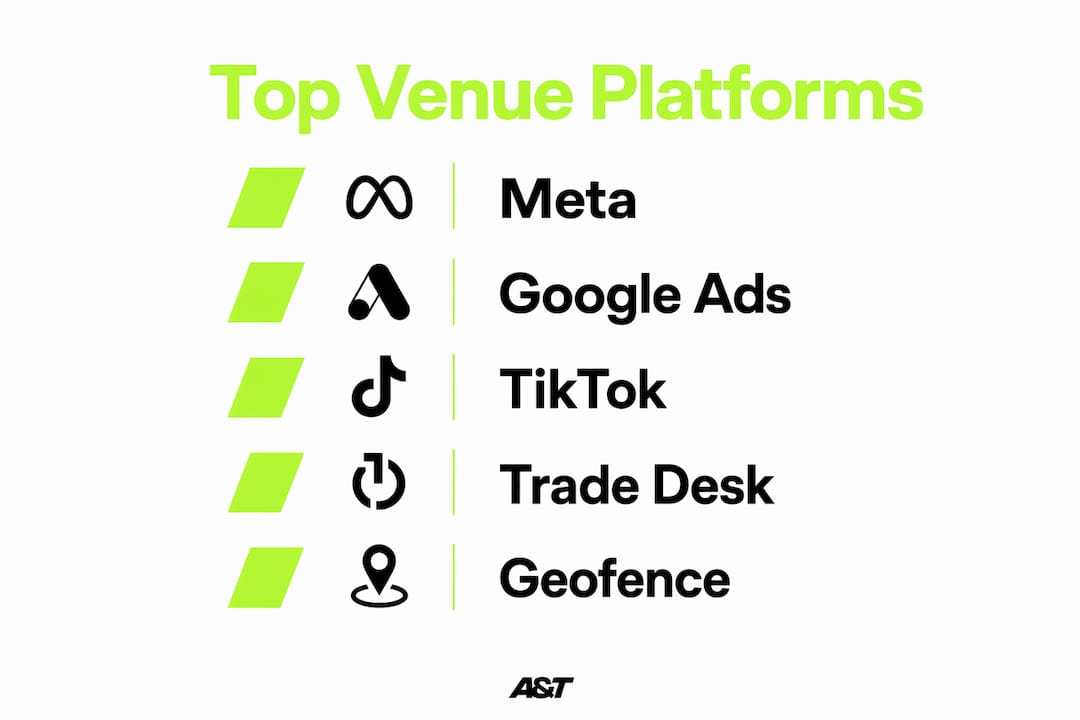
Meta, Google Ads, TikTok For Business, programmatic display, and mobile geofence partners are the best advertising platforms for venues running ticketed events in the U.S. The winning approach is a cross-channel funnel with conversion tracking locked in before launch, not a single-platform bet.
Here's where each platform fits:
Meta (Facebook & Instagram): Local awareness, event RSVPs, lookalike audiences, and conversion campaigns tied to ticket purchase pixels
Google Ads & YouTube: High-intent search capture ("jazz club near me tonight"), video awareness, and display retargeting
TikTok For Business: Short-form video reach for younger audiences and trend-driven ticket demand
The Trade Desk (programmatic/CTV): Cross-screen branded awareness and remarketing at scale
GroundTruth, Simpli.fi, PlaceIQ, Shared Audiences: Mobile geofence capture at competing venues, nearby foot traffic, and 30-day post-event retargeting
If you need measurable ticket conversions across multiple channels with proper attribution, hire a performance marketing agency. A&T Digital manages exactly this kind of multi-platform venue campaign, from pixel setup to creative to weekly optimization.
Table of Contents
Which ad platform works best for your venue goals?
How does geofence targeting actually work for venues?
What creative formats actually convert tickets and attendance?
How do you measure venue campaign performance accurately?
How should you allocate budget and time your venue campaign?
When should you hire a performance agency for venue campaigns?
Key Takeaways
What venue campaigns taught us about platform priorities
A&T Digital runs venue campaigns that convert, not just reach
Useful sources and vendor pages
Which ad platform works best for your venue goals?
Each platform earns its place in a venue media plan for a different reason. Knowing which to prioritize first saves budget and time.
Meta (Facebook & Instagram )
Meta is the default starting point for most venue campaigns. Event ads, carousel formats, and conversion objectives work well together, and the lookalike and interest targeting lets you reach people who look like your past ticket buyers within a defined radius. For recurring weekly nights, Meta's retargeting audiences keep warm prospects engaged without burning the full budget on cold reach.

Google Ads & YouTube
Google Search captures people already looking for what you offer. A query like "rooftop bar events this weekend" has purchase intent baked in. YouTube's 15–30 second pre-roll ads work for awareness before a major show, and Display retargeting pulls back site visitors who didn't convert. For venues with a longer sales cycle (season tickets, corporate buyouts), Google's broad match and Performance Max campaigns can surface demand you didn't know existed.
TikTok For Business
TikTok moves fast. Vertical video content showing the venue atmosphere, performer clips, or behind-the-scenes setup drives organic-feeling reach at paid scale. It's most effective for 18–34 audiences and for events where the vibe sells the ticket. Pair it with a conversion-optimized landing page and a clear CTA, or the clicks won't convert.
Programmatic display and CTV via The Trade Desk
The Trade Desk gives you cross-screen reach: desktop display, mobile web, connected TV, and audio. For branded awareness ahead of a major season or festival, programmatic lets you layer first-party data against contextual signals at a scale Meta and Google alone can't match. CTV placements work well for premium events where the audience skews 35-plus and watches streaming content.
Mobile geofence partners
GroundTruth, Simpli.fi, PlaceIQ, and Shared Audiences specialize in capturing device IDs at specific physical locations, including competitor venues, transit hubs, and parking lots near your event. This is where venue advertising gets genuinely precise.
How does geofence targeting actually work for venues?
Geofencing draws a virtual perimeter around a location. When a mobile device enters that boundary, it's captured and added to an ad audience. After the event, geofence retargeting runs for up to 30 days, serving ads to people who were physically present.
Performance reporting from geofence campaigns typically includes:
Total impressions delivered
Unique devices reached within the perimeter
Foot-traffic conversions attributed to the targeted period
A retargeting window of up to a month matters. Someone who attended a competing venue's concert recently is a warm prospect for your show soon. That dual-stage workflow, capture at the event then retarget afterward, is what separates geofence campaigns from standard local radius targeting.
Geofence partners often provide both on-site activation and a fixed retargeting window of 30 days. This dual-stage capture-plus-retarget workflow turns event attendees into customers at a fraction of the cost of cold prospecting.
Geofencing moves the needle most for trade shows, conferences, multi-day festivals, and last-minute attendance pushes for nearby foot traffic. When selecting a vendor, ask for impression-level reporting, foot-traffic attribution methodology, and confirmation that consent flows meet current U.S. privacy standards. Tools like geo-targeted consent banners help ensure compliant location-based ad delivery across regions.
What creative formats actually convert tickets and attendance?
Video with an urgent CTA outperforms static for ticket conversions. Static carousel and event lead forms work best in the discovery-to-consideration stage, not at the point of purchase.
Creative checklist for every venue ad:
Hero image or video showing the venue atmosphere or performer
Clear event date, time, and location
Price or offer (early bird, limited availability)
Direct CTA: "Buy Tickets," "Reserve Your Spot," or "RSVP Now"
Urgency cue: seats remaining, countdown, or offer deadline
Mobile-first framing (vertical or square crop)
Landing page that mirrors the ad's offer exactly
Format by platform:
TikTok: 9:16 vertical video, 15–30 seconds, native-feeling content
YouTube: 15–30 second pre-roll for awareness; 6-second bumpers for retargeting
Meta: Carousel for multi-event lineups; single-image event ads for conversion; lead forms for season ticket inquiries
In-venue screens: QR-enabled creatives via platforms like VERSE for direct scan attribution and daypart scheduling
A practical creative brief template: one hero video (30–60 seconds) plus two shorter cuts (15s and 6s), three static variants for A/B testing, and one QR-enabled version for in-venue or DOOH screens. Brief once, produce multiple assets.
Pro Tip: Swap creative by daypart. Run atmosphere-focused video Thursday through Saturday evenings and offer-led static ads Monday through Wednesday when purchase intent is lower. Use QR codes or promo codes on in-venue screens to tie offline redemptions directly to your paid media spend.
How do you measure venue campaign performance accurately?
Install platform pixels and server-side conversion tracking before any campaign goes live. Measurement set up after launch means lost data and unreliable ROAS numbers.
Tracking setup steps (in order):
Install Meta Pixel and Google Tag on your ticketing or event landing page
Configure server-to-server (S2S) postbacks from your ticketing platform to Meta and Google
Set up GA4 with custom event mapping (ticket purchase, RSVP, form submit)
Import offline conversions from your POS or ticketing system (Eventbrite, AXS, or custom exports)
Apply consistent UTM parameters across all paid channels
Verify with a test purchase: confirm the conversion fires in each platform's event manager
Check for deduplication between browser pixel and S2S postback to avoid double-counting
Key KPIs for venue campaigns: cost per ticket (CPA), return on ad spend (ROAS), incremental lift versus organic baseline, and foot-traffic conversions from geofence partners. For multi-touch campaigns, compare last-click attribution against a data-driven model in GA4 to understand which channels assist conversions rather than just close them. A&T Digital's playbooks combine pixel and S2S postbacks specifically to deduplicate conversions and sharpen ROAS measurement across channels.
How should you allocate budget and time your venue campaign?
A 6–8 week campaign structure works for most ticketed events. The split shifts toward conversion spend as the event date approaches.
Budget allocation by phase (example for a headline show):
Weeks 1–3 (Awareness): 40% of budget on YouTube, TikTok, and programmatic reach
Weeks 4–5 (Consideration): 35% on Meta retargeting, Google Display, and geofence capture
Weeks 6–7 (Conversion): 20% on Meta and Google conversion campaigns targeting warm audiences
Final 7–10 days: Reallocate remaining awareness budget into conversion-focused placements for last-minute fill
Week | Phase | Key Activities |
|---|---|---|
1–2 | Awareness | Launch video creative on YouTube and TikTok; set up geofence capture |
3–4 | Consideration | Meta carousel retargeting; Google Display to site visitors |
5–6 | Conversion | Conversion campaigns on Meta and Google Search; geofence retargeting active |
7–8 | Last-minute fill | Shift budget to conversion; push urgency creative; check CPA daily |
Cost models vary by platform: Meta and Google Display run CPM; Google Search runs CPC; YouTube uses CPV; geofence partners typically bill CPM with foot-traffic attribution reporting. For last-minute fill, CPC and CPA bidding on high-intent audiences gives you the most control over spend efficiency.
When should you hire a performance agency for venue campaigns?
Hire an agency when you need multi-channel coordination, advanced tracking (S2S, offline imports), and consistent ROAS. Run in-house for small, single-platform experiments where the stakes are low.
What a specialist agency should deliver:
Full campaign strategy across Meta, Google, TikTok, and programmatic
Pixel audit and S2S conversion tracking setup before launch
Creative briefs and production coordination
Geofence vendor management and audience integration
Weekly performance optimization with documented KPI benchmarks (CPA, ROAS)
Transparent media reporting with data ownership staying with the client
The agencies that consistently deliver for venues are the ones who set up tracking before they touch the budget. If an agency can't show you a conversion verification process, that's the signal to keep looking.
A&T Digital has run paid campaigns for entertainment venues and museum ticket sales, with documented case-study outcomes covering ticket CPA, ROAS, and audience growth. Partner certifications (Google Partner, Meta Business Partner) matter because they signal access to platform support, beta features, and verified best practices. Ask any agency you evaluate to show their venue campaign results and their optimization workflow before signing.
Key Takeaways
Cross-channel venue campaigns that combine Meta, Google Ads, TikTok, and geofence targeting with proper conversion tracking consistently outperform single-platform approaches for ticket sales and attendance.
Point | Details |
|---|---|
Prioritize these five platforms | Meta, Google Ads/YouTube, TikTok For Business, The Trade Desk, and mobile geofence partners cover the full funnel. |
Geofence retargeting window | Capture devices at events and retarget for up to 30 days to convert warm prospects. |
Tracking before launch | Install pixel, S2S postbacks, and GA4 event mapping before spending a dollar on ads. |
Budget shift at day 7–10 | Move remaining awareness budget into conversion placements for last-minute ticket fill. |
A&T Digital for multi-channel campaigns | A&T Digital manages strategy, media buying, creative, and tracking across all major venue ad platforms. |
What venue campaigns taught us about platform priorities
Most venue operators come to us having spent money on one platform, usually Meta, without a tracking setup that tells them whether it worked. The instinct to start with Meta is right. The mistake is stopping there and measuring success by reach instead of ticket sales.
The platforms that consistently move the needle for venues are the ones that combine intent signals with retargeting. Google Search captures people already looking for an event. Geofence partners capture people who showed up somewhere relevant. Meta and TikTok build the awareness that makes those intent signals fire in the first place. None of them work in isolation.
The other thing most guides understate: creative fatigue hits venue campaigns fast. An event ad that performs well in week one is often invisible by week three because the same audience has seen it repeatedly. Rotating creative by daypart and audience segment isn't optional; it's the difference between a campaign that scales and one that stalls. The venues that win are the ones treating their ad creative like a product, briefing new assets on a schedule, not waiting until performance drops.
A&T agency runs venue campaigns that convert, not just reach
A&T Digital is the performance marketing team venues hire when they need more than impressions. We manage paid advertising across Google Ads, Meta, TikTok, programmatic display, and geofence integrations, with conversion tracking and S2S postbacks built in from day one. Our clients get a clear CPA target, weekly reporting, and creative that's built to convert ticket buyers, not just generate clicks.
The first step is a paid media audit: we review your current tracking setup, identify attribution gaps, and propose a campaign roadmap with platform priorities matched to your event calendar. Ready to run campaigns that fill seats? Talk to our performance marketing team and get a proposed roadmap within the week.
Useful sources and vendor pages
Shared Audiences — geofence event targeting platform with 30-day retargeting and foot-traffic attribution reporting
VERSE — AI-driven in-venue DOOH and screen manager with QR attribution and daypart scheduling
Shozzle — in-venue screen network for contextual display advertising
Passiro geo-consent — geo-targeted consent banners for compliant location-based ad delivery
A&T Digital: digital marketing for venues — practical campaign setups and case-study outcomes for venue paid advertising
A&T Digital: optimize venue campaigns — retargeting workflows, creative rotation cadence, and KPI-driven optimization loops
A&T Digital: venue ad creative process — creative brief templates and format guidance for venue advertising