Optimize venue campaigns: proven workflow for higher ticket sales
Posted on
Marketing
Posted at

You're running paid ads, the budget is moving, and the creative looks sharp. But ticket sales aren't where they need to be. Sound familiar? The problem isn't your ad spend. It's the absence of a systematized optimization workflow built specifically for entertainment venues. Without a repeatable process connecting your paid campaigns to real-time data, audience behavior, and automation, you're essentially guessing. This guide walks you through a proven, step-by-step workflow that venue marketing teams can apply immediately, from the first ad impression to the final ticket scan, with measurable results at every stage.
Table of Contents
Key Takeaways
Point | Details |
|---|---|
Lifecycle approach | Structuring your campaigns around attract, automate, and nurture phases drives consistent ticket sales increases. |
Tools and automation | Leveraging the right CRM and performance-tracking tools enables smarter, more efficient optimization cycles. |
Stepwise execution | Systematic goal-setting, A/B testing, and retargeting are crucial to maximize return on every channel. |
Adapt for edge cases | Adjusting tactics for late buyers and prioritizing first-party data can dramatically boost results. |
Workflow mindset wins | Consistent processes matter more than jumping to every new ad trend or platform. |
Understand the campaign optimization lifecycle for venues
Before you fix anything, you need to see the full picture. Most venue teams treat campaign optimization as a one-time task: launch, monitor, tweak. That's not a workflow. That's reactive management.
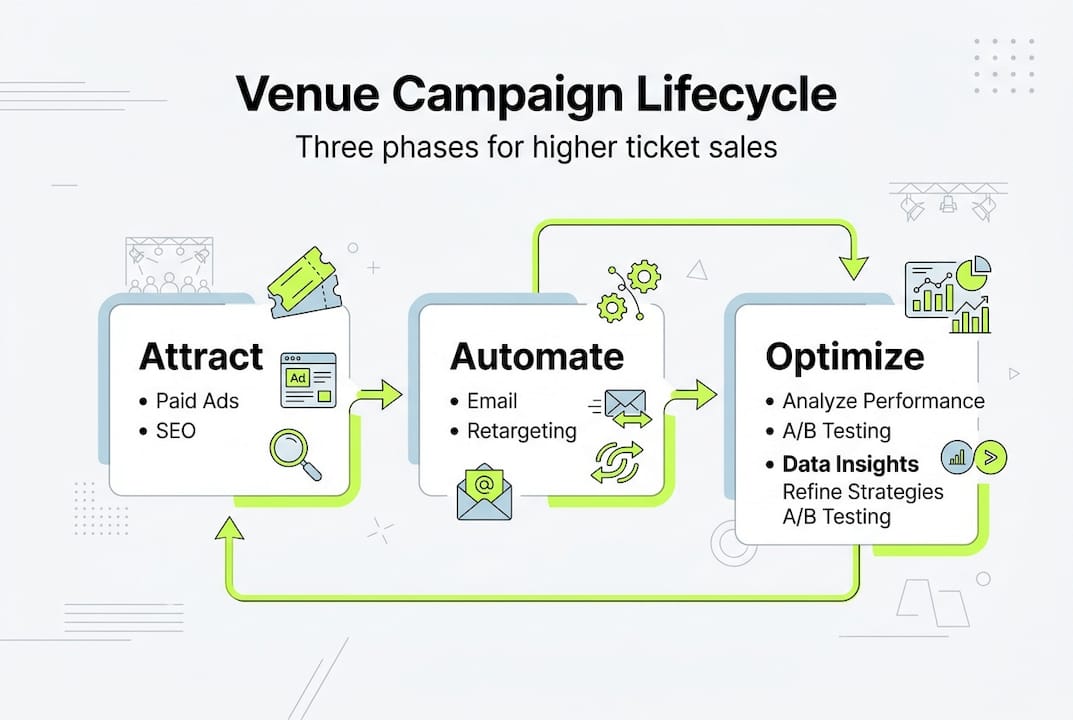
A true high ROI marketing workflow follows a continuous lifecycle with three distinct phases. The venue campaign optimization workflow breaks down into Attract and Capture, Manage and Automate, and Convert and Nurture. Each phase has specific tools, actions, and success metrics.
Phase | Core actions | Key tools |
|---|---|---|
Attract and Capture | Paid ads, SEO, social targeting | Google Ads, Meta Ads, landing pages |
Manage and Automate | CRM workflows, lead segmentation | HubSpot, Mailchimp, Zapier |
Convert and Nurture | Retargeting, referral programs, email sequences | Pixel tracking, dynamic ads, automation |
Here's what separates venues that consistently sell out from those that don't: they treat this lifecycle as a system, not a series of disconnected tasks. When your CRM feeds your retargeting audiences, and your retargeting data informs your creative testing, the entire machine gets smarter with every campaign.
For a broader view of how this connects to event strategy, the event marketing guide from Cvent provides solid context on aligning paid channels with event timelines.
Key principles to keep in mind:
Integration matters. CRM, pixel tracking, and analytics must talk to each other.
Real-time data wins. Static reports from last week don't help you optimize today.
Automation is not optional. Manual workflows break under pressure, especially near event dates.
Continuous improvement beats perfection. Small, frequent optimizations outperform big, infrequent overhauls.
This lifecycle thinking is the foundation. Everything else builds on it.
Gather your data, tools, and prerequisites
With the lifecycle framework in place, it's time to ensure all the operational pieces are ready for streamlined optimization.

The biggest mistake venue marketers make is launching campaigns before their tracking infrastructure is solid. If your pixel isn't firing correctly, or your CRM isn't capturing ticket purchase events, you're optimizing blind. Data-driven optimization relies on real-time analytics, A/B testing, automation for email reminders, retargeting, and performance tracking tied directly to ticket sales.
Here's a practical readiness table to assess where you stand:
Requirement | Minimum stack | Advanced stack |
|---|---|---|
Tracking | Meta Pixel, Google Tag Manager | Server-side tracking, GA4 events |
Audience data | Basic interest targeting | CRM-synced custom audiences, lookalikes |
Creative assets | Static images, one ad copy variant | Video, carousel, multiple copy tests |
Analytics | Platform-native dashboards | Google Analytics 4, attribution modeling |
Automation | Manual email sends | Triggered sequences, dynamic retargeting |
Before you run a single campaign, confirm these prerequisites are in place:
Meta Pixel and Google Ads conversion tracking are verified and firing on ticket purchase confirmation pages.
Your CRM is segmenting contacts by event interest, purchase history, and engagement level.
You have at least two creative variants ready for each ad set.
Google Analytics 4 is connected and tracking key events.
You've defined your cost-per-acquisition target before spending a dollar.
For venues exploring more sophisticated setups, programmatic event promotion tools offer powerful options for scaling reach with precision targeting. Pairing these with strong analytics for campaign performance gives you a real competitive edge.
Pro Tip: Automate your routine reporting tasks first. When weekly performance pulls happen automatically, your team spends time on creative testing and strategy instead of spreadsheet management.
Execute the workflow: step by step campaign optimization
Once your technical and creative foundation is assembled, you're ready to launch and systematically optimize your campaign.
The most effective venue campaigns run across multiple channels simultaneously. Paid social, search, programmatic, and email each play a distinct role. Here's the step-by-step execution workflow:
Set specific goals. Define ROAS targets, CPA ceilings, and ticket volume goals before touching any platform. Numbers first, always.
Build and segment audiences. Create separate ad sets for cold audiences, warm website visitors, and past ticket buyers. Each group needs different messaging.
Launch with creative testing built in. Run at least two ad variants per audience segment from day one. Never launch a single creative without a challenger.
Implement frequency caps. Limit ad exposure to 3 to 5 impressions per user per week on social. Overexposure kills conversion rates and wastes budget.
Activate retargeting sequences. Set up pixel-based retargeting for website visitors who didn't purchase. Use dynamic creative that reflects the specific event they viewed.
Run weekly optimization cycles. Review performance every 7 days. Pause underperformers, scale winners, and rotate fresh creative every 2 to 3 weeks.
Automate email follow-ups. Trigger reminder emails at 7 days, 3 days, and 24 hours before the event for anyone who purchased but hasn't engaged recently.
For running optimized social ads, advanced targeting strategies on Facebook and Instagram consistently deliver strong results for event promotion.
Know your benchmarks. Paid channel performance shows Facebook and Instagram delivering 3 to 5x ROAS with a CPA of $10 to $50 for events, Google Ads hitting 3 to 6x ROAS with high-intent CTR between 5 and 15%, and programmatic reaching up to 20x ROAS in strong cases.
For deeper guidance on platforms for event marketing and proven marketing tactics, both resources offer actionable frameworks worth reviewing.
Late ticket buyers? Extend your campaign tail and retarget right up to the last minute. Some venues see 20 to 30% of total ticket sales in the final 48 hours before an event.
Pro Tip: Use audience exclusions aggressively. Exclude existing ticket purchasers from acquisition campaigns immediately after they convert. This alone can reduce wasted spend by 10 to 15%.
Troubleshooting, benchmarking, and edge cases
Even a robust workflow hits real-world snags. Here's how to diagnose and fix the most common ones, and fine-tune for your venue's unique audience.
The three most common failure points in venue campaigns are tracking gaps, audience fatigue, and low landing page conversion rates. Each has a clear fix.
Tracking gaps: If conversions aren't recording, check pixel firing order and confirm that your thank-you page URL matches the conversion event trigger. Use Meta's Test Events tool and Google Tag Assistant to verify.
Audience fatigue: If frequency is above 5 and CTR is dropping, your audience has seen the ad too many times. Rotate creative immediately and expand your audience pool.
Low conversions: If click-through rates are strong but ticket sales are flat, the problem is your landing page, not your ads. Test headline copy, urgency signals, and checkout friction.
Here's a quick benchmark table to assess campaign health:
Channel | Target ROAS | Target CTR | Target CPA |
|---|---|---|---|
Facebook and Instagram | 3 to 5x | 1 to 3% | $10 to $50 |
Google Search Ads | 3 to 6x | 5 to 15% | $15 to $40 |
Programmatic Display | Up to 20x | 0.1 to 0.5% | $5 to $25 |
Email Marketing | $36 to $42 per $1 spent | 20 to 30% open rate | Near zero |
Email remains the highest ROI channel at $36 to $42 returned for every dollar spent, but only if you own a quality list.
For edge cases, the approach shifts. Late ticket buying requires an extended ad tail, micro-events benefit from signal-triggered emails, and privacy regulation shifts make first-party data your most valuable asset going forward.
For venues navigating 2026 paid advertising trends, understanding how privacy changes affect targeting is now a core competency, not an afterthought. Build your first-party data strategy now. And review venue ticketing strategies to align your ad workflow with smart pricing and demand management.
Why most venue campaigns underperform and how a workflow mindset changes everything
With troubleshooting and benchmarking addressed, let's zoom out and tackle what truly shifts the needle for venue marketers.
Here's what we've seen consistently: venues that struggle with paid advertising aren't failing because of bad creative or wrong channels. They're failing because they treat every campaign as a fresh start. No documented process. No institutional learning. No quarterly review loop that feeds insights back into the next campaign.
The industry obsesses over tactics. New ad formats, new platforms, new targeting options. But chasing every trend without a stable workflow underneath is like redecorating a house with a broken foundation.
Investing in process and automation consistently outperforms investing in the next shiny tactic. When you build quarterly review loops, where you document what worked, what failed, and why, you compound your results over time. Your second campaign beats your first. Your fifth beats your third.
The venues we've seen grow ticket sales reliably share one trait: they treat marketing like operations. Systematic, measurable, and always improving. Understanding ROI in performance marketing from a process perspective, not just a spend perspective, is what separates consistent performers from one-hit wonders.
Build the workflow. Trust the data. Iterate every cycle.
Power your venue campaigns with expert support
Ready to implement a workflow that reliably grows ticket sales? We work with entertainment venues to build and manage paid ad systems that are strategic, data-driven, and built for scale.
Our team handles everything from Google Ads management to Meta Ads campaigns, with a focus on measurable outcomes and smart budget allocation. We don't believe in unnecessary meetings or generic strategies. We build systems that perform.
If your venue is ready to move from reactive ad management to a proven optimization workflow, explore our venue campaign solutions and connect with our team. Real results, real partnerships.
Frequently asked questions
What are the best benchmarks for venue advertising campaigns?
For venues, aim for a 3 to 5x ROAS on Facebook and Instagram, 3 to 6x on Google Ads, and a CPA between $10 and $50. Programmatic ads can reach up to 20x ROAS in strong-performing cases.
How can venues optimize campaigns for last minute ticket buyers?
Extend your ad campaigns closer to the event date and activate retargeting with dynamic creative to capture late-stage interest from users who already engaged but didn't convert.
Which channels deliver the highest ROI for event marketing?
Email delivers the highest return per dollar at $36 to $42 for every $1 spent, while Google Search Ads attract higher-intent buyers and consistently strong conversion rates.
What's the role of automation in campaign optimization?
Automation handles email reminders, retargeting sequences, and performance tracking so your team can focus on strategy. Automation at scale has saved major event organizers thousands of hours annually.
How can venues adapt to privacy and data regulations?
Shift your targeting and measurement strategy toward first-party data, reducing dependence on third-party cookies. Build your owned email and CRM lists now before further regulatory changes tighten data access.


