The Role of Context in Ads: 2026 Performance Guide
Posted on
Marketing
Posted at

Contextual advertising connects ads to a user's current environment and intent, driving higher engagement and sales. It outperforms behavioral targeting by working in privacy-restricted settings and delivering more relevant, timely messages. Marketers who actively manage and optimize context-based placements achieve better return on ad spend and stronger brand trust.
The role of context in ads is to match advertising messages with a user's immediate environment and mindset, producing relevance that drives real results. Contextual advertising, the industry's standard term for this practice, is no longer a secondary tactic. 60% of consumers are more likely to purchase after seeing contextually relevant ads. That single number reframes context from a brand safety filter into a direct revenue driver. The global contextual advertising market reached £180 billion in 2025, pushed forward by privacy regulations like GDPR and the accelerating phase-out of third-party cookies. For marketing professionals and business owners running paid campaigns, understanding how context affects ads is now a core competency, not an optional upgrade.
How does context influence ad performance compared to behavioral targeting?
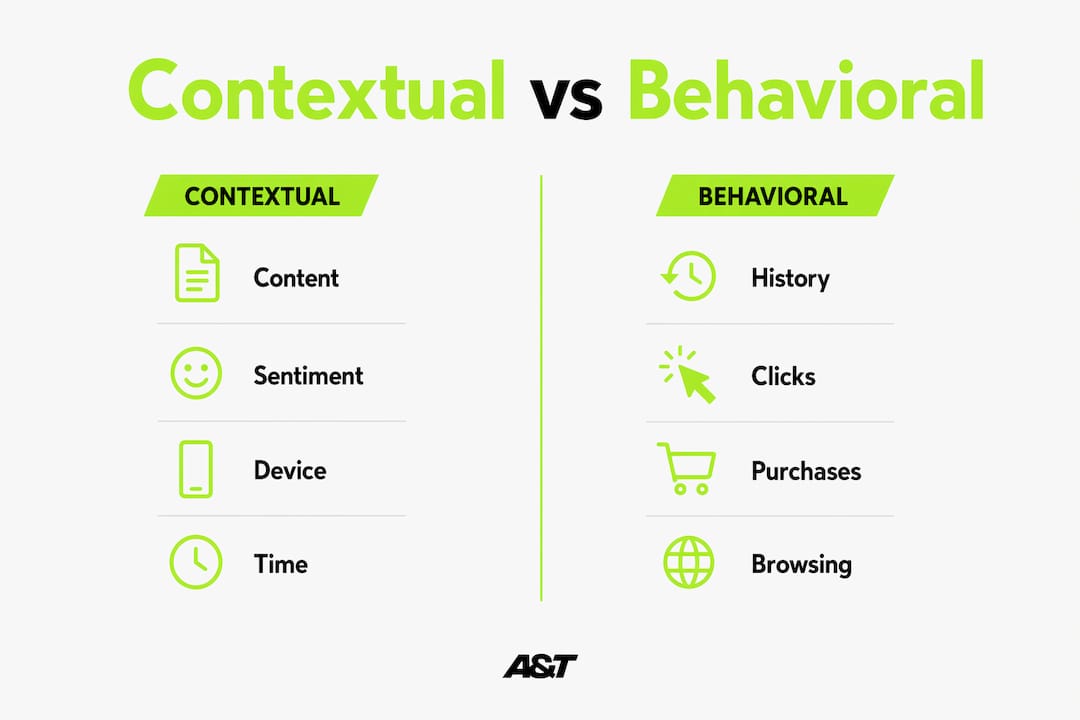
Behavioral targeting uses historical data, past clicks, browsing patterns, and purchase history, to predict what a user might want next. The problem is that data ages fast. A user who researched running shoes three weeks ago may have already bought a pair, switched interests, or simply moved on. Serving that person another shoe ad based on stale signals wastes budget and irritates the audience.
Contextual targeting works differently. It reads the current page, the topic, the tone, and the user's immediate intent, then matches an ad to that live environment. A reader on a nutrition blog sees a protein supplement ad. A visitor on a home renovation forum sees a hardware store promotion. The ad fits the moment, not a profile built from old behavior.
The performance gap is significant. Contextual marketing strategies yield up to 50% higher engagement than behavioral targeting that relies on outdated user data. Higher engagement means lower cost per click, better Quality Scores in Google Ads, and more conversions per dollar spent.
Relevance without surveillance. Contextual ads do not require tracking personal data across sites, which means they work in privacy-restricted environments where behavioral ads cannot run.
Lower ad fatigue. Ads that match the surrounding content feel natural. Users do not experience the "that ad is following me" effect that erodes trust in retargeting campaigns.
Stable performance. Behavioral targeting's decay due to cookie instability makes contextual relevance a more reliable performance variable over time.
Better brand recall. When an ad aligns with what a user is actively reading or watching, the message sticks because it reinforces an existing mental state.
Pro Tip: Run an A/B test with identical creative: one set placed using behavioral signals, one placed using contextual signals. Measure click-through rate and post-click conversion rate separately. The contextual set will often win on conversion rate even when behavioral wins on raw clicks.
What contextual factors determine ad relevance and placement?
Contextual relevance in marketing depends on reading multiple signals at once. No single factor determines placement quality. The combination of content meaning, user intent, device, timing, and location creates the full picture.
Content analysis: NLP and sentiment detection
Advanced contextual systemsuse natural language processing (NLP) and sentiment analysis to understand page meaning accurately. NLP goes beyond keyword matching. It reads the full semantic context of a page, so an ad for a fishing rod appears on a page about recreational fishing, not on a page about a police sting operation where the word "fishing" also appears. Sentiment detection adds another layer. A page discussing a product recall carries negative sentiment. Placing a brand ad there damages perception, even if the topic matches superficially.
Environmental and situational signals
Beyond content, the environment shapes how an ad lands. Device type matters: a user on a mobile phone during a commute responds differently than a desktop user at a work desk. Time of day shifts intent. A food delivery ad at 11:30 a.m. catches a user thinking about lunch. The same ad at 9 a.m. misses the window entirely. Location adds precision for local businesses, connecting a nearby service to a user who is physically close enough to act.

Signal Type | Contextual Approach | Behavioral Approach |
|---|---|---|
Content relevance | Reads current page topic and tone | Uses past browsing history |
Privacy compliance | No personal data required | Requires user tracking |
Timing accuracy | Real-time environment match | Based on historical patterns |
Sentiment awareness | Detects page mood and tone | Not typically assessed |
Data freshness | Always current | Degrades over time |
Pro Tip: Do not treat "contextual targeting" as one setting. Separate your campaigns by content category, device type, and time of day. Each combination is a distinct environment with its own conversion behavior.
The importance of context in advertising also extends to content depth. A technical article written for engineers carries different buyer intent than a hobbyist blog covering the same product category. Matching ad creative to that distinction, technical language for the engineer, accessible language for the hobbyist, lifts relevance and response rates. Ad relevance in campaign performance is directly tied to how precisely you read these environmental layers.
Why is context more critical in 2026ʼs privacy–first environment?
Privacy regulation has fundamentally changed what behavioral targeting can do. GDPR in Europe, CCPA in California, and similar laws worldwide restrict how personal data is collected, stored, and used for advertising. Third-party cookies, the backbone of cross-site behavioral tracking, are being phased out across major browsers. Advertisers who built their entire strategy on cookie-based retargeting are now facing a structural gap.
Contextual advertising fills that gap cleanly. It does not rely on personal identifiers. It reads the page, not the person. That distinction makes it fully compliant with current privacy frameworks by design, not by workaround.
"The 2026 advertising shift favors 'what the user is experiencing' over 'who the user is,' emphasizing context over historical data." Source
This shift has real financial consequences. Advertisers who align message and environment through contextual methods report reduced consumer annoyance and stronger brand loyalty compared to behavior-based retargeting. The reason is straightforward: users do not feel tracked, so they do not feel manipulated. That trust translates into longer engagement and higher lifetime value.
The benefits of moving toward contextual ad strategies in 2026 include:
Privacy compliance by default. No consent banners or data processing agreements are needed for contextual placement.
Consistent reach. Contextual ads run in environments where behavioral ads are blocked or restricted, expanding available inventory.
Brand safety control. Advertisers choose the content categories and sentiment profiles where their ads appear, reducing the risk of placement next to harmful content.
Reduced dependency on platform data. Contextual signals come from the content itself, not from walled-garden audience data that platforms can restrict or change at any time.
Staying current on 2026 advertising trends is not optional for marketers who want to protect their return on ad spend as the privacy landscape continues to tighten.
How can marketers apply context strategies to their ad campaigns?
Treating contextual relevance as a dynamic performance variable, not a static placement filter, is what separates average campaigns from high-performing ones. Top performance marketers analyze environment-message matches at micro-segment levels and cut underperformers quickly. Here is a practical framework for doing exactly that.
Map your environments before writing creative. List the specific content categories, page types, and sentiment profiles where your ads will run. Write creative for each environment, not one generic version for all placements.
Segment by buyer state. A user reading a "best running shoes for beginners" article is in research mode. A user on a checkout page for running gear is in buying mode. Winning marketers segment ad assets by environment, sentiment, and buyer state, then prune poor matches to protect ROAS.
Use real-time signals to adjust landing pages. Google patents describe dynamically adjusting landing page elements based on real-time contextual intent. If your ad platform supports dynamic landing page parameters, use them. The page a user lands on should mirror the context that triggered the click.
Test environment-message pairs systematically. Run controlled tests where you change only the placement context while keeping creative constant. This isolates the impact of context on conversion rate and gives you clean data to act on.
Prune aggressively. An environment that generates clicks but no conversions is not a targeting win. Cut it. Reallocate that budget to environments where the message-context match is proven. This is the core discipline of contextual advertising best practices.
Pro Tip: Build a simple context scorecard for each placement: content relevance (1–5), sentiment match (1–5), buyer intent signal (1–5). Any placement scoring below 9 total gets paused and reviewed before scaling.
The most common mistake marketers make is treating contextual targeting as a one-time setup. Context shifts as content changes. A news site's tone on monday differs from its tone during a breaking crisis. Review your placement performance weekly, not monthly.
Key Takeaways
Contextual advertising outperforms behavioral targeting in engagement, privacy compliance, and long-term brand trust because it matches ads to what users are experiencing right now, not who they were last month.
Point | Details |
|---|---|
Context drives purchase intent | 60% of consumers are more likely to buy after seeing contextually relevant ads. |
Engagement advantage is measurable | Contextual strategies deliver up to 50% higher engagement than behavioral targeting. |
Privacy compliance is built in | Contextual ads do not require personal data, making them GDPR-compliant by design. |
Signals go beyond content topic | Device, timing, sentiment, and location all shape whether an ad fits its environment. |
Context requires active management | Prune poor environment-message matches weekly to protect spend and ROAS. |
Context is the variable most marketers are still underpricing
My honest read on where most paid media teams go wrong: they treat contextual targeting as a brand safety checkbox, not a performance lever. I have seen campaigns where the creative was excellent and the audience targeting was tight, but placements were scattered across content environments with no coherent logic. The result was mediocre conversion rates that the team blamed on the creative. The real problem was context.
The shift from identity-based to intent-based advertising is not just a privacy story. It is a performance story. When you put the right message in front of someone who is actively in the mental state your product addresses, you are not interrupting them. You are answering a question they are already asking. That is a fundamentally different dynamic than retargeting someone based on a click they made three weeks ago.
Authenticity in brandingcompounds this effect. Ads that feel native to their environment read as credible. Ads that feel out of place read as intrusive, regardless of how good the offer is. The environment is part of the message.
The marketers who will win in 2026 and beyond are the ones who stop asking "who is this person?" and start asking "what is this person doing right now, and what do they need in this moment?" That question is harder to answer with a single audience segment. It requires building creative and placement strategies that treat context as a first-class variable, not an afterthought.
— Ann
A&T agency approach to context driven paid advertising
Context-driven advertising is not a theory at Atdigiagency. It is built into how we plan, launch, and manage paid campaigns across Google Ads and Meta. Our team maps content environments before writing a single line of ad copy, segments placements by buyer state and sentiment, and uses real-time performance data to cut what does not convert. The result is ad spend that works harder because every placement is intentional. If you are running paid campaigns and want a team that treats Google Ads management as a precision discipline, not a set-and-forget system, we are ready to build that with you.
FAQ
What is the role of context in ads?
The role of context in ads is to align ad messages with a user's current environment, content, and intent. Ads placed in relevant contexts generate higher engagement and purchase likelihood than ads based on historical user data alone.
How does contextual targeting differ from behavioral targeting?
Contextual targeting reads the current page content and environment to place ads. Behavioral targeting uses past browsing history, which degrades in accuracy as data ages and faces increasing restrictions under privacy laws like GDPR.
Why does context matter more in 2026?
Third-party cookie deprecation and stricter privacy regulations have limited behavioral targeting's reach. Contextual advertising does not rely on personal data, making it both privacy-compliant and more stable as a performance channel.
What signals does contextual advertising use?
Contextual systems analyze page topic, NLP-derived semantic meaning, sentiment, device type, time of day, and location. Together, these signals determine whether an ad environment matches the message and the buyer's current state.
Can contextual ads improve return on ad spend?
Yes. Contextual advertising is a direct driver of ROAS, not just a brand safety tool. Marketers who segment placements by environment and buyer state and prune poor matches consistently see stronger conversion rates and lower wasted spend.