Why Scaling Ads Matters for Business Growth
Posted on
Marketing
Posted at

Scaling advertising campaigns involves carefully managing the inverse relationship between audience size and conversion efficiency to grow revenue sustainably. It requires deliberate, model-based decisions, balancing vertical and horizontal expansion while controlling budget increases and creative fatigue. Operational discipline, such as gradual budget hikes and proactive creative management, is essential for successful, long-term scaling.
Scaling advertising campaigns is defined as the deliberate process of expanding paid ad reach and spend to grow revenue while maintaining or improving cost efficiency. Understanding why scaling ads matters separates businesses that plateau from those that compound growth. The core challenge is not budget size. It is managing the inverse relationship between audience reach and conversion efficiency across platforms like Google Ads and Meta. Experts like Sam Shev and performance teams at Atdigiagency consistently show that scaling ad campaigns without a data-driven model leads to predictable, expensive failure.
Why scaling ads matters: audience size versus conversion efficiency
The most counterintuitive truth in paid advertising is this: as your audience grows, your conversion rate falls. This is not a flaw in your targeting. It is the structural reality of how attention and intent are distributed across any market.
Diminishing returns in marketingfollow a predictable curve. Your first 1,000 reached users are your highest-intent buyers. They already know the problem, they are actively searching for a solution, and your ad meets them at the right moment. As you push beyond that core segment into broader audiences, you are buying progressively worse attention. Conversion rates drop. Cost-per-acquisition rises. The math becomes harder with every dollar you add.
The data makes this concrete. Scaling from 1K to 400K audience reach multiplies conversions by roughly 100x, but conversion rate falls by 3 to 4 times and CAC triples. That means you are getting more volume, but paying significantly more per customer. Push further to 1 million users and the conversion increase becomes minimal while CAC nearly triples again. More reach does not mean proportionally more revenue.
Audience Size | Relative Conversion Rate | Relative CAC |
|---|---|---|
1,000 (core intent) | Highest (baseline) | Lowest (baseline) |
400,000 (broad reach) | 3–4x lower than baseline | ~3x higher than baseline |
1,000,000+ (mass reach) | Minimal gains over 400K | Nearly 3x higher again |
This table is not a reason to avoid scaling. It is a reason to scale with a model, not a gut feeling. Sam Shev's analysis frames this as a predictable failure mode that founders walk into when they treat growth as linear. The importance of scaling ads lies precisely in understanding this curve before you spend, not after.
"Founders struggle with scaling because they treat it as linear rather than non-linear growth; predictive models enable planned scaling instead of costly surprises." — Sam Shev
Pro Tip: Before increasing your budget, map your current conversion rate and CAC at your existing audience size. That baseline is your benchmark for measuring whether each scaling step is profitable or destructive.
Vertical scaling versus horizontal scaling: which approach wins?
The industry uses two primary frameworks for scaling ad campaigns, and knowing when to use each is what separates sustainable growth from wasted spend.
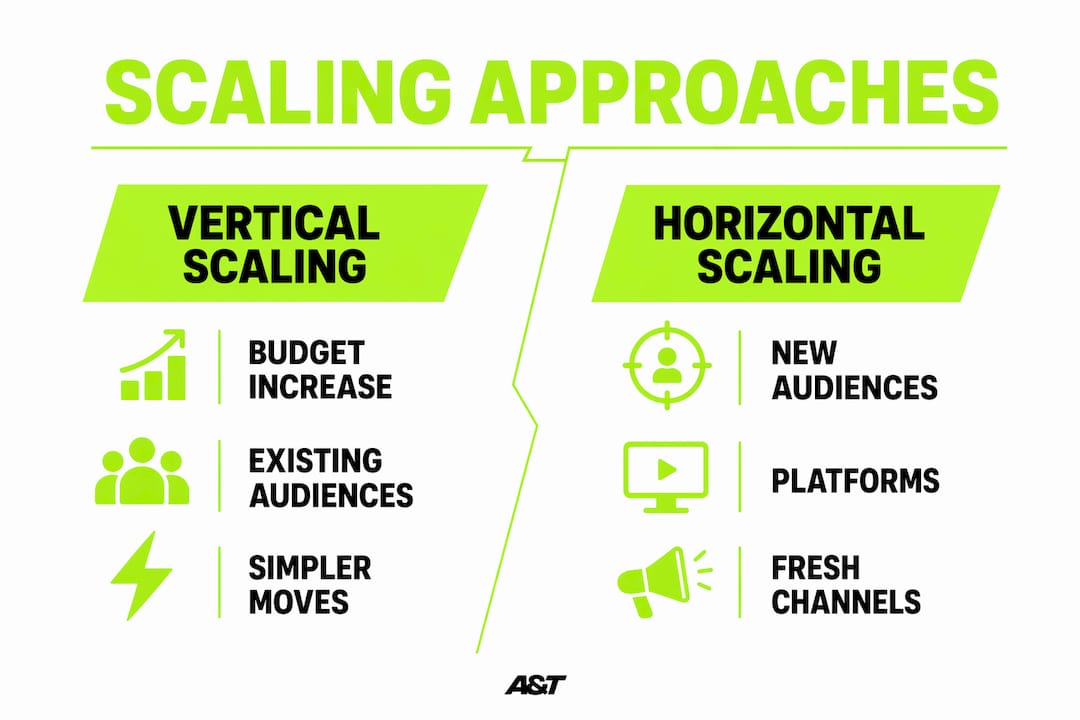
Vertical scaling means increasing budget within your existing ad sets and audiences. It is the simplest move and the most common mistake when used as the only tool. Budget increases work up to a point, but they accelerate audience saturation and creative fatigue faster than most marketers expect. The same audience sees your ads more often, frequency rises, and performance degrades.

Horizontal scaling means expanding into new audiences, geographies, ad formats, or platforms. It opens fresh, efficient frontiers rather than squeezing harder on an exhausted segment. Accounts scaling above $50k per month succeed primarily through validated ad sets, proactive creative management, and audience expansion rather than linear budget growth. That finding reframes the entire conversation: at high spend, horizontal scaling becomes the primary growth lever.
Scaling Type | Method | Best Used When | Key Risk |
|---|---|---|---|
Vertical | Increase budget in existing ad sets | Early stage, proven creative, room in audience | Audience saturation, creative fatigue |
Horizontal | New audiences, platforms, geographies | Existing audiences near saturation | Higher production workload, coordination complexity |
The practical sequence most performance teams recommend is this:
Validate creative and audience fit at a controlled budget before scaling vertically.
Scale vertically in controlled increments until CPM or frequency signals saturation.
Shift to horizontal expansion by launching new audience segments, testing new platforms, or entering new geographies.
Run both approaches in parallel once you have the creative pipeline to support it.
The benefits of ad scaling compound when you treat vertical and horizontal as complementary tools, not competing options.
What are the biggest operational challenges when scaling ads?
Scaling ad campaigns introduces operational problems that do not exist at small budgets. Three challenges account for most performance crashes: learning phase resets, audience saturation, and creative fatigue.
Meta's algorithm requires a learning phase to optimize delivery for your objective. Budget increases over 20% force the algorithm to rebuild its delivery model, causing a 7 to 14 day period of elevated CPA and CPM. That efficiency dip is not a sign your campaign broke. It is the cost of moving too fast. The fix is gradual budget increases of 15 to 20% every 3 to 4 days, which preserves algorithm stability and avoids the reset penalty.
Creative fatigue accelerates sharply as budgets grow. At a €200 per day spend level, a strong creative may perform for 3 to 4 weeks. At €1,000 per day, the same creative fatigues in 7 to 10 days because rising frequency burns through your audience faster. This means your creative production schedule must scale alongside your budget, not lag behind it. Treating ad creation like a factory assembly line with reusable templates and systematic variation is not optional at high spend. It is the operational foundation.
Here is a numbered sequence for managing these challenges in practice:
Set a rule to never increase any ad set budget by more than 20% in a single change.
Monitor frequency at the ad set level. When frequency exceeds 3 to 4 for cold audiences, rotate creatives immediately.
Watch CPM trends weekly. Rising CPM without a corresponding rise in conversions signals audience saturation, not just market conditions.
Use Campaign Budget Optimization (CBO) for high-budget campaigns with multiple proven ad sets. CBO deduplicates audience reach and allocates spend to the best-performing sets automatically. Use Ad Set Budget Optimization (ABO) when you need granular control over individual audience segments.
Build a creative calendar two weeks ahead of your scaling plan so new assets are ready before fatigue hits, not after.
Pro Tip: Track creative frequency and CPM in the same weekly report. When both rise together, you have an audience saturation problem. When only CPM rises, check for broader market competition or seasonality.
How to build a framework for deliberate ad scaling decisions
The impact of scaling ads is maximized when you plan each step with a model rather than reacting to performance data after the fact. The framework below gives you a repeatable decision process.
Start with marginal CAC, not blended CAC. Marginal CAC measures the cost of each incremental conversion from your next budget increase. Blended CAC averages across all spend and hides the fact that your last dollar spent may be deeply unprofitable. If your marginal CAC exceeds your target threshold, further scaling harms profitability even when your blended number looks healthy.
Protect your high-intent segments before expanding into cold audiences. Dedicated budgets for retargeting pools and engaged users maintain tight CAC targets and generate your most efficient conversions. Cutting retargeting spend to fund cold audience expansion is one of the most common and costly scaling mistakes.
Improve post-click conversion before scaling spend. If your landing page converts at 2% and a competitor's converts at 4%, they can profitably outbid you at every audience tier. Shifting the efficiency curve through better landing pages, stronger offers, or faster load times gives you more room to scale before hitting the CAC ceiling. For a deeper look at this, improving ad ROI through conversion rate work often delivers more value than the next budget increase.
Scale horizontally before making large vertical budget jumps. New audiences, new platforms, and new geographies each have their own response curves. Entering them at controlled budgets lets you identify which segments are efficient before committing significant spend. The advantages of scaling across multiple channels include risk distribution and access to audiences that are not yet saturated by your competitors.
Pro Tip: Build a simple response curve model in a spreadsheet. Plot your current CAC at each budget level you have tested. The point where marginal CAC exceeds your target is your current scaling ceiling. That ceiling moves when you improve creative, landing pages, or audience targeting.
Key takeaways
Scaling ads profitably requires managing the inverse relationship between audience size and conversion efficiency through deliberate budget control, creative production, and audience strategy.
Point | Details |
|---|---|
Audience size drives CAC up | Conversion rates fall 3 to 4x and CAC triples as you scale from core to broad audiences. |
Horizontal scaling is the long-term lever | At high spend levels, new audiences and platforms outperform linear budget increases. |
Budget changes above 20% reset learning | Gradual increases of 15 to 20% every 3 to 4 days preserve Meta algorithm stability. |
Marginal CAC is the right metric | Blended CAC hides unprofitable incremental spend; track marginal CAC at each scaling step. |
Creative production must scale with budget | At high spend, creatives fatigue in days, not weeks. Systematized production is non-negotiable. |
The discipline gap nobody talks about
Most marketers I work with understand the theory of scaling. They know about diminishing returns. They have heard about learning phases. What they underestimate, consistently, is how much process discipline the execution actually requires.
Scaling is not a strategy decision you make once. It is a weekly operational practice. The teams that scale successfully are not the ones with the biggest budgets. They are the ones with the tightest feedback loops, the most consistent creative output, and the clearest model for when to push and when to hold.
The creative production bottleneck is where I see the most damage. A business will approve a budget increase, the ads go live, and two weeks later performance collapses because the creative team was not ready to rotate. The spend was there. The plan was not. Treating creative production like a factory, with templates, variation schedules, and lead times built into the calendar, is what separates teams that scale from teams that stall.
Data transparency matters just as much. When you can show a stakeholder a marginal CAC model and explain exactly where the efficiency curve breaks, budget conversations change. You stop defending spend and start planning it. That shift from reactive to planned scaling is, in my experience, the single biggest unlock for sustainable Google Ads growth and Meta performance at scale.
Scaling is not a destination. It is a discipline you build over time, one tested increment at a time.
— Ann
Ready to scale your ads without breaking performance?
At Atdigiagency, we build and manage paid ad systems designed to grow with your business. Our team handles Google Ads and Meta campaigns across multiple verticals, from telehealth to retail, with a process built around data-driven budget decisions, proactive creative rotation, and audience expansion strategies that protect your CAC as you grow. We do not just increase budgets. We model the scaling curve, protect your high-intent segments, and build the creative pipeline your campaigns need to perform at higher spend. If you are ready to grow without the guesswork, explore our Google Ads management and Meta Ads management services to see how we approach scaling for clients who need results, not meetings.
FAQ
What does scaling ads actually mean?
Scaling ads is the deliberate process of increasing paid advertising reach and spend to grow conversions and revenue while managing cost efficiency. It involves both budget increases and audience expansion across platforms like Google Ads and Meta.
Why does CAC increase when you scale ads?
CAC rises because incremental audience segments are less efficient than core high-intent users. As you reach broader audiences, conversion rates fall and each new customer costs more to acquire.
How do you scale ads without losing performance?
Increase budgets by no more than 15 to 20% every 3 to 4 days to avoid Meta's learning phase reset, rotate creatives before frequency-driven fatigue sets in, and expand into new audiences horizontally rather than relying solely on budget increases. You can also review digital marketing challenges for additional context on managing performance during growth phases.
What is the difference between CBO and ABO for scaling?
CBO allocates budget across multiple ad sets automatically and works best for high-budget campaigns with several proven ad sets. ABO gives you manual control over each ad set's budget and suits smaller campaigns or situations where you need precise spend allocation.
When should you stop scaling ad spend?
Stop scaling when your marginal CAC exceeds your target threshold, even if your blended CAC still looks acceptable. That point signals that additional spend is generating unprofitable conversions and further increases will erode overall campaign returns.