Event Audience Targeting Guide for SMB Marketers
Posted on
Marketing
Posted at

Effective event audience targeting combines behavioral segmentation, channel alignment, and measurable iteration. This approach outperforms demographic-only methods by focusing on engaging the right, most likely-to-convert groups first. Referrals also offer a high return, converting at three to five times the rate of cold traffic.
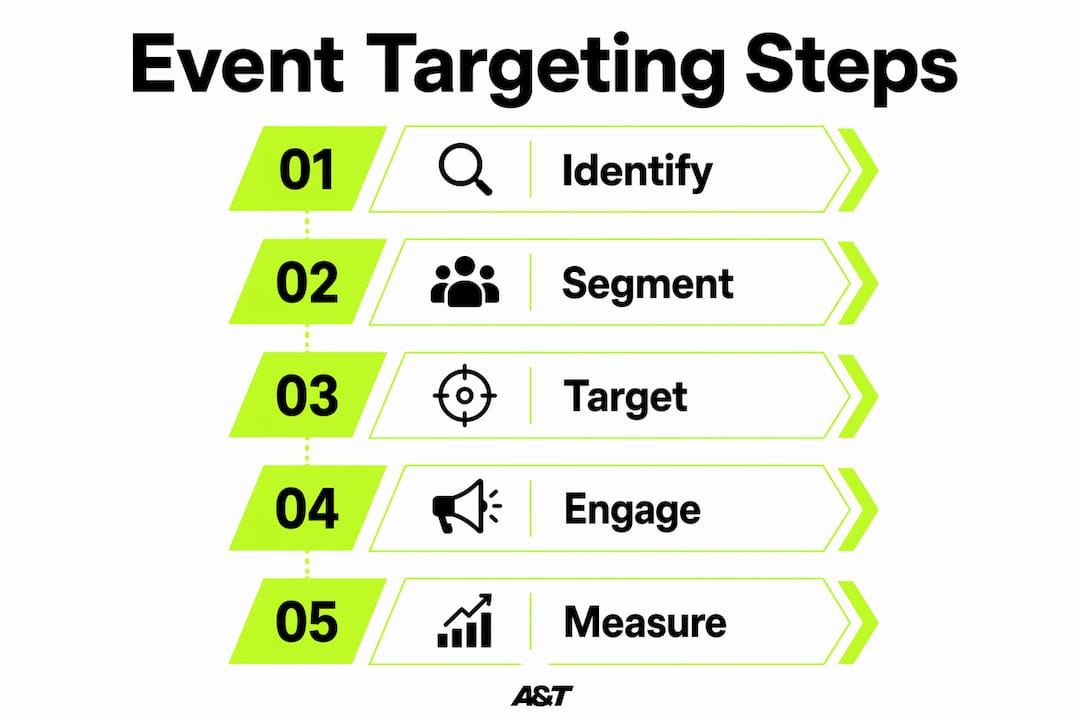
Effective event audience targeting is the process of identifying, segmenting, and engaging the right groups to maximize event attendance and ROI. Most event planners treat it as a single step. It is actually a system, built from behavioral data, channel alignment, and measured iteration. This guide gives marketing professionals and event planners at small to medium-sized businesses a practical framework for applying audience segmentation techniques that drive real registrations, not just impressions. You will find specific benchmarks, budget rules, and execution steps grounded in 2026 best practices.
What does an event audience targeting guide actually cover?
Audience targeting for events is the industry term for what marketers often call "finding the right people." It combines event demographic analysis with behavioral and intent data to build segments that are both reachable and profitable. Targeting by demographics alone is a documented failure mode. Behavior and intent segmentation is what separates campaigns that fill seats from campaigns that burn budget.

The core insight is simple. Not all potential attendees are equal. Past attendees convert at 15–25%, while cold leads convert at only 0.5–2%. That gap means your first targeting decision, which segment gets the most attention, determines most of your outcome before a single ad runs.
Three named techniques anchor every strong targeting system: behavioral segmentation, intent scoring, and persona mapping. Each one feeds the next. Behavioral segmentation groups people by what they have done. Intent scoring ranks them by how likely they are to act. Persona mapping gives your messaging a face and a motivation to speak to directly.
How do you identify and segment your event audience?
The foundation of any targeting effort is clean, observable data. Survey respondents often misrepresent their behavior, so effective segmentation prioritizes observed data like purchase history, email engagement, and website activity over self-reported attitudes. Your CRM is the starting point. Pull attendance history, open rates, click patterns, and ticket purchase timing before you build a single segment.
Four criteria make a segment worth targeting:
Observable: You can identify who belongs to it using real data, not assumptions.
Accessible: You can reach them through a channel you actually use.
Sizable: The group is large enough to justify dedicated messaging.
Distinct: Their motivations differ enough from other groups to warrant a separate approach.
Segments based on abstract attitudes with no identifiable data behind them waste budget. A segment called "people who love live music" is not a segment. A segment called "email subscribers who opened your last three event announcements but did not purchase" is one you can act on today.
Behavioral intent adds another layer. Segmenting by job title alone is insufficient. True segmentation considers loyalty signals, price sensitivity, and timing of past purchases. Past ticket buyers who purchased in the first 48 hours of a sale are "super-fans." They deserve early access offers and loyalty perks, not the same generic email your cold list receives.
Persona mapping completes the picture. Personas must represent the full ecosystem of buyer influences, including analysts, advocates, and community influencers, not just the person who clicks "buy." A B2B event, for example, often has a budget holder, a day-to-day champion, and an external peer whose opinion tips the decision. Build a persona for each.
Pro Tip: Link your CRM segments directly to your ad platform audiences. Upload your past attendee list as a custom audience in Meta Ads or Google Ads, then use lookalike modeling to find new prospects who share the same behavioral profile.
Which channels work best for each audience segment?
Channel selection is where most event marketers lose money. They pick channels they are comfortable with rather than channels their segments actually use. Matching channels to audience media habits avoids wasted spend and improves ROI. TikTok reaches Gen Z event-goers. Email remains the highest-converting channel for Millennials. LinkedIn advocacy works for B2B professional events.
The 50-30-20 budget rule gives you a starting framework for allocation:
Budget Tier | Allocation | Channel Type | Example Use |
|---|---|---|---|
Compounding channels | 50% | Email, SEO, organic social | Nurture past attendees and warm leads |
Paid acquisition | 30% | Google Ads, Meta Ads, LinkedIn | Reach new and cold segments |
Experimental tactics | 20% | Influencer, podcast, new platforms | Test emerging channels with low risk |
LinkedIn advocacy produces a 5% CTR compared to 0.4–0.6% for standard paid social ads. That difference matters when you are allocating the 30% paid acquisition budget. For B2B events, shifting more of that 30% toward LinkedIn and away from broad paid social is a data-backed decision, not a preference.
Paid channels work best when they target warm segments first. Use Google Ads to capture intent from people already searching for your event category. Use Meta Ads to retarget website visitors and past attendees with tailored creative. Cold prospecting through paid social is the most expensive path to a registration. Reserve it for the experimental 20% until you have conversion data to justify scaling it.
Pro Tip: Run separate ad sets for each segment rather than one broad campaign. A past attendee who already loves your event needs a different message than a cold prospect who has never heard of you. Separate ad sets give you clean performance data for each group.
How do you execute an event targeting campaign step by step?
Execution without a clear sequence produces inconsistent results. Follow this order to build a campaign that compounds rather than collapses under pressure.
Set KPI tiers before launch. Measure 6–8 core KPIs organized into primary metrics (registrations, revenue), leading metrics (email open rates, ad CTR), and quality metrics (attendee satisfaction, referral rate). Define what success looks like for each segment before spending a dollar.
Build your audience lists. Upload past attendee data to your ad platforms. Create lookalike audiences from your highest-converting segment. Segment your email list by engagement level and purchase history.
Write segment-specific messaging. A super-fan who attended last year responds to exclusivity and early access. A cold prospect responds to social proof and a clear value statement. Write separate subject lines, ad copy, and landing page headlines for each group.
Launch paid acquisition 6–8 weeks before the event. Warm audiences need less lead time. Cold audiences need more touches before they convert. Starting paid acquisition too late is the single most common execution mistake for SMB event planners.
Test one variable at a time. Run A/B tests on subject lines, ad creative, and landing page headlines. Change one element per test. Mixing variables makes it impossible to know what drove the result.
Reallocate budget weekly based on conversion data. If your past attendee segment is converting at 20% and your cold segment is converting at 1%, shift budget toward the warm segment immediately. Do not wait until the campaign ends to act on the data.
You can find a detailed framework for tracking campaign KPIs that covers how to structure your dashboard before launch.
How do you measure success and improve event audience engagement?
Measurement is where most SMB event marketers stop too early. They check registration numbers and call it done. The campaigns that improve over time track a full set of metrics and use them to feed the next event's targeting decisions.
Track these metrics across every segment:
Registration rate by segment: Which group converts best from impression to sign-up?
Cost per registration: How much does each segment cost to convert?
Email open and click rates: Which subject lines and offers resonate?
Ad CTR by creative: Which message drives the most qualified clicks?
Referral conversion rate: Referrals convert at 3–5 times the rate of cold traffic, making attendee advocacy one of the highest-ROI activities you can measure.
Attendee satisfaction score: Post-event surveys reveal whether you attracted the right people or just any people.
The referral rate deserves special attention. Referrals converting at 3–5 times the cold rate means a structured referral program, even a simple one, can outperform a significant portion of your paid acquisition budget. Build a referral mechanism into every event campaign and measure it as a primary channel.
A common measurement pitfall is treating all registrations as equal. A registration from a past attendee who paid full price is worth more than a registration from a cold lead who used a discount code. Segment your conversion data by audience type to see the true picture. For a step-by-step approach to measuring event ad ROI, the framework applies directly to multi-segment campaigns.
Key Takeaways
Effective event audience targeting combines behavioral segmentation, channel alignment, and measured iteration to consistently outperform demographic-only approaches.
Point | Details |
|---|---|
Behavior beats demographics | Segment by purchase history and engagement, not just age or job title. |
Past attendees are your best segment | Past attendees convert at 15–25%, far above cold leads at 0.5–2%. |
Use the 50-30-20 budget rule | Split spend across compounding, paid, and experimental channels for balanced growth. |
Set KPI tiers before launch | Define primary, leading, and quality metrics before any budget is spent. |
Referrals are a high-ROI channel | Attendee referrals convert at 3–5 times the rate of cold traffic. |
Why I think most event planners target the wrong people first
The most common mistake I see is planners spending the majority of their paid budget on cold audiences before they have fully activated their warm ones. It feels counterintuitive to focus on people who already know you. Growth seems to come from reaching new people. But the data does not support that instinct.
Past attendees and engaged subscribers are the most profitable segment you have. They already trust you. They have already made the decision once. Reaching them first, with the right message and a reason to act early, fills a meaningful portion of your seats before you spend a dollar on cold prospecting. That gives you a conversion baseline, social proof, and budget efficiency that cold campaigns cannot match.
The second mistake is building personas that only include the buyer. Including influencers and analysts in your persona set changes how you write copy and which channels you prioritize. A peer recommendation from a trusted analyst carries more weight than any ad you will ever run. Map that influence and build it into your channel plan.
Start with your warmest segment. Measure everything. Then expand outward with the budget you saved.
— Ann
Paid media that makes your event targeting work harder
Atdigiagency builds and manages paid ad systems for event marketers who need results, not just reach. The team runs Google Ads campaigns that capture high-intent searchers at the moment they are looking for events like yours, and Meta Ads campaigns that retarget warm audiences and scale lookalike prospecting with tested creative. Every campaign is built around your specific segments, not a generic template. If you are ready to put your targeting strategy into a paid system that compounds over time, Atdigiagency is the team that builds it.
FAQ
What is event audience targeting?
Event audience targeting is the process of identifying, segmenting, and reaching specific groups of potential attendees based on behavioral data, demographics, and intent signals to maximize registrations and ROI.
Which audience segment converts best for events?
Past attendees are the highest-converting segment, with conversion rates of 15–25% compared to 0.5–2% for cold leads, making them the first priority in any event marketing campaign.
How should I split my event marketing budget across channels?
The 50-30-20 rule allocates 50% to compounding channels like email and organic social, 30% to paid acquisition like Google Ads and Meta Ads, and 20% to experimental tactics.
Why is demographic segmentation alone not enough for events?
Demographics describe who someone is, not what they are likely to do. Behavioral and intent-based segmentation, built from purchase history and engagement data, produces segments that are both observable and profitable to target.
How do referrals fit into an event targeting strategy?
Attendee referrals convert at 3–5 times the rate of cold traffic, making a structured referral program one of the most cost-efficient channels in any event promotion plan.