What Is Cross Channel Marketing? Boost Results Now
Posted on
Marketing
Posted at

Cross-channel marketing involves seamless data sharing and coordinated messaging across platforms. Operating independently on multiple channels is multi-channel presence, not true integration. For effective results, businesses must align creative, target audiences, and measure performance across all touchpoints.
Most marketing managers running ads on Google, Facebook, and email at the same time believe they're doing cross-channel marketing. They're not. Running separate campaigns on separate platforms with separate messaging is just multi-channel presence. Cross-channel marketing means those platforms talk to each other. Data flows between them. Messaging adapts based on what customers have already seen or done. The difference between the two approaches can be the difference between campaigns that stall out and campaigns that scale. This guide breaks down what cross-channel marketing actually is, why it matters for SMBs, and how to build it correctly.
Table of Contents
Understanding cross-channel marketing: Definition and key components
Why cross-channel marketing matters: Business impact and customer experience
Key channels in cross-channel marketing: Maximizing synergy
Best practices to optimize your cross-channel marketing strategy
Perspective: Why true cross-channel mastery requires both art and science
Accelerate your cross-channel marketing with expert support
Frequently asked questions
Key Takeaways
Point | Details |
|---|---|
Cross-channel advantage | Coordinating campaigns across platforms unlocks higher engagement and sales over operating channels in silos. |
Channels work together | Paid, social, email, and organic channels become more powerful when working as part of a unified strategy. |
Measure what matters | Tracking unified performance metrics ensures your cross-channel approach is actually driving growth. |
Optimize and adapt | Regularly updating and personalizing campaigns is key to mastering cross-channel marketing. |
Understanding cross channel marketing: Definition and key components
Cross-channel marketing is a strategy where all your advertising platforms share data, coordinate messaging, and work together to move a customer through one connected journey. It's not about being everywhere at once. It's about creating a seamless experience so that a customer who clicks your Google Ad sees a related message on Instagram and receives a follow-up email that matches what they browsed. Every touchpoint feels intentional.
Multi-channel marketing, by contrast, means you operate on multiple platforms independently. Your Google Ads team runs one message. Your social media team runs another. Your email list gets something different. The customer experiences three different brands in three different conversations. That's fragmented, and it costs you.
Cross-channel marketing integrates data and messagingacross platforms for better customer experiences, which is the foundation that separates coordinated campaigns from scattered ones.
The four core components of cross-channel marketing are:
Central data layer: A shared source of customer behavior, history, and preferences that all channels draw from
Consistent creative: A unified message and visual identity adapted for each platform's format
Shared targeting: Audience segments that carry over from one channel to the next
Unified measurement: A single framework for tracking performance across all platforms
Here's how cross-channel compares to multi-channel marketing across the factors that matter most:
Factor | Cross-channel | Multi-channel |
|---|---|---|
Data integration | Shared across all platforms | Siloed per channel |
Customer experience | Seamless and coordinated | Disconnected and repetitive |
Measurement | Unified attribution | Platform-by-platform |
ROI | Higher, compounding | Harder to optimize |
Creative strategy | Adapted from one core message | Often inconsistent |
Businesses using coordinated cross-channel campaigns see up to 3x higher engagement rates compared to those running isolated channel strategies. Coordination isn't just a nice-to-have. It's a performance multiplier.
For a deeper look at how this plays out in real paid campaigns, our multi-channel advertising guide covers the full picture.
Why cross channel marketing matters: Business impact and customer experience
The business case for cross-channel marketing is straightforward. When your channels share data and messaging, you stop interrupting customers and start guiding them. That shift changes outcomes at every stage of the funnel.
Cross-channel marketing improves campaign ROIand customer lifetime value in measurable ways. Marketers who run coordinated campaigns consistently report better results than those running standalone efforts. Here's what that looks like in practice for SMBs:
Higher email open rates when email follows a paid social touchpoint the customer already engaged with
Increased repeat purchase rates because retargeting across channels reinforces brand memory
Lower cost per acquisition when channels support each other instead of competing for the same customer
Higher average order value when product recommendations stay consistent across platforms
Stronger customer retention through personalized follow-up sequences tied to purchase behavior
From the customer's perspective, cross-channel marketing simply feels better. They don't see an ad for a product they already bought. They don't get an email offering a discount right after paying full price. The experience feels tailored, not automated.

That personalization is what builds trust. And trust is what drives repeat business.
Pro Tip: The most common mistake SMBs make is treating each channel as its own campaign. If your paid social team doesn't know what your email team is saying, you're not doing cross-channel. You're doing parallel marketing. Align your teams around a shared customer journey map before you spend another dollar on ads.
When your channels reinforce each other, every dollar works harder. That's the core promise of cross-channel ROI impact done right.
Key channels in cross channel marketing: Maximizing synergy
Not all channels deserve equal priority. The goal is to choose a mix that covers awareness, nurturing, conversion, and retention without spreading your budget too thin. For most SMBs, the highest-leverage combination looks like this:
Paid search (Google Ads): Captures demand from customers actively searching for your solution. High intent, high conversion potential.
Paid social (Facebook, Instagram, LinkedIn): Builds awareness and re-engages past visitors. Strong for visual storytelling and retargeting.
Email: Nurtures existing contacts and drives repeat purchases. The highest ROI channel when paired with behavioral triggers.
SMS: Reaches customers with time-sensitive offers. Works best for loyalty programs and flash promotions.
Organic search (SEO): Builds long-term visibility and credibility, supporting paid efforts by reducing dependency on ad spend alone.
Brands combining paid, social, email, and organicachieve superior reach and consistency, which is why channel mix matters as much as budget.
Here's an example of how a typical SMB cross-channel sequence works: A customer searches Google and clicks a paid search ad. They visit the product page but don't buy. A Meta retargeting ad shows them a testimonial. Three days later, they get an email with a limited offer. They convert. Post-purchase, an email sequence keeps them engaged. That's one unified journey across four touchpoints.
Here's a sample cross-channel mix breakdown by role:
Channel | Role | Stage |
|---|---|---|
Google Ads | Demand capture | Conversion |
Meta Ads | Awareness and retargeting | Awareness and consideration |
Nurture and retention | Nurture and post-purchase | |
SEO/content | Long-term visibility | Awareness |
SMS | Time-sensitive offers | Conversion and retention |
To unify creative and messaging across these channels, follow these steps:
Define one core campaign message and value proposition
Adapt that message for each channel's format and audience mindset
Align your visual identity so customers recognize the brand across platforms
Set shared campaign dates and offer windows so channels don't conflict
Assign one person or team to oversee cross-channel consistency
For more detail on making Facebook campaigns work within this kind of system, see our Facebook campaign best practices.
Best practices to optimize your cross channel marketing strategy
Knowing which channels to use is only half the work. The other half is making sure they operate as one system instead of several disconnected efforts. Here's the planning framework we recommend:
Set goals first. Define what success looks like before you choose channels. Is it new leads, repeat purchases, or lower churn? Goals shape everything else.
Map the customer journey. Identify every touchpoint a prospect experiences from first awareness to post-purchase. Then assign each channel a specific role in that journey.
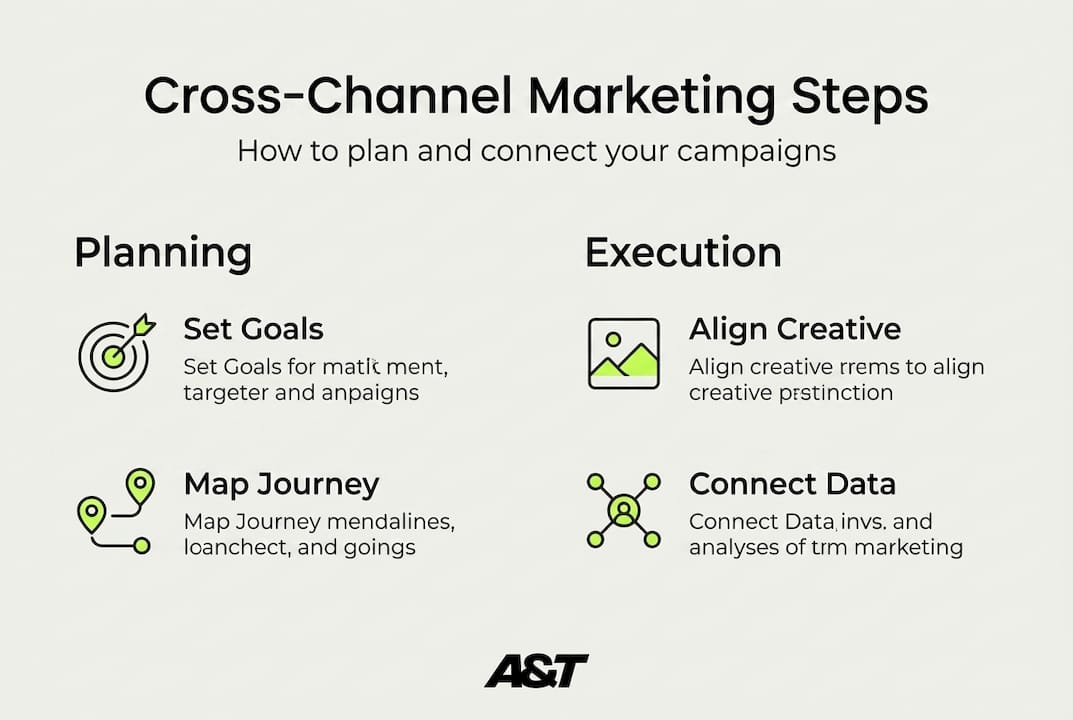
Align creative. Build one master message and adapt it for each platform. Same offer, different format.
Ensure data flows. Connect your ad platforms, CRM, and email tools so customer actions in one channel inform what happens in the next.
Measure and iterate. Review performance weekly. Kill what isn't working. Scale what is.
The tools that make this manageable for SMBs:
Google Analytics 4: Cross-channel attribution and behavior tracking
Meta Ads Manager: Audience management and retargeting across Facebook and Instagram
Klaviyo or HubSpot: Email and SMS automation with behavioral triggers
Zapier: Connects platforms that don't natively integrate
Northbeam or Triple Whale: Advanced multi-touch attribution for paid campaigns
Two common pitfalls to avoid: inconsistent attribution (meaning you're crediting the wrong channel for conversions) and ignoring mobile users (more than half of clicks happen on mobile, and a poor mobile experience breaks the entire journey).
Optimization includes unified measurement, ongoing learning, and regular creative updates to keep campaigns performing at their peak.
Pro Tip: Use automation to sequence touchpoints based on behavior, not just time. If someone opens your email but doesn't click, trigger a retargeting ad. If they click but don't buy, follow up with a stronger offer. Behavior-based sequencing outperforms time-based drip campaigns every time. Pair this with the paid media best practices that support smart ad spend decisions.
Perspective: Why true cross channel mastery requires both art and science
We see a lot of teams invest heavily in the tech stack and almost nothing in creative strategy. They buy the attribution tool. They connect the platforms. They set up the data flows. And then they run the same generic ad copy across every channel and wonder why results are flat.
Here's the uncomfortable truth: technology is the infrastructure, but messaging is the engine. Cross-channel marketing only works when the customer feels understood, not just retargeted.
The best cross-channel campaigns we've worked on combine two things simultaneously. First, systems thinking: clean data, tight audience segmentation, clear attribution. Second, empathetic storytelling: messaging that speaks to where the customer is in their journey, not where the marketer needs them to be.
Most guides focus on the systems side and skip the creative side entirely. That's a mistake. The teams winning at cross-channel right now are the ones treating every touchpoint as a conversation, not a broadcast.
True cross-channel mastery means continual experimentation. Test creative. Test sequences. Test offers. Never set and forget. If you want to go deeper on building this kind of integrated system, our multi-channel paid ads strategies page lays out how we approach it for our clients.
Accelerate your cross channel marketing with expert support
Managing a coordinated cross-channel system in-house is demanding. Most SMB marketing teams are stretched thin already. Building the data connections, maintaining creative consistency, and optimizing across platforms simultaneously takes expertise most teams don't have the bandwidth to develop on their own.
We build and manage integrated paid advertising systems that treat Google and Meta as parts of one strategy, not two separate campaigns. From audience building to creative development to reporting, everything is connected.
If you're ready to stop running parallel campaigns and start running a real cross-channel system, our Google Ads management and Meta Ads management services are built exactly for this. Let's build something that scales.
Frequently asked questions
How is cross channel marketing different from multi channel marketing?
Cross-channel marketing integrates data and messaging for a unified customer experience, while multi-channel simply operates on multiple platforms independently without shared data or coordinated messaging.
What channels should I prioritize in cross channel campaigns?
Focus on paid search, paid social, email, and organic search first, as paid, social, and organic channels deliver the strongest synergy for most SMBs operating with limited budgets.
How can small businesses measure cross channel marketing success?
Track unified KPIs like ROI, conversion rate, and customer engagement across all platforms, since unified measurement is the foundation of an optimized cross-channel strategy.