
The role of ad funnels in boosting sales in 2026
Posted on
Marketing
Posted at

Many businesses believe increasing ad spend is the secret to higher sales. In reality, optimizing conversion funnels can boost orders without adding a single dollar to your budget. Understanding how ad funnels guide customers from awareness to purchase transforms your marketing efficiency. This guide explains the role of ad funnels and proven strategies to optimize them for maximum ROI.
Table of Contents
Key takeaways
Point | Details |
|---|---|
Optimized funnels increase sales without more traffic | Small conversion improvements multiply revenue significantly |
Lower customer acquisition costs | Better funnels convert paid clicks more efficiently |
Stage-by-stage analysis reveals drop-off points | Identifying leaks helps prioritize fixes |
Unified data prevents misattribution | Accurate tracking supports smarter budget allocation |
Conversion APIs enhance attribution accuracy | Server-side tracking improves campaign optimization |
Understanding the role of ad funnels in marketing
An ad funnel maps the journey prospects take from first discovering your brand to becoming paying customers. The sales funnel model helps businesses pinpoint exactly where potential customers abandon the journey. This visibility enables targeted fixes that dramatically improve conversion rates.
Most funnels follow these core stages:
Awareness: Prospects discover your brand through ads, social media, or search results
Interest: They explore your offerings, read product descriptions, and compare options
Decision: Prospects add items to cart or submit contact forms
Action: They complete the purchase or conversion goal
Retention: Post-purchase engagement turns buyers into repeat customers
Understanding these stages helps you create targeted content and offers for each phase. You wouldn't pitch a discount code to someone who just discovered your brand, just as you wouldn't serve basic awareness content to cart abandoners. Each stage demands specific messaging aligned with customer intent.
Mapping your funnel reveals friction points where customers drop off. Perhaps your product pages lack compelling copy, or your checkout process requires too many steps. What is ad funnel strategy dives deeper into aligning your marketing efforts with each funnel stage for maximum impact.
How optimizing ad funnels boosts sales and lowers costs
The financial impact of funnel optimization often surprises business owners. Improving conversion rates delivers more sales from existing traffic, making every ad dollar work harder. Small percentage gains multiply into substantial revenue growth.

Consider a business receiving 10,000 monthly site visitors from paid ads. At a 2% conversion rate, they generate 200 orders. Improving conversion to 3% yields 300 orders, a 50% increase without spending more on traffic. The math becomes even more compelling at higher conversion rates.
Conversion Rate | Orders (10k visitors) | Increase vs 2% | Cost Per Order (at $5k ad spend) |
|---|---|---|---|
2% | 200 | baseline | $25 |
3% | 300 | +50% | $16.67 |
4% | 400 | +100% | $12.50 |
5% | 500 | +150% | $10 |
When funnels convert effectively, customer acquisition costs plummet. The table shows how a jump from 2% to 5% conversion cuts cost per order by 60%. Your paid traffic budget remains constant, but each click becomes significantly more valuable.
A well-optimized funnel reduces waste by ensuring prospects encounter the right message at the right time. Generic landing pages hemorrhage money because they fail to address specific customer needs at different journey stages. Tailored experiences keep prospects moving forward.
Pro Tip: Before requesting more ad budget, audit your funnel for quick wins like clearer CTAs, faster page loads, or simplified checkout flows. These fixes often deliver better ROI than increased spend. Learn how to prioritize improvements through our performance marketing workflow guide.
The critical role of unified data and accurate attribution
Modern customer journeys create attribution nightmares for marketers. Consumers take six or more actions before purchasing, jumping between devices and channels. This complexity makes tracking true conversion sources nearly impossible with basic analytics.
Data fragmentation causes marketers to optimize based on incomplete information. You might pause a Google Ads campaign that appears underperforming, not realizing it drives crucial upper-funnel awareness that leads to conversions credited elsewhere. Misattribution wastes budgets on channels that look good in reports but deliver minimal real impact.
Key challenges fragmented data creates:
Incorrect channel performance assessment leading to poor budget allocation
Inability to identify true customer journey paths across touchpoints
Wasted spend on channels that receive credit for conversions they didn't drive
Difficulty optimizing campaigns when you can't see full-funnel impact
Platform algorithms receiving incomplete signals, hampering automated optimization
Conversion APIssolve attribution problems by sending server-side data directly to ad platforms. Unlike browser-based tracking vulnerable to blockers and iOS privacy restrictions, CAPIs ensure platforms receive complete conversion signals. This accuracy helps algorithms optimize campaigns based on real performance, not partial data.
Unified tracking connects the dots between awareness ads, consideration content, and final conversions. You gain visibility into which channels truly drive sales versus which simply receive last-click credit. This insight transforms budget allocation from guesswork into strategic deployment.
Pro Tip: Implement conversion tracking that captures full customer journeys, not just last-click attribution. Combined with regular funnel analysis, this approach reveals optimization opportunities invisible in standard reports. Check our guides on why optimize ad campaigns and track ad performance metrics for implementation details.
Strategies for optimizing your ad funnel effectively
Successful funnel optimization requires systematic diagnosis and targeted fixes. Understanding your funnel beats simply spending more because fixing leaks multiplies ad effectiveness while waste drains budgets.
Follow this process for comprehensive funnel improvement:
Map your complete funnel from first touchpoint through post-purchase engagement
Calculate conversion rates between each stage to identify major drop-off points
Prioritize fixes starting with stages showing the largest percentage losses
Test solutions individually to measure impact before implementing multiple changes
Monitor results for at least two weeks before judging effectiveness
Document learnings to build institutional knowledge for future optimization
The biggest gains often come from unexpected places. You might assume checkout improvements deliver maximum impact, only to discover product page messaging drives the real bottleneck. Data-driven diagnosis prevents wasting effort on minor issues while critical leaks persist.
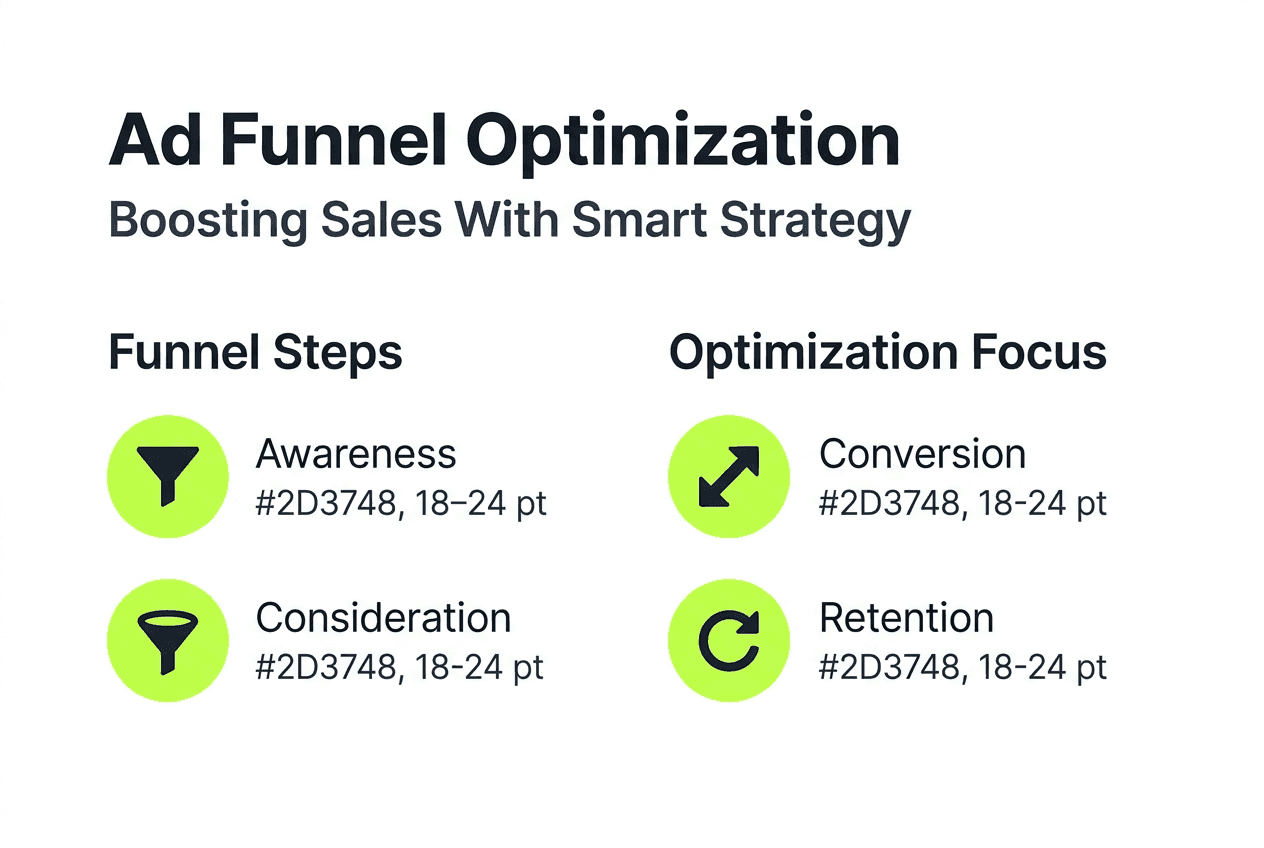
Retention optimization extends funnels beyond initial purchase. Loyalty programs, personalized recommendations, and strategic follow-up communications transform one-time buyers into repeat customers. Acquiring new customers costs 5-25x more than retaining existing ones, making retention investments highly profitable.
Tactic | Primary Benefit | Common Challenge |
|---|---|---|
Landing page optimization | Higher click-to-conversion rates | Requires ongoing A/B testing |
Cart abandonment emails | Recovers 10-30% of lost sales | Needs email automation setup |
Retargeting campaigns | Re-engages interested prospects | Can annoy users if overused |
Loyalty programs | Increases customer lifetime value | Requires infrastructure investment |
Checkout simplification | Reduces final-step abandonment | May conflict with data collection goals |
Personalized offers aligned with customer journey stages outperform generic promotions. Someone browsing for the first time needs social proof and education, not aggressive discounts. Cart abandoners respond to urgency and incentive combinations. Repeat customers value exclusive access and VIP treatment over basic price cuts.
Learn systematic approaches through our digital ad spend management and step by step ad campaign setup resources.
How ATDigi Agency can help optimize your ad funnels
Optimizing ad funnels across multiple channels requires specialized expertise and constant attention. ATDigi Agency builds and scales high-performing funnels for e-commerce businesses through data-driven Google Ads and Meta campaigns. We identify leak points, implement tracking solutions, and systematically improve conversion rates while lowering acquisition costs.
Our team handles everything from funnel mapping and attribution setup to campaign optimization and creative testing. Whether you need Google Ads management or Meta ads management, we deliver measurable improvements in sales and ROI. Stop guessing where your funnel leaks and start growing with confidence.
Frequently asked questions
What are some common funnel leaks to watch for?
Poor landing page experiences top the list of conversion killers. Slow load times, unclear value propositions, and weak calls to action cause prospects to bounce before engaging. Missing or confusing CTAs leave visitors uncertain about next steps, while weak follow-up communications fail to re-engage interested prospects who didn't convert immediately.
How does retention affect the ad funnel's overall success?
Retention dramatically improves unit economics by increasing customer lifetime value. Best-performing funnels extend beyond initial purchase through loyalty programs and personalized follow-ups. When customers buy multiple times, initial acquisition costs become investments rather than expenses, making aggressive growth strategies financially sustainable.
Why is data unification critical for funnel optimization?
Unified data eliminates misattribution that causes poor budget decisions. When you see complete customer journeys across channels, you allocate spend based on true performance rather than last-click credit. This visibility reveals which touchpoints genuinely drive conversions versus which simply receive undeserved attribution, enabling smarter optimization and higher overall ROI.