Campaign planning guide: Steps to achieve higher ROI
Posted on
Marketing
Posted at

Successful digital campaigns require clear objectives, targeting, tracking, and creative validation before launch.
Post-launch iteration and accurate measurement are crucial for sustained ROI growth and campaign scaling.
Automation enhances campaign performance but relies on clean data and proper setup from initial planning.
Most small and medium-sized businesses pour money into digital ads and walk away with little to show for it. Not because they picked the wrong platform. Not because they spent too little. But because they launched campaigns without a clear structure, solid measurement, or a repeatable process. The result is wasted budget, murky data, and the frustrating feeling that paid advertising "just doesn't work." It does work. It just demands a disciplined workflow from start to finish. This guide gives you exactly that: a proven, step-by-step approach to planning campaigns that actually deliver measurable returns.
Table of Contents
What you need before you start: Preparation and requirements
Measuring campaign success: Metrics and analysis foundations
Why most digital campaign guides miss the point and how to plan for real ROI
Key Takeaways
Point | Details |
|---|---|
Preparation is key | Clear objectives, tracking setup, and creative assets are vital before launching any campaign. |
Follow a proven workflow | Successful campaigns result from a clear, step-by-step process covering objectives, budget, tracking, and optimization. |
Measure what matters | Track 3 to 5 core metrics aligned with business goals for actionable campaign insights. |
Avoid common mistakes | Sidestep wasted budget by ensuring tracking, balanced targeting, and routine monitoring. |
Blend automation with control | Combine manual setup, creative alignment, and automation for the highest campaign ROI. |
What you need before you start: Preparation and requirements
Before jumping into campaign building, let's cover what must be in place so your effort is not wasted.
Campaigns fail for predictable reasons. Unclear objectives, missing tracking, undefined audiences, and unreviewed creative assets are the top culprits. The good news is that every one of these is preventable with proper preparation. A practical campaign-planning workflow confirms this sequence: define objectives, set budget and schedule, set up tracking and conversion measurement, validate creatives, launch and monitor key KPIs, then optimize and scale. Skip any of these steps and you are building on a cracked foundation.
HubSpot's campaign planning guidanceoutlines a similarly thorough approach, covering strategy, budget, resources, metrics, analytics, audience, channels, timeline, and post-campaign analysis. Notice that measurement and audience definition both appear before the campaign goes live. That order is intentional.
Here is what every campaign needs in place at the preparation stage:
Requirement | What it means | Why it matters |
|---|---|---|
Clear campaign objective | A specific, measurable goal (leads, purchases, calls) | Determines your bidding strategy and success criteria |
Defined target audience | Demographics, interests, behaviors, or intent signals | Controls who sees your ads and reduces wasted impressions |
Budget with timeline | Total spend and daily pacing over a set period | Prevents overspend and allows fair performance evaluation |
Tracking infrastructure | Pixel, tag, or API-based conversion events | Without this, you cannot measure or optimize results |
Creative assets | Ad copy, images, video, and landing page | Validates message-to-audience fit before spend begins |
Reporting baseline | Historical data or benchmarks | Gives context to your results from day one |
Common mistakes at the prep stage are costly and surprisingly common:
Skipping conversion tracking setup entirely, then trying to read results from clicks alone
Launching with one ad creative and no testing plan
Setting vague objectives like "get more awareness" with no measurable outcome attached
Targeting audiences that are either far too broad or so narrow ads barely serve
Ignoring landing page quality and directing paid traffic to a generic homepage
Pro Tip: Reserve 10% of your campaign budget specifically for creative testing and measurement setup. Businesses that skip this step often spend five times more later trying to diagnose why their campaigns underperformed. Understanding conversion tracking fundamentals before launch is one of the highest-return investments you can make in your campaign.
Step–by–step workflow: Plan, build, launch, and monitor
Now that you know what is needed, let's break down each stage of an expert campaign planning process.
Planning a campaign without a clear sequence is like building a house without blueprints. You might get something standing, but it will not be efficient, and fixing it later costs far more. Here is the exact workflow we use and recommend:
Define your objective. Decide on one primary goal per campaign. Lead generation, e-commerce purchases, phone calls, app installs. One goal keeps your bidding, targeting, and creative aligned. Mixed objectives produce mixed (and often poor) results.
Set your budget and timeline. Determine total campaign budget, daily spend limits, and a clear start and end date. Short campaigns with adequate budget outperform long campaigns with budget spread too thin. Give campaigns enough time to exit the learning phase, typically at least two weeks of consistent spend.
Define your audience and targeting parameters. Identify who you are reaching and why. Use demographic data, interest categories, in-market segments, or remarketing lists. Targeting strategies that layer intent signals with behavioral data consistently outperform single-dimension targeting. Build at least one remarketing audience from day one.
Set up conversion tracking before anything goes live. This is non-negotiable. Google's official guidance recommends setting up conversion tracking and using Smart Bidding strategies like Maximize Conversions only after conversion data is flowing. Running Smart Bidding without tracking data is like asking GPS to navigate without a signal.
Build and validate your creative assets. Write multiple versions of ad copy. Prepare at least three to four image or video formats. Review landing page relevance and load speed. Google specifically recommends including at least 3 ads per ad group and at least four asset types to give the algorithm room to optimize delivery.
Launch and monitor key KPIs daily for the first two weeks. During this window, watch for technical issues: ads not serving, tracking firing incorrectly, budget pacing off. Check impression share, click-through rate, and cost per conversion. Do not make major changes during the learning phase. Patience here pays off.
Optimize and scale. After sufficient data is collected, cut underperforming ad variations, expand winning audiences, adjust bids, and test new creative angles. Use implementing conversion tracking insights to refine what actions matter most to your bottom line.
Manual vs. automation-supported campaign setup: A comparison
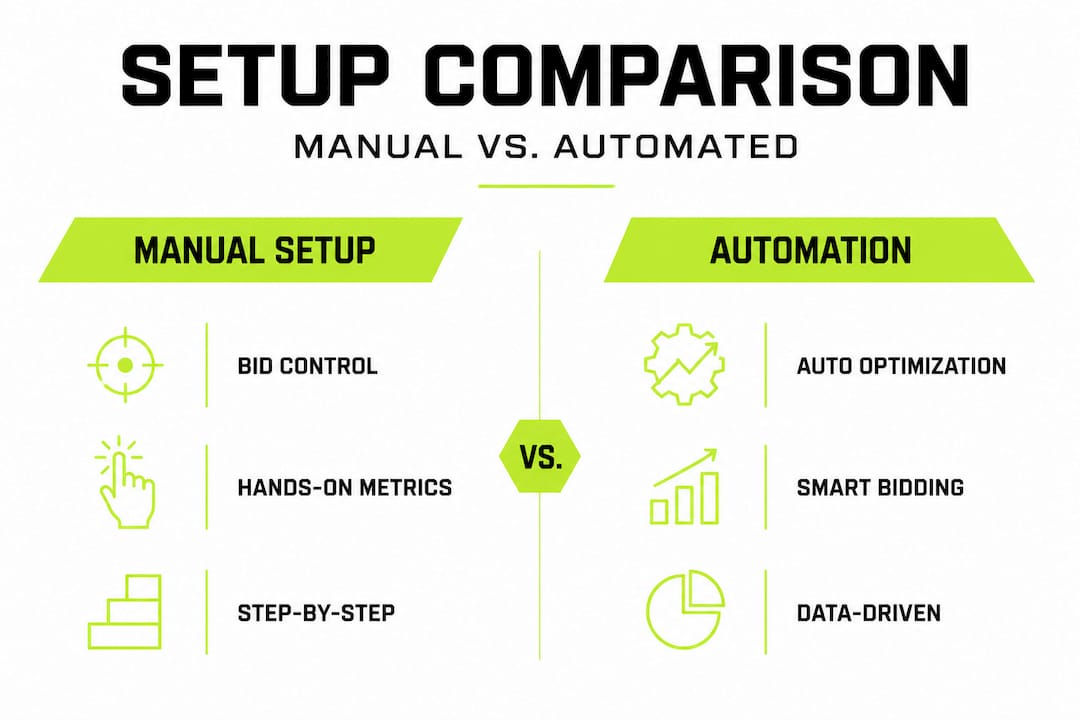
Factor | Manual setup | Automation-supported setup |
|---|---|---|
Bidding control | Full manual control over bids | Algorithm optimizes bids in real time |
Data requirement | Works with minimal data | Requires solid conversion data to perform |
Time investment | High, constant monitoring needed | Lower after proper setup |
Best for | Brand-new accounts, testing phases | Mature campaigns with 30+ conversions/month |
Risk | Human error, slower response | Underperforms without quality conversion data |
Up to 70% of campaigns underperform due to missing conversion tracking or misaligned goal metrics. That is not a small margin. It means most campaigns launched without this foundation are burning money from the start.

Measuring campaign success: Metrics and analysis foundations
Great campaigns are never "set and forget." Here is how to clearly measure and learn from every campaign you run.
One of the most common traps in digital advertising is reporting on the wrong numbers. Clicks feel good. Impressions feel impressive. But neither one pays your bills. Marketing campaign measurement should align with business impact, campaign performance, and audience behavior. Start simple with 3 to 5 core metrics, then add others as you iterate.
Think of your metrics in three layers:
Executive level (business impact): Revenue generated, customer acquisition cost (CAC), return on ad spend (ROAS), and total conversions. These answer the question: "Is this campaign growing our business?"
Operational level (campaign performance): Cost per click (CPC), click-through rate (CTR), conversion rate, and cost per lead (CPL). These answer: "Is the campaign efficient?"
Tactical level (audience behavior): Impression share, frequency, engagement rate, and quality score. These answer: "Is our targeting and creative landing well?"
Examples of strong KPIs versus weak ones:
Strong: Cost per qualified lead, ROAS, customer acquisition cost, revenue attributed to campaign
Weak: Total impressions, total clicks without conversion data, "reach," general engagement rate on awareness posts
Strong: Landing page conversion rate (visits to form submits or purchases)
Weak: Average session duration on its own, bounce rate without context
Pro Tip: When launching a new campaign, limit your core metrics to three to five that are directly tied to business value. Adding ten dashboards of data at launch creates analysis paralysis, not clarity. Lock your primary metric first, then expand your reporting view over time.
"The measure of a campaign is not how many people saw it. It is how many people took the action that moved your business forward." Align every metric to real impact, not just what looks good in a dashboard.
For a full breakdown of how to interpret and act on your campaign data, the guide on measuring campaign ROI covers attribution, reporting windows, and how to frame performance for stakeholders. Pairing that with using analytics effectively gives you a complete picture of how your data should drive decisions.
Avoiding common pitfalls: Troubleshooting and expert tips
Even with careful planning, some traps can cost you. But you can sidestep or quickly correct them.
The most expensive mistakes in digital advertising are not the obvious ones. They are the ones that silently drain budget while the dashboard looks "fine." Here are the most common pitfalls and how to address each one directly.
Pitfall 1: Missing or broken conversion tracking. Google ties Smart Bidding to conversion tracking, meaning campaigns using automated bidding without proper conversion data are essentially guessing. The algorithm has nothing to optimize toward. The fix is straightforward: audit your tracking before launch using Google Tag Assistant or Meta's Pixel Helper, confirm events fire on the correct actions, and verify data flows into your reporting platform.
Pitfall 2: Targeting that is too narrow or too broad. Too-narrow targeting can prevent ads from serving entirely, while too-broad targeting floods your budget with irrelevant traffic. Both scenarios waste money. The right approach: start with a moderate audience size, layer in two to three qualifying signals (location, intent, demographic), and monitor delivery closely in the first week.
Pitfall 3: Running one ad creative until it burns out. Creative fatigue is real. When the same ad shows repeatedly to the same audience, performance drops and cost per result rises. Build rotation into your planning. Prepare at least three ad variations at launch and schedule a creative refresh every four to six weeks.
Pre-launch checklist: Confirm tracking is live. Review audience size estimates. Check ad copy against platform policies. Verify landing page loads in under three seconds.
Weekly health check: Is the campaign spending its full daily budget? Are conversion numbers consistent with benchmarks? Has frequency crossed 3.0 on Meta? Is Google's campaign showing a "Learning" or "Limited" status?
Recovery protocol for underperforming campaigns: Pause the weakest ad variations. Reallocate budget to best performers. Introduce one new creative concept. Widen the audience slightly. Wait five to seven days before evaluating the impact of changes.
Pro Tip: Set a recurring reporting window every seven days for the first month of any new campaign. Reviewing performance too frequently (daily) leads to premature changes that disrupt the learning phase. Reviewing too rarely (monthly) means underperformance costs you weeks of budget. Weekly is the disciplined middle ground.
For tactical approaches to cutting ad spend waste without sacrificing results, and a deeper look at the strategy behind optimizing campaign ROI, those resources go deeper on the financial side of campaign management.
Why most digital campaign guides miss the point and how to plan for real ROI
Here is our honest take, from the practitioner's side of the table.
Most guides give you a checklist. Set an objective. Define your audience. Launch. The checklist is not wrong. But it treats campaigns like a form to fill out rather than a performance system to build. And that distinction is where most businesses quietly fail.
The real difference between campaigns that scale and campaigns that stall is not the template used in week one. It is what happens after launch. Smart marketing leaders obsess over three things: tracking accuracy, creative-to-audience relevance, and post-launch iteration speed. Those three factors, when dialed in, are what actually drive compounding ROI over time.
There is also a tension worth naming honestly: many guides still push manual step-by-step workflows while platforms like Google and Meta are rapidly shifting toward automation-first infrastructure. Our position is that automation is powerful but only when it has something real to work with. Without clean conversion data, Smart Bidding is not intelligent. It is reactive to noise.
The answer is not to resist automation. The answer is to set guardrails first. Build your tracking. Validate your creative. Define your audience carefully. Then let automation do what it does best: optimize bids and delivery at a speed and scale no human team can match manually.
Think of your campaign like an engine. The planning phase is your build. The launch phase is your ignition. But the real performance comes from tuning it after it is running. Businesses that treat campaigns as one-off events leave compounding returns on the table. Businesses that treat them as evolving systems, with iteration built into the process, see returns grow month over month.
For a deeper look at how to build that kind of sustained performance, the guide on advanced campaign ROI tactics walks through how leading advertisers structure their campaign architecture for long-term growth, not just short-term wins.
Expert support for high–ROI campaigns
If you want your next campaign to skip the learning curve and deliver results from the start, we can help.
At A&T Digital Agency, we specialize in building paid advertising systems that are strategic, trackable, and built to scale. From campaign planning and audience architecture to creative development and ongoing optimization, our team handles every layer of the process with precision. Whether you need full Google Ads management services or expert Meta Ads management solutions, we bring the structure and data-driven execution that turns ad spend into measurable business results. Reach out for a custom campaign review and find out exactly where your current campaigns can perform better.
Frequently asked questions
What is the most important first step in campaign planning?
Clearly define your campaign's objective and target audience before setting budget or tactics, as this sequencing is what ensures every downstream decision stays aligned with your actual business goal.
How many key metrics should I track for each campaign?
Start with just 3 to 5 core metrics tied to your main business goal, then add others as needed, because starting simple and iterating prevents analysis paralysis in the early stages.
Why do campaigns fail to deliver results?
Campaigns underperform when measurement is missing, targeting is too narrow, or conversion tracking is not set up, since Smart Bidding relies on conversion tracking to make intelligent optimization decisions.
Should I use manual or automated campaign setup?
Use manual guardrails and creative relevance at launch, then let automation optimize as you collect conversion data, because automation works best once the algorithm has solid conversion signals to work from.
How can I avoid wasting budget in digital campaigns?
Ensure conversion tracking is live, avoid too-narrow targeting, and monitor performance weekly to adjust and optimize, since too-narrow targeting can prevent ads from serving and silently drain your budget without delivering results.